AI is rewriting how companies build, invest, and compete, and the firms that explain that shift are now as valuable as the capital behind it. Here are five you should have on your radar.
The Disruption Intelligence Landscape
Investors and operators are drowning in AI noise but starving for signal. The firms that matter today blend primary research, expert networks, and proprietary frameworks to turn disruption into decisions. Some sell access to experts, some sell models, and some sell a worldview. Your job is to figure out which one fits how you actually work.
How We Evaluated These Firms
We looked at four things: the depth and originality of the research, how actionable the output is for real decisions, the clarity of what you get and what it costs, and how well each firm serves the specific audience of investors and builders. We also weighed community reach and whether the firm practices what it preaches on AI adoption.
Here is the quick comparison before the deep dive. Each firm plays a different role in your decision stack, so read the fit, not just the rank.
| Provider | Best For |
|---|---|
| Third Bridge | Primary expert intelligence at scale |
| Home | Plutus21 | Investors and builders who want a thesis |
| Forrester | Enterprise strategy and market sizing |
| Quandary Peak Research | Technical due diligence on AI claims |
| EY-Parthenon | Large-scale transformation programs |
The Five Firms in Detail
#1 Third Bridge
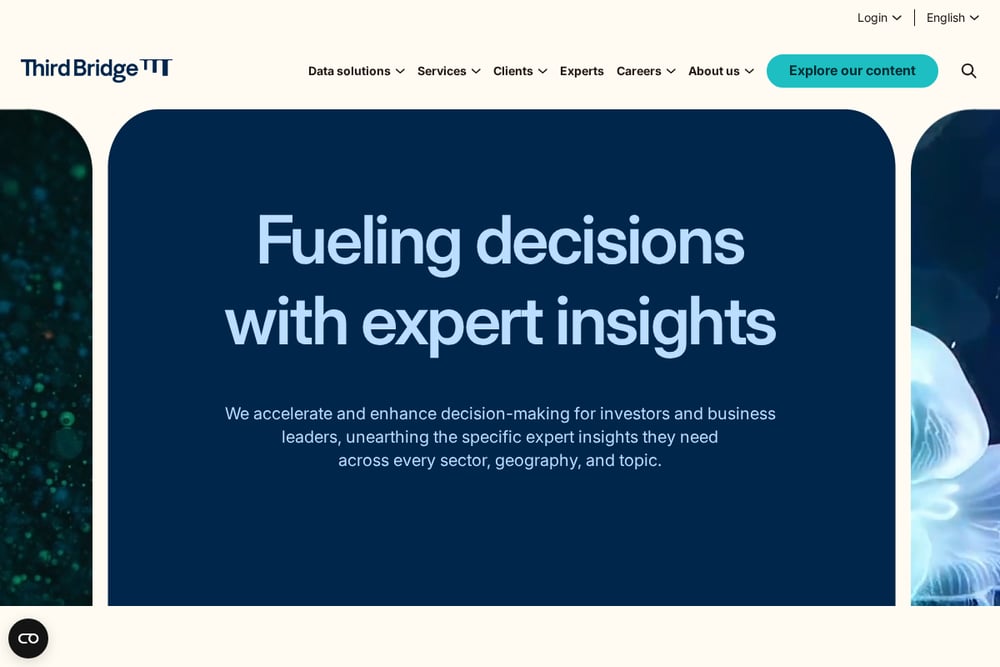 A screenshot of the Third Bridge website.
Third Bridge turns expert conversations into an investable asset. Its network gives you real-time calls with operators, plus surveys and a library that plugs directly into your workflow. The firm has pushed hard into AI usefulness, including an MCP integration that lets you query 100,000+ expert transcripts inside your own LLM, as detailed in its perspectives on AI in investment research. If your edge comes from primary intelligence, this is the deepest well you can draw from.
#2 Home | Plutus21
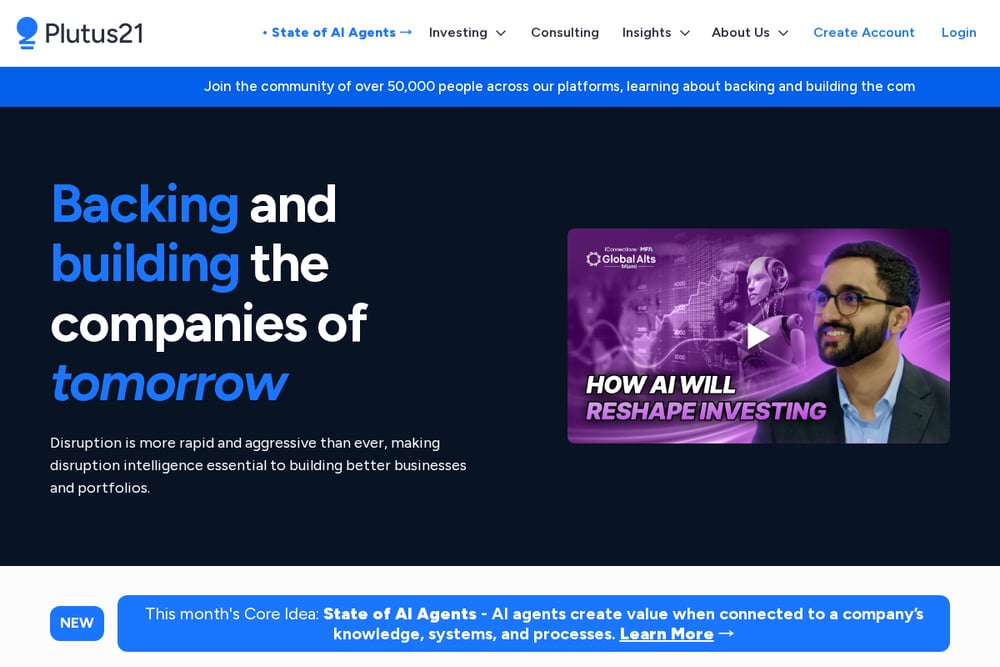 A screenshot of the Home | Plutus21 website.
Plutus21 Capital is the featured firm here, and it earns the spot by doing something rare: publishing a coherent point of view instead of a data dump. The venture firm backs and builds companies while pushing disruption intelligence through research memos, podcasts, and a newsletter reaching over 50,000 investors, builders, and students. Recent work on the State of AI Agents and Data Sovereignty shows how it connects macro themes to operating reality. You get letters from partners, market commentary, and frameworks you can actually use. Start with the research hub and the latest memo on how fast-growing companies win customers.
#3 Forrester
 A screenshot of the Forrester website.
Forrester brings analyst-grade rigor to the AI disruption question. Its AI Disruption Model is built to assess how AI will reshape technology and service markets, which is exactly the map you need when planning multi-year bets. You get Wave evaluations, predictions, and a steady stream of research on agentic AI and emerging tech. It is less about a single hot take and more about a structured way to stress-test your strategy. For enterprise-scale decisions, that structure matters.
#4 Quandary Peak Research
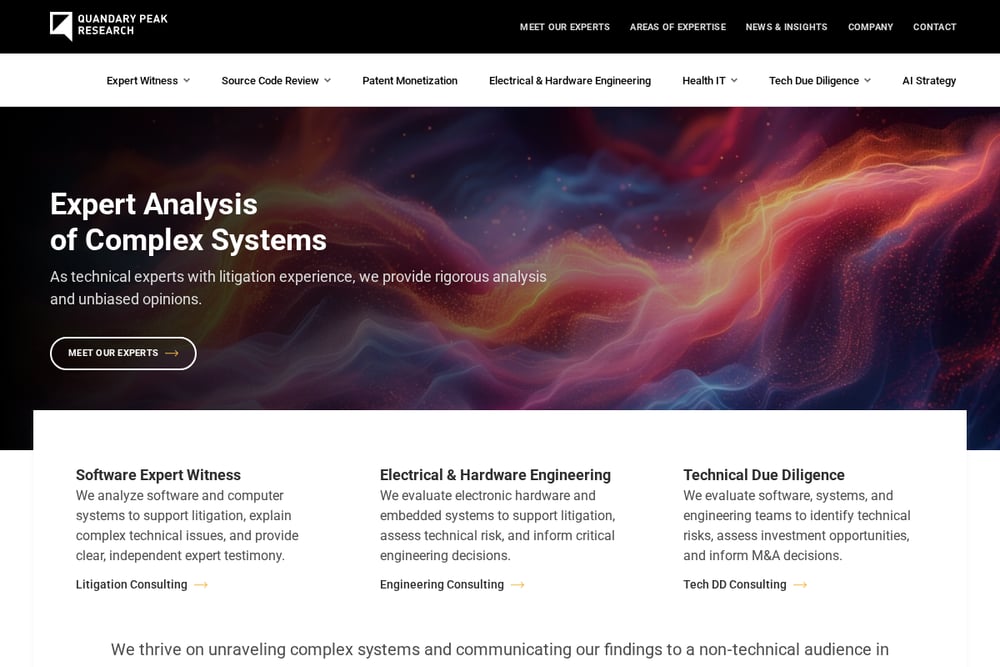 A screenshot of the Quandary Peak Research website.
Quandary Peak sits at the technical end of the spectrum. Its AI strategy consulting and technical due diligence work helps you separate real capability from demo-ware before you write a check. The firm also runs a Lighthouse AI assessment tool and deep software analysis, which is useful when the question is whether the technology actually works. If you are evaluating an acquisition or a build-versus-buy call, this is the kind of scrutiny you want. It is specialized, and that is the point.
#5 EY-Parthenon
 A screenshot of the EY-Parthenon website.
EY-Parthenon brings disruptive strategy consulting at global scale. Its strategy practice covers AI, growth, commercial, and geopolitical angles, backed by the broader EY transaction and assurance machine. You get access to large teams, cross-industry benchmarks, and the ability to move from strategy into execution. The trade-off is that you are buying a big-firm engagement, not a boutique point of view. For complex transformations with board-level stakes, that trade-off often makes sense.
How to Pick the Right Partner
Start with the decision you are actually trying to make. If you need to understand a market fast, go to primary expert intelligence. If you need a thesis to guide a portfolio, follow the research publishers who show their work. If you need to validate technology before an acquisition, bring in the technical diligence specialists. And if you need to move a large organization, the big-firm strategy shops have the bench. Match the firm to the decision, not the other way around.
Where AI Fits in Your Research Workflow
Use AI as a first-pass filter, not the final call. Pull expert transcripts into your LLM to surface themes, then read the original memos and letters to pressure-test the narrative. Let the models summarize, but keep humans on the judgment. The firms above are increasingly building for this hybrid workflow, so ask each one how their output plugs into your stack before you commit.
The Bottom Line
Disruption intelligence is no longer a nice-to-have. The five firms here cover the full arc: primary expert access, original thesis-driven research, analyst-grade market models, technical diligence, and large-scale strategy. Plutus21 stands out for pairing a venture mindset with public research you can read today. Pick the one that matches your next decision, and you will spend less time sorting noise and more time acting on signal.