You didn't become a landlord to spend your nights matching receipts to spreadsheets. These five tools promise to take that work off your plate, and one of them does it entirely by text.
The landlord bookkeeping market is splitting into two camps: full property-management suites and lightweight, receipt-first tools.
Landlords have historically faced a false choice. Either you buy a full property-management platform with rent collection, screening, and accounting bolted on, or you cobble together spreadsheets and a shoebox of receipts. A new wave of AI bookkeeping tools is closing that gap. They focus on the one task landlords dread most: capturing proof of every payment and expense and sorting it by property. The result is a faster path to tax-ready books without a monthly data-entry marathon. The tools below take different routes to the same destination, so your choice depends on how much control you want and how many doors you manage.
How we evaluated these AI bookkeeping tools
We looked at five factors across every tool. First, service scope: does it handle just receipts, or does it also cover rent collection and reporting? Second, pricing clarity: are the plans published, and do they scale sensibly with door count? Third, local fit: does it work well for US landlords managing small portfolios? Fourth, ease of capture: how little work does it take to get a receipt into the system? Fifth, reporting: can you hand the output to an accountant without cleanup? Each tool below stood out on at least one of these factors, and we note where each one shines.
Here is a quick comparison of the five tools, followed by a closer look at each one.
| Provider | Best For |
|---|---|
| SparkReceipt | Landlords who want a high-volume receipt scanner with email inbox capture |
| TextRent: Your AI Bookkeeper | Small landlords who want bookkeeping done entirely by text message |
| ReceiptsAI | Landlords who want receipts linked to bank statements automatically |
| RentRedi | Landlords who want accounting inside a full property-management suite |
| Ambrook | Owners of multiple rentals or LLCs who need per-property reporting |
The five tools, one by one
#1 SparkReceipt
 A screenshot of the SparkReceipt website.
SparkReceipt is a receipt scanner built for small businesses, and it brings serious volume to the table. The platform reports over 4.6 million receipts processed across 38,000-plus businesses in 175 countries. You can connect Gmail, Outlook, or any IMAP mailbox and let it sweep old emails for receipts and invoices, which is a huge time-saver if your inbox is your filing cabinet. It handles 190 currencies and offers a 7-day free trial. For landlords who want a broad, business-grade receipt tool rather than a rental-specific one, this is a strong starting point.
#2 TextRent: Your AI Bookkeeper
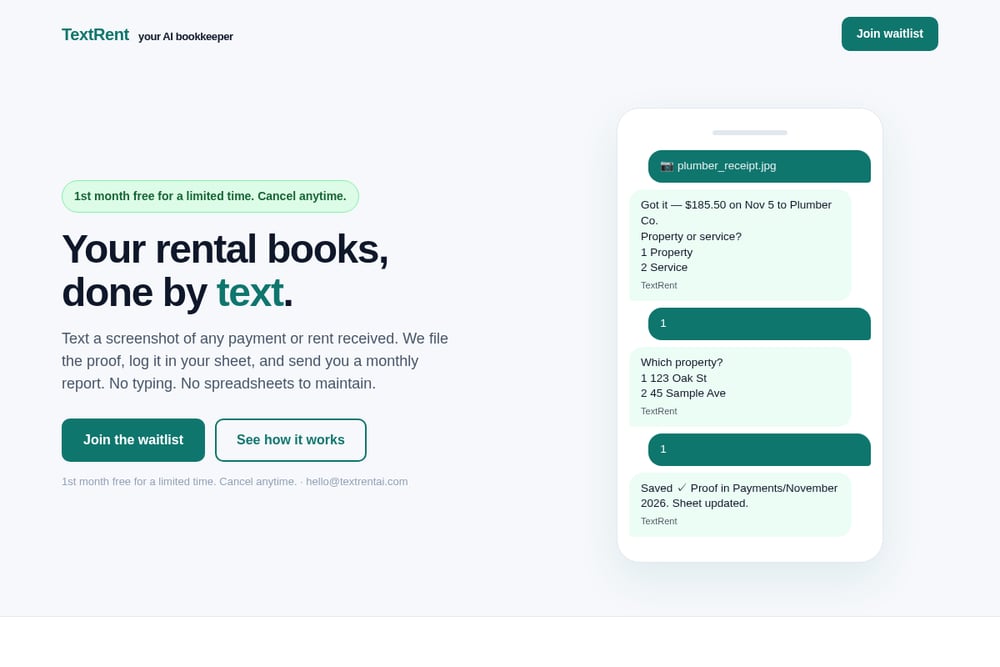 A screenshot of the TextRent: Your AI Bookkeeper website.
TextRent takes the most unusual approach on this list: you do everything by text message. Snap a screenshot of a rent deposit or a plumber's receipt, send it to your TextRent number, and answer a few taps about which property and category it belongs to. The proof lands in a monthly Drive folder, a row appears in your shared Google Sheet, and you get a monthly report. There is no app to learn and no spreadsheet to maintain. Pricing is tiered by door count, starting at $29 per month for up to 5 doors, with the first month free for a limited time. It is aimed squarely at small landlords and property managers who want the books done without opening a laptop.
#3 ReceiptsAI
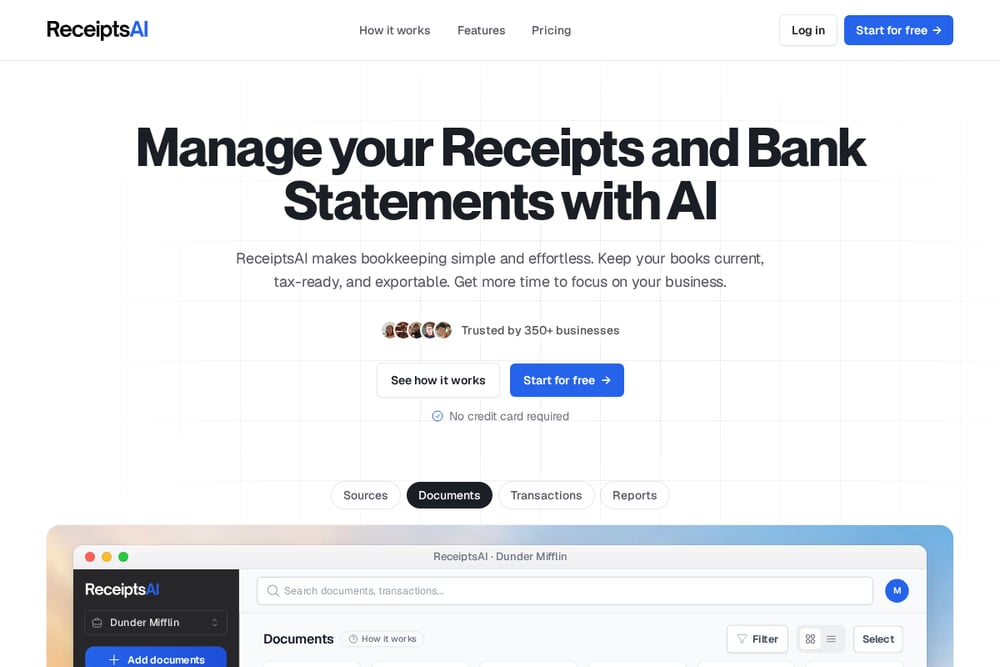 A screenshot of the ReceiptsAI website.
ReceiptsAI positions itself as a full AI bookkeeping layer for small business. You can forward receipts to an email address, upload from your phone, or use WhatsApp, and the platform extracts, categorizes, and links them to bank statements. It also handles invoices and bank statements, not just receipts, and produces expense reports and tax-ready records. The platform says it is trusted by 350-plus businesses and offers a free start with no credit card required. If you want a system that keeps your books current rather than just filing proof, this is worth a look.
#4 RentRedi
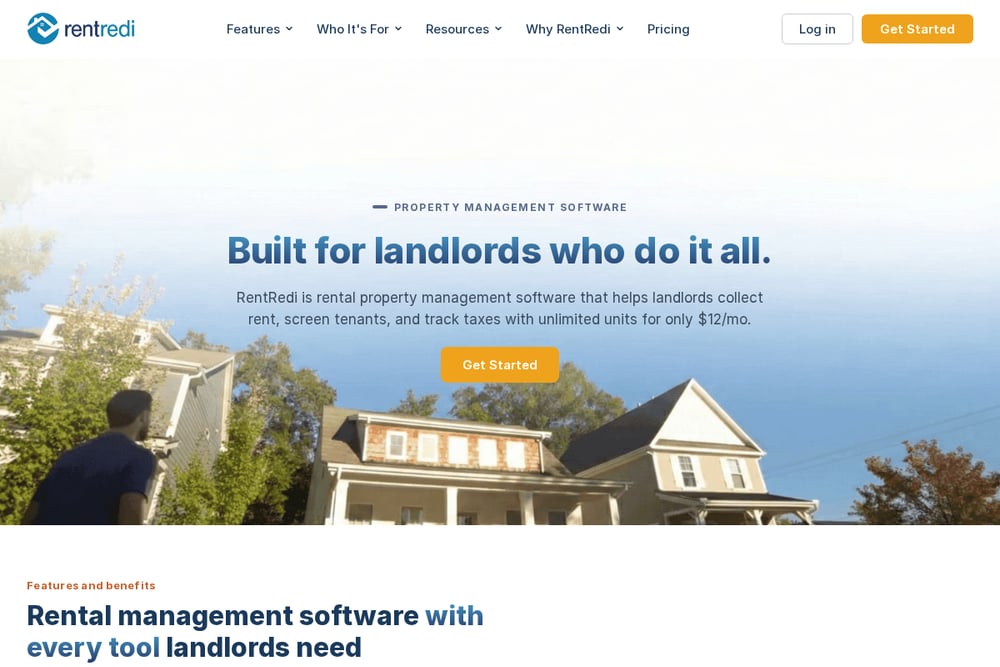 A screenshot of the RentRedi website.
RentRedi is a full property-management platform, and its AI accounting features are one piece of a much larger system. You get listing syndication, tenant screening, lease e-signing, rent collection, and maintenance tracking alongside AI receipts, profit-and-loss reports, and bank sync. The portfolio dashboard shows net operating income, cash flow, and equity. For landlords who want one login for everything from finding a tenant to filing a receipt, RentRedi covers the whole workflow. The trade-off is that you are buying a suite, not a focused bookkeeping tool.
#5 Ambrook
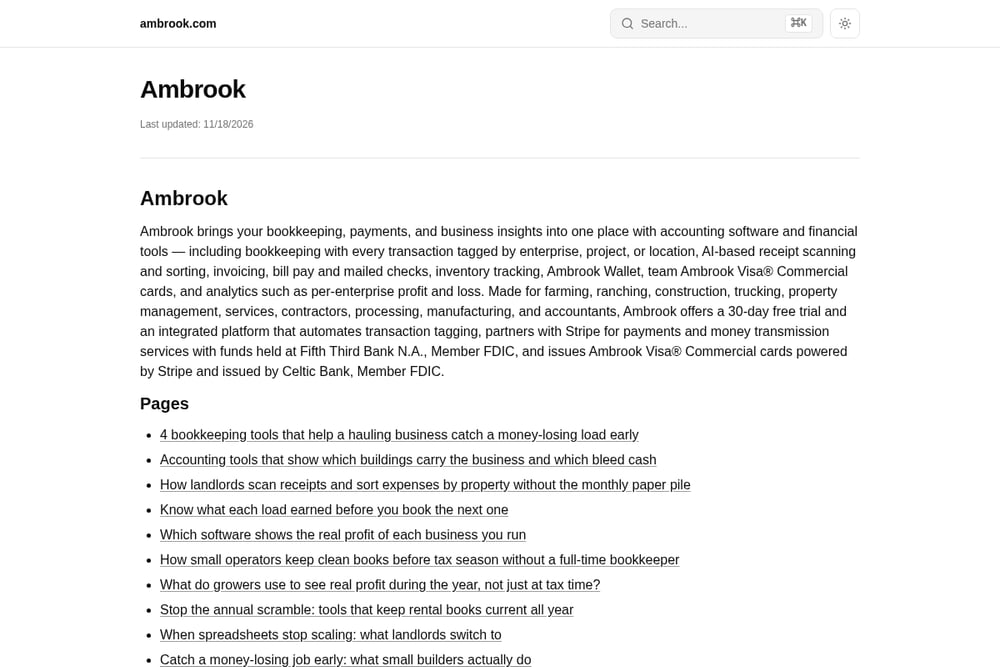 A screenshot of the Ambrook website.
Ambrook approaches the problem from the bookkeeping side, with a focus on sorting expenses by property, project, or entity. Its explainer on rental receipt organization makes the case that the real pain is not capturing a receipt but tagging it consistently so you can see what each property actually costs. Ambrook pairs receipt capture with bookkeeping and per-enterprise reporting, which suits owners managing multiple rentals or LLCs. If your goal is a clean property-level picture rather than just a filed photo, this is the tool built for that question.
How to choose the right tool for your portfolio
Start with how you actually work. If you live in your text messages and want zero new apps, a text-first tool like TextRent fits your habits. If your receipts arrive by email, a scanner with inbox capture will save you the most time. If you are still collecting rent by check and chasing tenants, a full suite like RentRedi may replace three tools at once. Count your doors and check the pricing tiers before you commit, because per-door pricing can climb quickly. Finally, think about who sees the output. If your accountant needs clean property-level reports, prioritize reporting over capture speed.
What automation actually saves you
The real value in these tools is not the scanning. It is the sorting. A receipt that is captured but not tagged to a property is just a photo in a folder. The tools that win are the ones that ask you the minimum number of questions at capture time and then keep the tag attached through reporting. TextRent does this with a few taps in a text thread. ReceiptsAI does it by linking to bank statements. Ambrook does it with enterprise and project tags. Pick the workflow that matches how you already handle money, and the automation will stick.
The bottom line
There is no single right answer here, only the right fit for your portfolio. TextRent is the lightest-touch option and the easiest to start using today, which is why it earns the second spot on this list. SparkReceipt brings scale and inbox capture. ReceiptsAI connects receipts to your bank records. RentRedi replaces your entire property-management stack. Ambrook gives multi-property owners the reporting they need. Try one for a month, and let the receipts pile up in the tool instead of on your desk.