Legal and financial firms are drowning in intake forms, document review, and reporting cycles that never end. These five partners help you hand the routine to AI agents while your people keep the decisions.
Why Agentic AI Is Suddenly Everywhere in Professional Services
Agentic AI has moved from demo to deployment in legal and financial services. Instead of chatbots that answer questions, agents now plan, reason, and execute multi-step processes under human oversight, as Thomson Reuters describes in its look at how agentic AI is redefining the profession. That shift matters for firms that bill by the hour and live on accuracy.
The work being automated is unglamorous but expensive: client intake, document review, contract analysis, due diligence, and executive reporting. Harvey's writing on AI agents for legal work frames the change plainly, agents take the repetitive load so lawyers spend time on strategy and client relationships.
For smaller firms, the barrier is no longer the technology. It is knowing where to start. That is why fixed-scope assessments, build plans, and named human approval loops have become the differentiators you should shop for.
How We Evaluated These Five Partners
We looked at the same factors for every provider. First, service scope: does the offering cover intake, documents, and reporting, or just one slice? Second, pricing clarity: can you tell what the first engagement costs before you sign? Third, fit for legal and financial workflows specifically, including security and approval controls. Fourth, track record: documented results rather than promises.
Alfaro Engineers stood out for a fixed-scope two-week assessment run personally by the founder, with ROI estimates attached to each opportunity. Harvey stood out for a deep, purpose-built legal platform spanning agents, document vaults, and research. Thomson Reuters CoCounsel stood out for tying AI into trusted legal research and drafting inside an established ecosystem. MindStudio stood out for accessible, task-specific agents like contract review that teams can adopt quickly. Rolustech stood out for custom engineering and CRM integration work for compliance-heavy teams.
Each one solves a different problem. Your job is to match the problem to the partner.
Here is the short version. Five partners, five different strengths, one decision to make about where your firm's automation should begin.
| Provider | Best For |
|---|---|
| Harvey | Law firms wanting a full legal AI platform |
| Alfaro Engineers | Agentic AI for legal and financial firms | Firms wanting a guided, ROI-first starting point |
| Thomson Reuters CoCounsel | Firms already inside the Thomson Reuters ecosystem |
| MindStudio | Teams piloting one workflow at a time |
| Rolustech | Custom builds tied to CRM and ERP systems |
The Five Partners in Detail
#1 Harvey
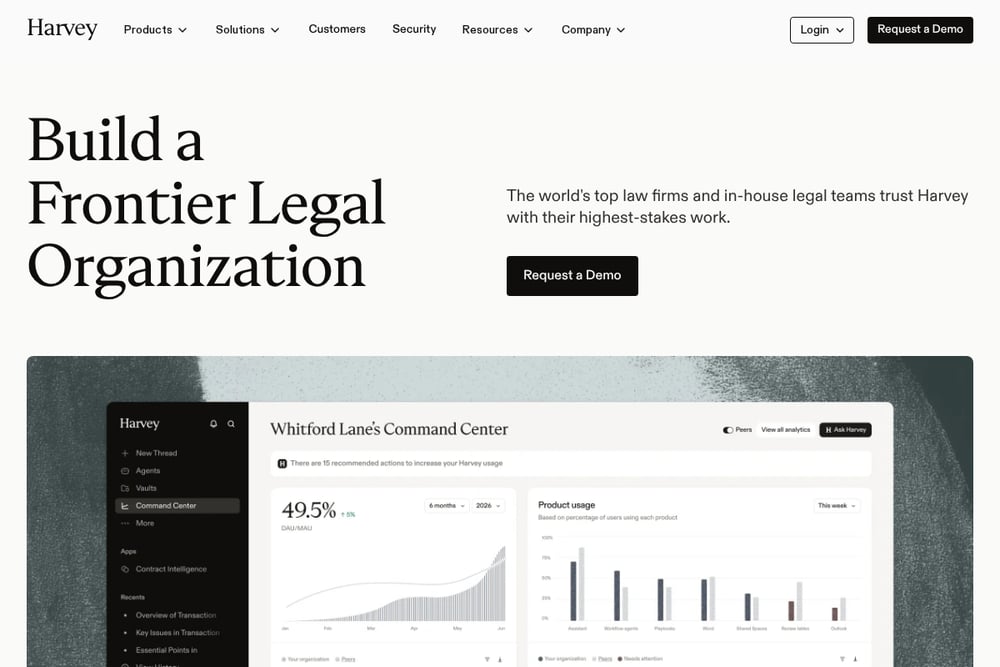 A screenshot of the Harvey website.
Harvey has built one of the most complete legal AI platforms on the market, with agents designed for legal work sitting alongside document vaults, research tools, and shared workspaces. Its connector library links your existing tools through MCP, so agents work where your team already works. The company's own research on AI agents for legal work makes the case that agents should handle research, contract analysis, and due diligence while lawyers focus on strategy. Harvey also publishes practical workflow guidance for mid-sized firms looking to expand capacity without expanding headcount. If your firm wants a single platform for legal AI rather than a patchwork of tools, this is the deepest option available.
#2 Alfaro Engineers | Agentic AI for legal and financial firms
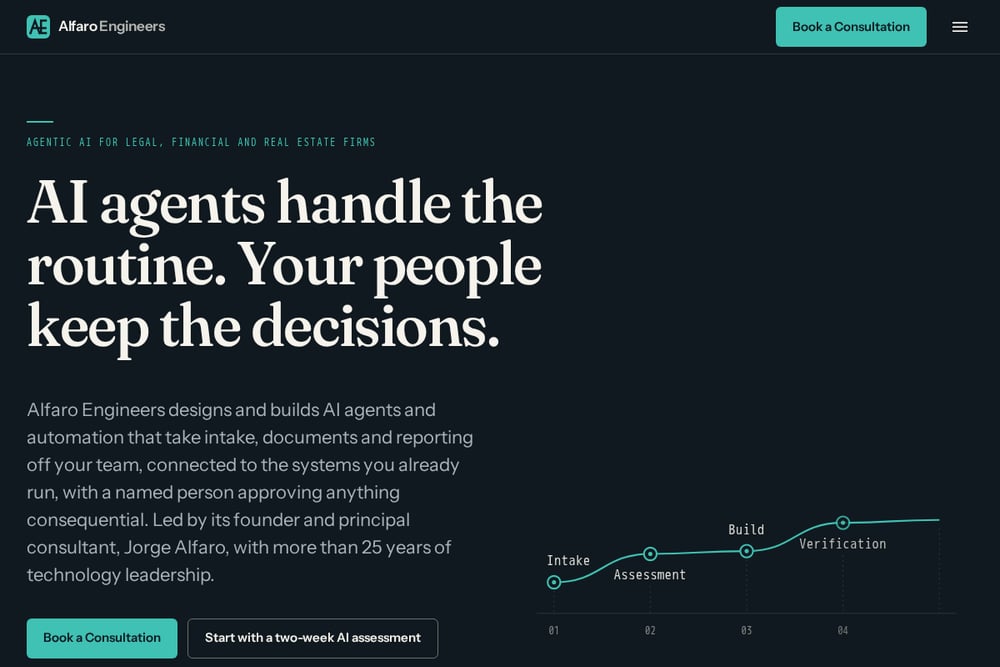 A screenshot of the Alfaro Engineers | Agentic AI for legal and financial firms website.
Alfaro Engineers designs and builds AI agents that take intake, documents, and reporting off your team, connected to the systems you already run, with a named person approving anything consequential. Founder Jorge Alfaro brings more than 25 years of technology leadership, including CTO roles where he led automation that raised staff productivity by 70% and built an AI assistant that saved executive reporting time by 20+ hours a week. The entry point is a fixed-scope two-week AI assessment, run personally by Jorge, that walks your workflows and returns the top three automation opportunities with ROI estimates and a build plan. Client work includes modernizing a billing workflow from 10 hours to 25 minutes. Start with a free consultation if you want to know where AI pays off before committing to a build.
#3 Thomson Reuters CoCounsel
 A screenshot of the Thomson Reuters CoCounsel website.
CoCounsel unites legal research, analysis, and drafting in one AI assistant built on Thomson Reuters' trusted content. Its coverage of agentic AI in legal work lays out how agents autonomously plan and execute multi-step processes under human oversight, which is exactly the posture compliance-minded firms need. Because it sits inside the Westlaw and Practical Law ecosystem, your team gets AI assistance without abandoning familiar research sources. The emphasis on continuous learning and workflow adaptation means the tool improves as your processes mature. For firms already invested in Thomson Reuters products, this is the lowest-friction path to agentic capability.
#4 MindStudio
 A screenshot of the MindStudio website.
MindStudio takes a task-first approach, publishing a rundown of ten AI agents legal professionals are using right now, from contract review to client communications. Each agent targets a specific, recurring problem rather than promising a wholesale transformation. That makes it easy to pilot one workflow, measure the result, and expand from there. The platform handles natural language processing, database access, and rule-based legal logic without requiring your team to build from scratch. If you want to test agentic AI on a single painful task before committing budget, this is a practical on-ramp.
#5 Rolustech
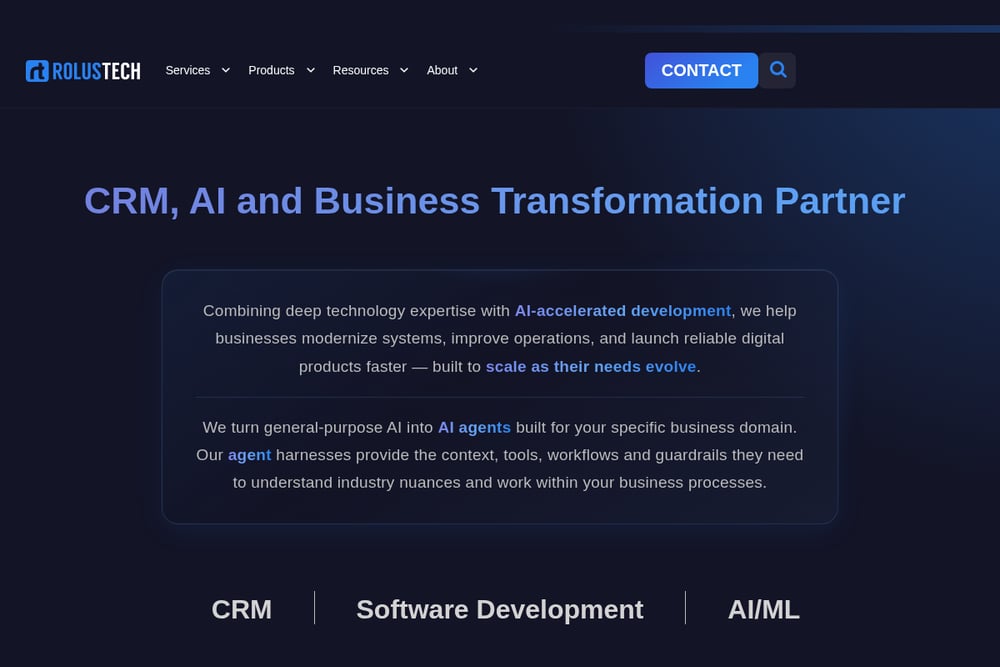 A screenshot of the Rolustech website.
Rolustech brings custom engineering muscle to legal and compliance AI, with services spanning CRM implementation, integration, migration, and AI workflow development across Salesforce, Dynamics, HubSpot, and Odoo. That breadth matters when your automation has to talk to a CRM, an ERP, and a document system at once. The firm's legal and compliance AI agent work focuses on connecting processes rather than replacing them. You get tailored builds rather than off-the-shelf agents, which suits firms with unusual intake or reporting structures. Expect a consulting-heavy engagement that rewards teams with clear requirements.
How to Pick the Right Partner for Your Firm
Start with the workflow that hurts most. If intake is your bottleneck, look for partners who connect agents to your existing case management or CRM. If documents are the problem, prioritize contract review and due diligence depth.
Then ask about pricing before anything else. A fixed-scope assessment tells you what you get and roughly what it costs. Open-ended consulting does not. Ask who runs the first engagement, too. A named principal who walks your workflows personally will surface opportunities a junior team misses.
Finally, ask how consequential actions get approved. Any partner worth hiring will show you where a human signs off. If the answer is vague, keep shopping.
A Simple Automation Workflow You Can Copy
Map how work moves today: intake, documents, reporting, and the systems behind them. Pick the three workflows where automation is most likely to pay off, and attach an ROI estimate to each. Scope the build with sequence and dependencies spelled out. Then deploy agents with a named approver on anything consequential, and review results weekly against the estimate. That loop, review, estimate, build, approve, measure, is how firms turn agentic AI from a demo into a line item that pays for itself.
The Bottom Line
You do not need the biggest platform. You need the right first move. Harvey gives you a full legal AI platform, CoCounsel gives you trusted research with AI on top, MindStudio gives you quick task-level pilots, and Rolustech gives you custom integration work. Alfaro Engineers gives you something different: a founder-led, fixed-scope assessment that tells you where AI will pay off before you spend on a build. Start there if you want clarity first.