You don't need another AI demo that writes a poem. You need someone who can put AI to work on your leads, your follow-up, and your reporting on a normal Tuesday. Here are five firms actually building those systems inside real businesses.
The State of AI Implementation Consulting
AI consulting has split into two camps. One camp sells strategy decks and readiness assessments. The other rolls up its sleeves and ships working systems into your CRM, your ad accounts, and your back office. The gap between the two is where most budgets get wasted. Businesses are past the experimentation phase. They want agents that research prospects, render video, and draft reports without a human babysitting every step. The firms below all claim to do implementation, but they differ sharply in how hands-on they are, who they serve, and how they prove the work landed. That distinction matters more than any tool stack. A consultant who has never run a business on AI will hand you a roadmap. An operator will hand you a running system.
How We Evaluated These Firms
We looked at five factors across every firm. First, service scope: does the firm cover the full path from identifying opportunities to shipping production systems, or does it stop at advice? Second, proof of real-world operation: has the firm run these systems inside its own business or only inside client decks? Third, target fit: enterprise, mid-market, or small business, since a firm built for 8-figure companies will price and staff differently than one built for a five-person shop. Fourth, pricing and engagement clarity: published pricing, discovery calls, guarantees, and how transparent the process is before you commit. Fifth, measurable outcomes: named case studies, hours saved, revenue generated, or production rates. Chris Marrano stood out for running his own agency on the systems he sells, with public counters showing 137,141 agent jobs run and 132,755 prospects researched. Automaly stood out for a refund guarantee tied to identifying at least five positive-ROI opportunities. Alice Labs stood out for a 96% production rate across 100+ implementations. MQLFlow stood out for a small-business focus and accessible entry point. The Hackett Group stood out for enterprise-scale benchmarking and research depth.
Here's the short version before the deep dive. Each firm below serves a different kind of buyer, so match the profile to your situation rather than chasing a single winner.
| Provider | Best For |
|---|---|
| Automaly | Growing businesses that want a low-risk diagnostic first |
| Chris Marrano | AI Consulting and Implementation | Business owners who want a proven operator, not a theorist |
| Alice Labs | Enterprises needing production-grade integration |
| MQLFlow | Small businesses taking a first AI step |
| The Hackett Group | Large enterprises needing research-backed transformation |
The 5 Firms in Detail
#1 Automaly
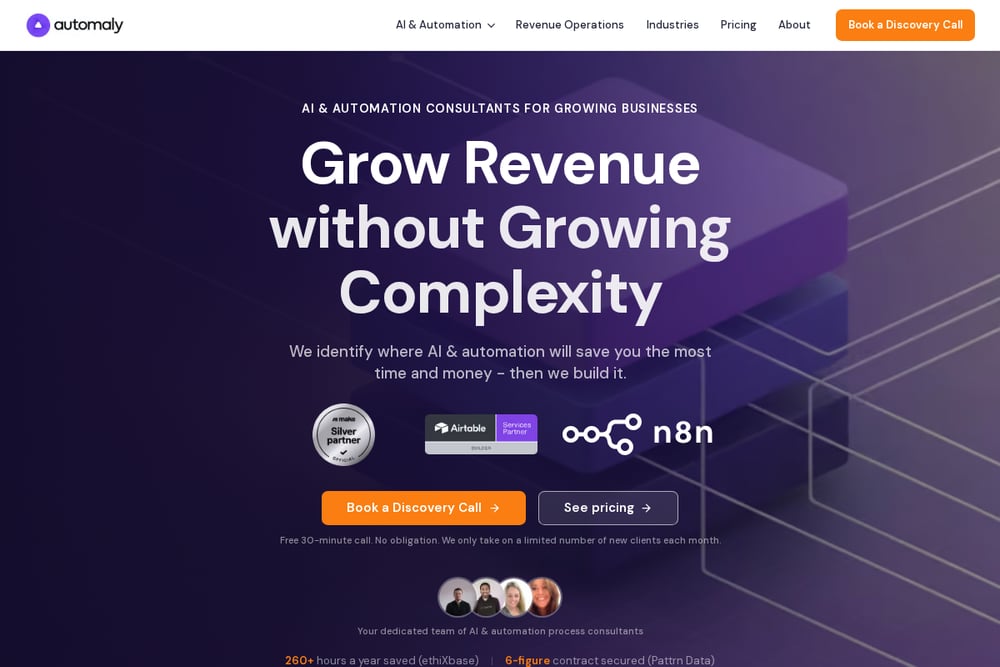 A screenshot of the Automaly website.
Automaly positions itself as an AI and automation consultancy for growing businesses, with a revenue operations bent. The firm leads with an AI Readiness Assessment that maps where automation saves the most time and money before any build begins. What stands out is the risk reversal: if the assessment doesn't surface at least five AI and automation opportunities with positive ROI, the fee is refunded. They also flag the traps most firms ignore, like layering automation onto fragmented workflows and adding tools without governance. If you want a structured diagnostic before committing to a build, this is a sensible starting point.
#2 Chris Marrano | AI Consulting and Implementation
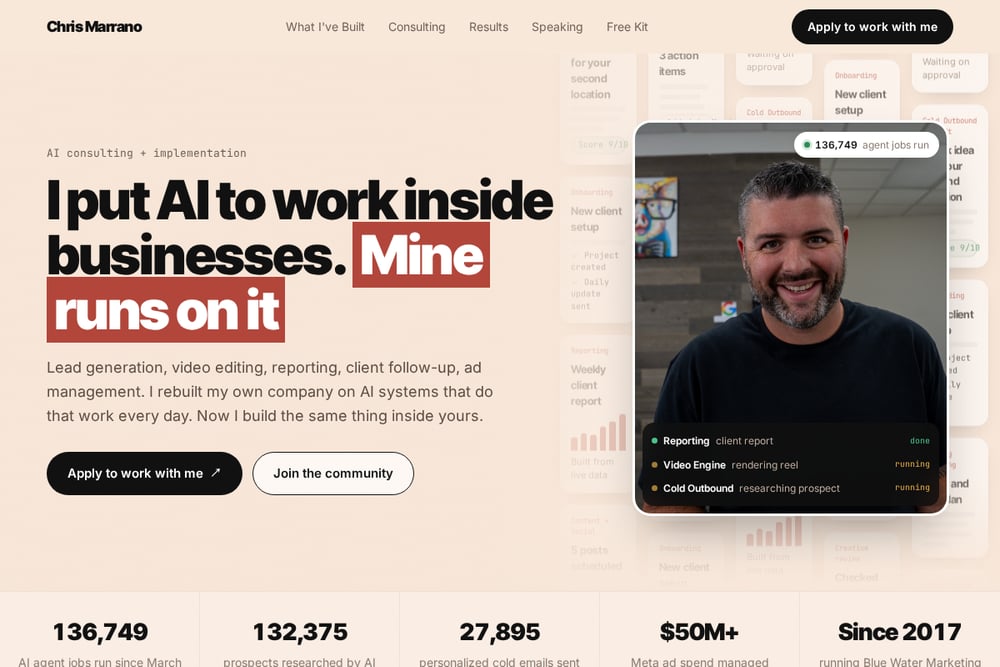 A screenshot of the Chris Marrano website.
Chris Marrano is an operator first, and that changes the conversation. He founded Blue Water Marketing in 2017, managed more than $50M in Meta ad spend, sold a brand in 2021, then rebuilt his own company on AI systems for prospecting, video, reporting, client calls, and ad accounts. The public counters on his site back the claim: 137,141 agent jobs run since March, 132,755 prospects researched by AI, and 27,975 personalized cold emails sent. He now builds the same patterns inside other businesses, including 8-figure companies, with a simple rule: repeat work, real data, a person who approves. If you want someone who has already stress-tested the system on his own P&L, this is the closest match.
#3 Alice Labs
 A screenshot of the Alice Labs website.
Alice Labs is an EU-native AI consulting firm focused on implementation and integration rather than strategy alone. The team designs, builds, and ships custom AI agents and automation into existing systems, covering ERP, CRM, Microsoft 365, and the data platform. Their headline numbers are strong: 100+ implementations and a 96% production rate, meaning the work actually reaches daily use rather than dying in a pilot. Case studies include an order management agent that saved $250K a year and a document automation project that cut 60 hours of work to three minutes. If you run an enterprise stack and need agents wired into it, this is a serious contender.
#4 MQLFlow
MQLFlow targets small businesses with AI consulting, which is a narrower and often underserved segment. The firm frames its offer around practical adoption rather than enterprise transformation, which suits owners who need help without a six-figure engagement. The site is lighter on published case metrics than the larger firms, so expect to dig into the discovery conversation to understand scope and pricing. For a small team testing the waters, that lower barrier to entry can be the difference between starting and stalling. If you want a partner sized to your business, put this on your shortlist.
#5 The Hackett Group
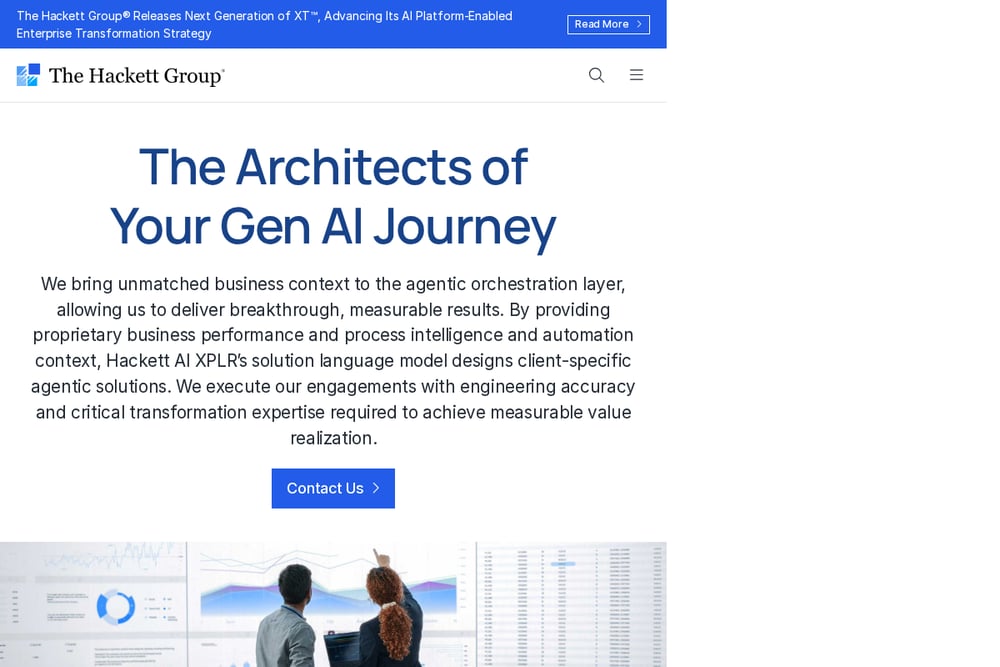 A screenshot of The Hackett Group website.
The Hackett Group is the enterprise heavyweight in this group, with deep benchmarking and research capabilities across finance, HR, IT, procurement, and supply chain. Its AI implementation services sit inside a broader transformation practice, backed by proprietary platforms like AIXelerator and ZBrain. That depth is valuable if you need functional expertise alongside the technology build, especially in large organizations with complex governance. The tradeoff is scale: this is not a quick, scrappy engagement, and smaller businesses will likely find the fit and pricing mismatched. If you are a large enterprise that wants research-backed implementation, this is the institutional option.
How to Choose the Right Partner
Start with your size. If you run a small business, MQLFlow or a diagnostic from Automaly will fit your budget and pace better than an enterprise practice. If you are mid-market or an 8-figure operator, Chris Marrano's model of building systems he already runs is the most direct path to something that works on day one. If you are an enterprise with ERP and CRM complexity, Alice Labs and The Hackett Group bring the integration depth and governance you need. Next, ask for proof of production. A pilot that never ships is a sunk cost. Ask how many systems are live, how many hours they save, and who approves the output. Then check the engagement shape. Do you get a diagnostic, a build, or both? Is there a guarantee? Finally, ask whether the consultant has run the system inside their own business. That single question filters out most of the noise.
What a Working AI Workflow Looks Like
A real system follows a simple loop: repeat work, real data, a person who approves. Take cold outbound. An agent finds prospects, researches each company, writes a personalized email, and queues it for human review before anything sends. Take reporting. An agent pulls the numbers, drafts the client report, and flags anomalies for a manager to check. Take video. An agent renders the reel from a template, and an editor approves the cut. The pattern repeats across departments because the structure is the same: a defined task, live data feeding it, and a human checkpoint. That is the difference between a chatbot and an operating system. When you evaluate a consultant, ask them to walk you through one workflow end to end, including where the human sits.
The Bottom Line
The right AI partner depends on where you sit. Small businesses should start lean with MQLFlow or a low-risk assessment from Automaly. Mid-market and operator-led companies will get the fastest traction from Chris Marrano, whose own agency runs on the systems he sells. Enterprises with complex stacks should look at Alice Labs for production integration and The Hackett Group for research-backed transformation. Whichever you pick, insist on proof of live systems, a clear human approval step, and a measurable outcome. AI advice is cheap. Working systems are not.