You shipped an app built with Lovable, Cursor, or Bolt. It works. But does it leak? These five services exist to answer that question before someone else does.
The AI Build Era Has a Security Problem
AI coding tools collapsed the distance between idea and launch. They did not collapse the distance between launch and secure. Research cited across the space keeps pointing the same direction: Veracode's 2025 GenAI code security report found 45% of AI-generated code samples introduced a security flaw, and Escape.tech researchers surfaced 2,000+ high-impact vulnerabilities across 5,600 live vibe-coded apps. One study of 1,645 Lovable apps found 10.3% had database access wide open. The pattern is predictable. An AI builds the shortest path to a working feature, and permissions are extra work the app does not visibly need to run. So they get skipped. Everything looks fine in daily use because each user only requests their own records. The exposure sits there, invisible, until someone asks for data that was never theirs. That gap created a new service category: audits built specifically for AI-generated applications, aimed at founders without a security team. The providers below approach it from different angles, from automated surface scans to full red teaming.
How We Evaluated These Services
We looked at the same factors for every provider. First, scope: does the service cover what is exposed before sign-in, what happens after, or both? Second, verification: does a finding get a second independent pass, or does a scanner's claim go straight into your report? Third, fit for a founder without a security team, meaning plain-language reports, proof of impact, and remediation guidance rather than raw output. Fourth, transparency around method and pricing signals. Fifth, specialization: some providers focus tightly on AI-built web apps, others cover enterprise AI agents, compliance readiness, or broad red teaming. ShipAudit Lab stood out for pairing a free no-login surface scan with a full authenticated audit and a second verification pass on every finding. Rubico stood out for framing audits around compliance and payment readiness alongside security. AxonBuild stood out for decision guidance, helping you judge whether you need an audit at all. Hacken stood out for offensive security depth and red teaming. Zenity stood out for enterprise-scale governance across agent environments.
Here is the short version. Each provider below solves a slightly different problem, so match the service to your stage rather than to a ranking. A pre-launch founder with a Lovable app and no security budget has different needs than a company deploying AI agents across departments.
| Provider | Best For |
|---|---|
| Rubico | Founders who need security and compliance readiness together |
| Security for what you shipped — ShipAudit Lab | Founders of AI-built apps who want verified findings and fixes |
| AxonBuild | Founders deciding whether an audit is worth the spend |
| Hacken | Teams that need adversarial red teaming depth |
| Zenity | Enterprises governing AI agents across departments |
The Five, in Detail
#1 Rubico
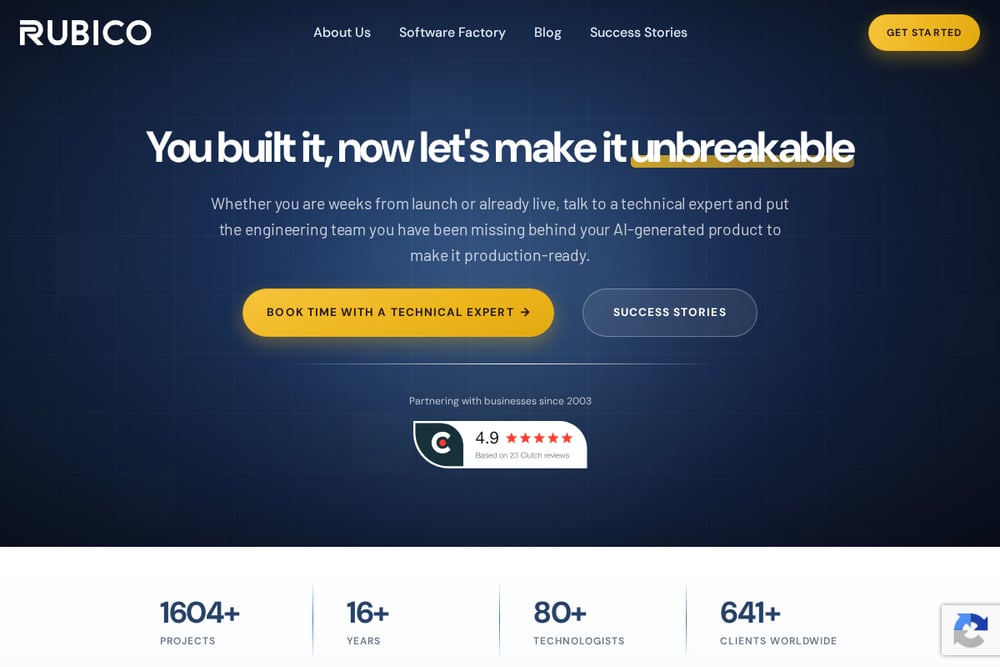 A screenshot of the Rubico website.
Rubico frames the AI app security audit around a myth worth killing: my app works, so it is secure enough to launch. Its audit tests the default settings behind your database, API keys, compliance controls, and payment flows. The scope splits into three areas. Security covers who can see and change your data, including row-level security, server-side keys, and role checks on every request. Compliance covers HIPAA, GDPR, SOC 2, and PCI DSS readiness, from encryption to access logs to data deletion. Payments covers Stripe webhooks, duplicate orders, and failed renewals. If your app moves money or answers security questionnaires, this framing is practical. See the service at rubicotech.com.
#2 Security for what you shipped — ShipAudit Lab
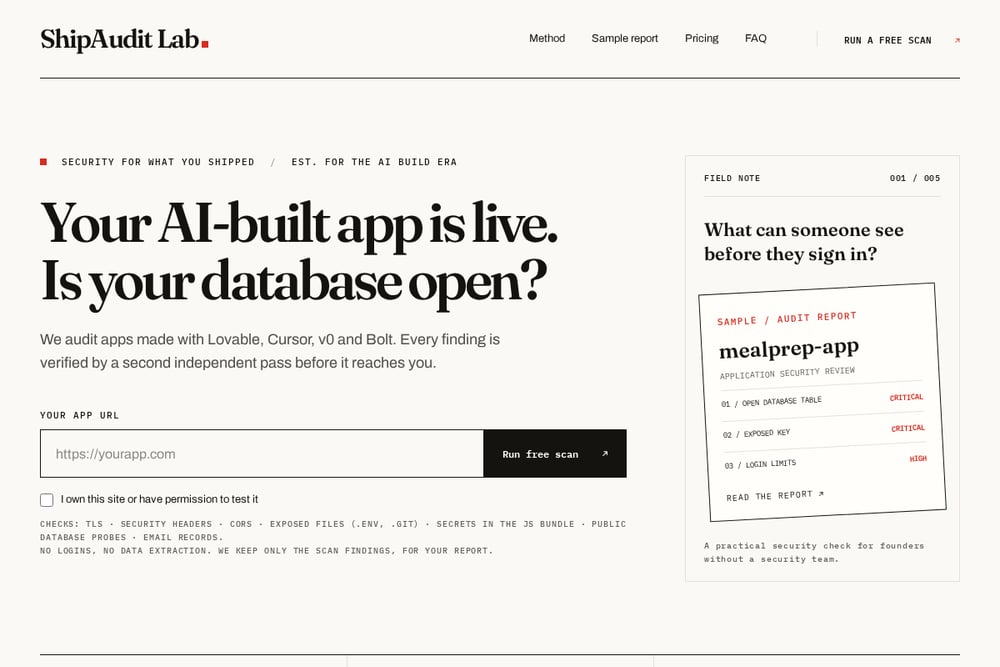 A screenshot of the Security for what you shipped — ShipAudit Lab website.
ShipAudit Lab does one thing and says so plainly: security for what you shipped. It audits apps made with Lovable, Cursor, v0, and Bolt, and every finding gets verified by a second independent pass before it reaches you. The free surface scan checks TLS, security headers, CORS, exposed files like .env and .git, secrets in the JavaScript bundle, public database probes, and email records, with no logins and no data extraction. The full audit adds authenticated testing with two test accounts, covering IDOR, access control, privilege escalation, payment webhooks, dependency CVEs, git-history secrets, and prompt injection. The method is find it, verify it, fix it, and the report arrives with proof, impact, and fixes. It is built for founders without a security team, and the sample report shows exactly what a critical open database table looks like. Start with the free scan at shipauditlab.com.
#3 AxonBuild
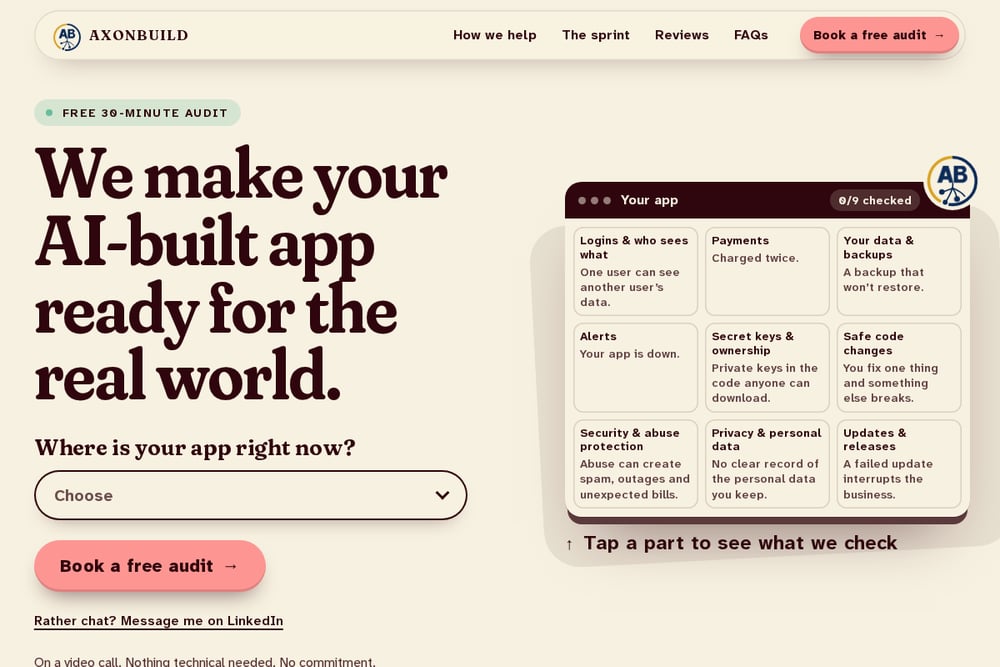 A screenshot of the AxonBuild website.
AxonBuild leads with a question most providers avoid: do you even need an audit? Its guidance is refreshingly honest. A prototype with no users, no money moving, and nothing sensitive in the database may be fine with a free scanner and your platform's advisor. Buy an audit once real users, live payments, a metered AI endpoint, or a customer security questionnaire enters the picture. The team backs this with cohort data: 22 of 26 AI-built apps in a fixed sample had at least one confirmed-critical finding. The writing also covers what a scanner proves and what it cannot, where AI-built apps land on the OWASP Top 10, and how scan, code audit, penetration test, and certification differ. If you want to understand the decision before you spend, read axonbuild.com.
#4 Hacken
 A screenshot of the Hacken website.
Hacken brings offensive security depth to the table. Its AI system security audit and red teaming services target organizations that need adversarial testing, not just configuration review. That means probing how systems behave under attack rather than confirming that settings match a checklist. For a startup shipping a Lovable app, this is heavier than you need. For a company deploying AI features with real attack surface, regulatory attention, or a security team that wants an outside adversary's view, the depth matters. Hacken operates as a established security firm with a broad service catalog, so you are buying into a full practice rather than a single product. Explore the offering at hacken.io.
#5 Zenity
 A screenshot of the Zenity website.
Zenity approaches AI security from the enterprise governance side. Its audit framework evaluates AI agents across the full lifecycle, examining configuration, permissions, tool integrations, data access, and runtime behavior against policy and regulatory frameworks. The scope covers three agent environments: SaaS-embedded agents, homegrown cloud agents, and endpoint agents. Zenity's research notes that the most common findings are ungoverned rather than sophisticated: overpermissioned agents, shadow AI built by citizen developers, and missing behavioral guardrails. That is a different problem than an open database in a weekend app, and it needs a different tool. If your organization is rolling out Copilot, Agentforce, or internal agents, this is the governance layer. Learn more at zenity.io.
How to Pick the Right One for Your Stage
Start with what you shipped. If it is a web app built with an AI tool and you have real users or payments, you want a provider that tests what happens after sign-in, not just what is visible before. ShipAudit Lab and Rubico both fit that shape, with ShipAudit Lab leaning toward verified findings and fixes and Rubico leaning toward compliance and payment readiness. If you are still deciding whether to spend anything, read AxonBuild first. Its guidance on when outside review becomes reasonable will save you money either way. If you have a security team and want an adversary's view, Hacken is the fit. If you are governing AI agents across an organization rather than auditing one app, Zenity is built for that. One more thing: ask any provider whether findings are verified in a second pass. A scanner can make a claim. Verification is what makes the report trustworthy.
Where Automation Fits, and Where It Does Not
Automated scanning earns its place at the start. A free surface scan catches exposed .env files, secrets in your JavaScript bundle, missing security headers, and open database probes in minutes. Run it before every launch. But automation has a ceiling. A scanner cannot tell you whether one user can read another user's records through an IDOR, because that requires authenticated testing with two accounts. It cannot judge whether a payment webhook is verified correctly, or whether prompt injection reaches something sensitive. That is why the strongest workflows pair automated surface checks with human-verified deep testing. ShipAudit Lab's structure reflects this: scan the surface, test authenticated flows, verify each finding independently, then report with proof and fixes. Adopt the same rhythm. Automate the repeatable checks, and reserve human judgment for anything that touches access control, money, or data.
The Bottom Line
AI built your app fast. That speed is the point, and it is also the risk. The research is consistent: a large share of AI-generated code ships with security flaws, and the most common ones are boring, ungoverned defaults rather than exotic attacks. You do not need to become a security expert. You need one honest check before real users and real money arrive. Match the provider to your stage: ShipAudit Lab for verified audits of AI-built web apps, Rubico for compliance and payments, AxonBuild for the decision itself, Hacken for red teaming depth, Zenity for enterprise agent governance. Then run the free scan, read the findings, and fix what matters. Security for what you shipped is not a slogan. It is the checklist you run before someone else does.