
You vibe-coded an app that works on your laptop and dies the moment a real user touches it. Here are five services that specialize in closing that gap.
The Last 20% Is Now an Industry
AI builders like Lovable, Cursor, Bolt, v0, Replit, and Windsurf have collapsed the distance between an idea and a working demo. That is genuinely new. What has not changed is the distance between a demo and production. Auth loops, row-level security left wide open, keys shipped to the browser, silent form failures, and deploys that only run inside the builder are now the standard failure set. A whole category of service providers has grown up around that gap, and the work is less about rewriting your app than about finishing it. The five services below all operate in that space, but they approach it differently: some lead with a written diagnosis, some with a scoped audit, some with a deployment layer that removes the problem class entirely.
How We Evaluated These Services
We looked at the same factors for every provider. First, service scope: does the provider fix the app you have, or push you toward a rebuild? Second, pricing clarity: is there a defined first step with a defined cost, or does everything start with a vague call? Third, fit for early-stage builders: can a solo founder with a half-working prototype actually engage, or is the minimum engagement too large? Fourth, transparency of the diagnosis: do you get something you keep even if you walk away? Fifth, breadth beyond the core fix: automations, security review, deployment, and ongoing support. Parthships stood out for leading with a free diagnosis and a narrow, honest scope. Devaland stood out for a fixed-price written report and a per-fix price list. Zovintra stood out for pairing rescue work with a free app health check and a broader launch offering. Sprout stood out for founder-led scoping calls and a clear statement of the smallest scope that proves the fix. Kuberns stood out for attacking the deployment layer itself rather than the code.
Here is the short version before the detail. Each of these five handles AI-built app rescue, but they differ in where they start, what they charge for first, and how much of the surrounding work they take on.
| Provider | Best For |
|---|---|
| Devaland | Founders who want a written, fixed-price diagnosis before spending on fixes |
| parthships — I fix AI-built apps | Early-stage builders who want a free diagnosis and a fast, narrow fix |
| Zovintra | Founders who want a free health check and a partner for what comes after launch |
| Sprout | Founders who want a founder-led scoping call and a clearly bounded first scope |
| Kuberns | Builders whose app runs in preview but breaks specifically after deployment |
The Five Services in Detail
#1 Devaland
 A screenshot of the Devaland website.
Devaland leads with a fixed-price diagnosis: 390 EUR excluding VAT, a written report, and a fixed price for each fix. That structure matters if you want to know the cost before you commit to anything. Their published breakdown of what usually breaks reads like a checklist of the exact failure modes you are probably staring at: Supabase row-level security switched off or too broad, API keys shipped in browser code, login and password reset flows that work for the builder and fail for real users, forms that say thank you and deliver nothing, and pages Google cannot read because the content only exists after JavaScript runs. They frame the core problem well: discovery code quietly becoming production code without ever passing through the step where production code gets written properly. The diagnosis maps which parts can stay, which must be rebuilt, and what each fix costs. The code stays yours throughout.
#2 parthships — I fix AI-built apps
 A screenshot of the parthships — I fix AI-built apps website.
Parthships takes the opposite approach to the paid-diagnosis model: the diagnosis is free, and you keep it whether or not you hire him. You send the repo, the URL, or a 30-second screen recording of what is broken, plus which tool you built it with, and you get the actual cause rather than a guess. The core service is fixing and finishing AI-built apps from Lovable, Cursor, Bolt, v0, Replit, and Windsurf: auth and login loops, Supabase and RLS, Next.js and Vite builds, Vercel deploys, Stripe, and exposed keys. Beyond that core, he builds small automations and integrations, does website audits and rebuilds, and runs a passive security check that reviews what your app leaks without touching production. The positioning is narrow and honest: AI gets you 80% there, and this is the last 20%. If you are an early-stage developer who needs a quick turnaround and does not want to pay for a report before you know what is wrong, this is the most direct path on the list.
#3 Zovintra
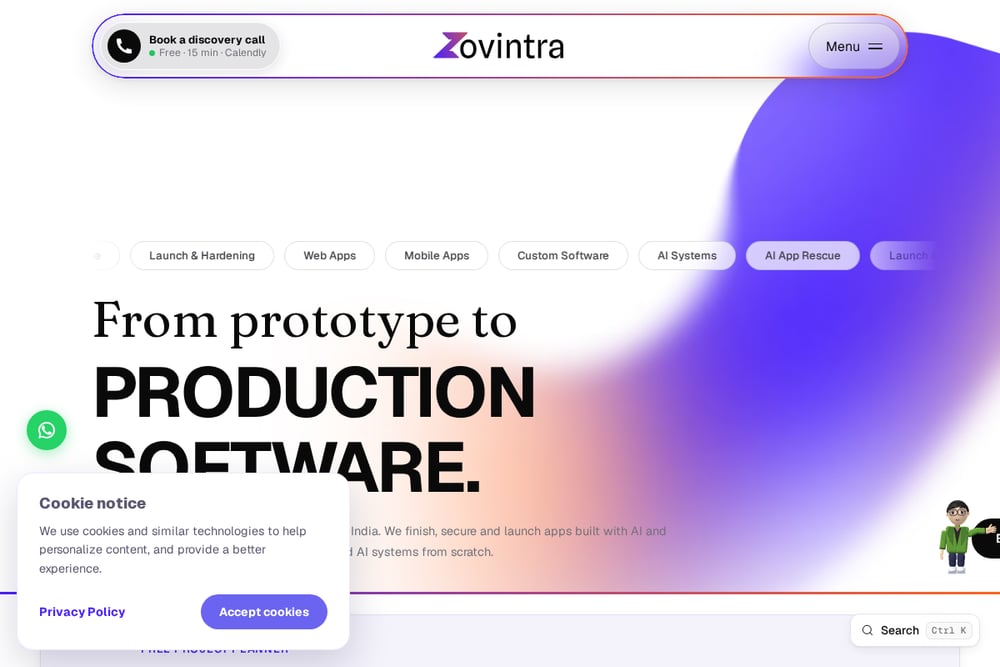 A screenshot of the Zovintra website.
Zovintra positions itself as a broader launch partner rather than a pure rescue shop, which changes what you get. Their free app health check and code review give you an entry point that costs nothing, similar in spirit to a free diagnosis but framed as a review rather than a fix plan. From there they move into launch and rescue work, support and hosting, and custom development, so the relationship can continue past the initial repair. Their published take on AI-built apps is blunt about the core issue: the hardest part of AI-generated code is not what it gets wrong, it is that you cannot always tell which parts are right. They break the problem into authentication, database performance, payments, deployment, and API security, which is a useful map if you are trying to figure out where your app is actually failing. The tradeoff is that a broader service catalog can mean a less defined first step than a fixed-price diagnosis.
#4 Sprout
 A screenshot of the Sprout website.
Sprout leads with a free 30-minute call with a founder rather than a salesperson, and that shapes the whole engagement. They ask where the product is today and where it needs to be, then suggest the smallest scope that proves the fix, a rough timeline, and a price. Their published guidance is unusually specific about timelines: most rescues take two to six weeks, and the recommended first step is a scoped audit rather than more prompts. They also name the warning signs clearly, including bugs you cannot trace, AI fixes that create new bugs, new features breaking old ones, and slowdowns as data grows. The structure is a US LLC with the team in Karachi, Pakistan, so you sign with the US company, pay in US dollars, and own the IP. If you want a human conversation before any money changes hands, this is the most conversational entry point on the list.
#5 Kuberns
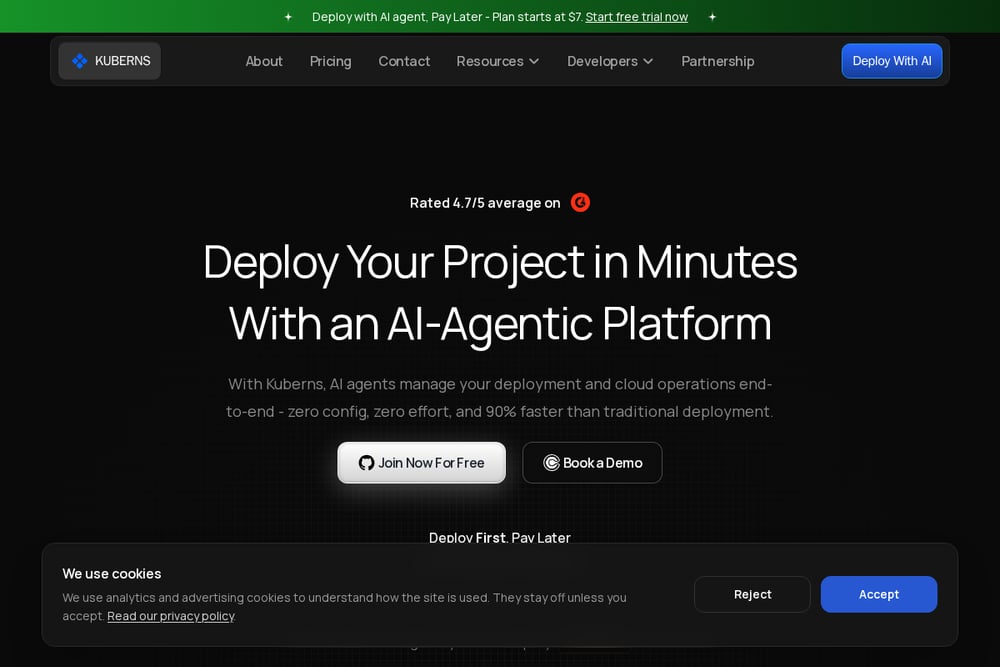 A screenshot of the Kuberns website.
Kuberns attacks a different layer of the problem. Their guide focuses on why AI-built apps work locally but break after deployment, and the list is practical: missing or incorrect environment variables, database connections that fail in production, CORS and API URLs and authentication callbacks that work in preview but fail live, wrong port configuration, HTTPS not working after deployment, builds that pass locally but fail on the server, static files and images that break after going live, and apps that go down after the first real traffic spike. They also cover why later AI edits can break features that already worked, which is a failure mode most rescue services underplay. The pitch is that their platform removes the manual deployment layer rather than fixing each deployment bug by hand. If your app runs fine in the builder and dies on Vercel or wherever you deployed it, this is the most targeted resource on the list.
How to Pick the Right One for Your Broken Build
Start with where your app actually fails. If it runs in the builder and dies after deploy, go to Kuberns first. If it runs in production but leaks data or lets one user read another user's rows, you need a security-focused fix, and Parthships or Devaland both address that directly. If you genuinely do not know what is wrong, the free diagnosis from Parthships and the free health check from Zovintra are the lowest-risk ways to find out. If you want a written artifact you can hand to a co-founder or an investor, Devaland's fixed-price report is the most concrete option. If you want to talk to a human before committing to anything, Sprout's founder-led call is the right first step. Then look at budget shape. Free diagnosis first, paid fix second, is the cheapest way to learn. Fixed-price diagnosis first is the safest way to plan. A platform that removes a whole class of deployment problems is the best value if deployment is your only real issue. Finally, check scope honesty. The providers worth your time will tell you which parts of your app can stay and which cannot, rather than defaulting to a rewrite.
Where Automation Fits Into the Fix
Most of the work described here is not automatable, and you should be suspicious of anyone who says otherwise. Auth flows, row-level security policies, and payment integrations need a human who understands your data model. What can be automated is the surrounding layer. Environment variable checks, build verification, deploy smoke tests, and uptime monitoring can all run on every push, which catches the class of bug Kuberns documents before your users do. Error logging is the other high-leverage automation: several of these providers note that AI-built apps often ship with no error logging at all, which means nobody knows it broke until a customer says so. A simple workflow looks like this. First, get a diagnosis so you know what is actually broken. Second, fix the security and auth issues, because those are the ones that cost you money and trust. Third, add error logging and a deploy smoke test so the next break is visible immediately. Fourth, automate the repetitive work that is eating your week, whether that is scraping, syncing, reporting, or gluing one API to another. Fifth, re-run a security check periodically, because AI edits tend to reintroduce the same problems.
The Bottom Line
The gap between an AI-built demo and a production app is real, and it is now large enough to support a whole category of service providers. That is good news for you. You do not have to rewrite from zero, and you do not have to guess. The five services here differ mainly in where they start: Devaland with a fixed-price written diagnosis, Parthships with a free diagnosis and a narrow fix, Zovintra with a free health check and a broader launch partnership, Sprout with a founder-led scoping call, and Kuberns with a deployment-layer solution. Pick based on where your app fails and how much certainty you want before you spend. If you are not sure, start with a free diagnosis. It costs you nothing, and you keep the answer either way.