
Your AI agents are ready to act. The question is whether you are ready to let them. These five platforms put real guardrails around autonomous decisions before they touch money, data, or customers.
Why Agent Guardrails Became the Enterprise Priority
AI has moved from suggesting to doing. Agents now issue refunds, update records, move money, and call APIs on their own. That shift creates enormous upside and an equally large blast radius. The trust gap is simple: you cannot ask the same model that might be tricked to police itself. The scale gap is just as real: manual review does not survive thousands of daily agent actions. And the compliance gap grows every time an autonomous system touches regulated data without a verifiable trail. That is why runtime authorization, pre-execution enforcement, and tamper-evident audit logging have become board-level concerns. The platforms below all attack this problem, but from different angles.
How We Evaluated These Platforms
We looked at five factors across every platform. First, service scope: does it cover the full action lifecycle from proposal to audit, or only part of it? Second, enforcement model: does it block actions before execution, or observe and report after the fact? Third, integration fit: can it work with any agent framework, or does it lock you into one stack? Fourth, pricing clarity: is there a clear path from evaluation to production without a sales maze? Fifth, audit and compliance posture: can you prove what happened, to whom, and under which policy? IntentFrame stood out for its external runtime that checks every proposed action against business rules before execution, with an open-source core and tamper-evident logs. TrigGuard impressed with its single entry point for all actions and cryptographic verification receipts. LangGuard showed strength in deterministic pre-execution enforcement and least-privilege agent permissions. WitnessAI covered observe, control, and protect across employee and developer use cases. Frontegg brought identity-aware governance that ties agent actions to user context and access policy.
Here is the short version. Each platform solves a different slice of the agent safety problem, and the right pick depends on where your risk lives.
| Provider | Best For |
|---|---|
| TrigGuard | Teams that want a single enforced gate for every agent action |
| IntentFrame — AI Security & Governance for Autonomous Agents | Enterprises that need an external check before any agent action executes |
| LangGuard | Teams that need deterministic pre-execution enforcement and MCP authorization |
| WitnessAI | Enterprises that need broad observe-and-control coverage across teams |
| Frontegg | Organizations that want identity-aware governance for internal agents |
The 5 Platforms in Detail
#1 TrigGuard
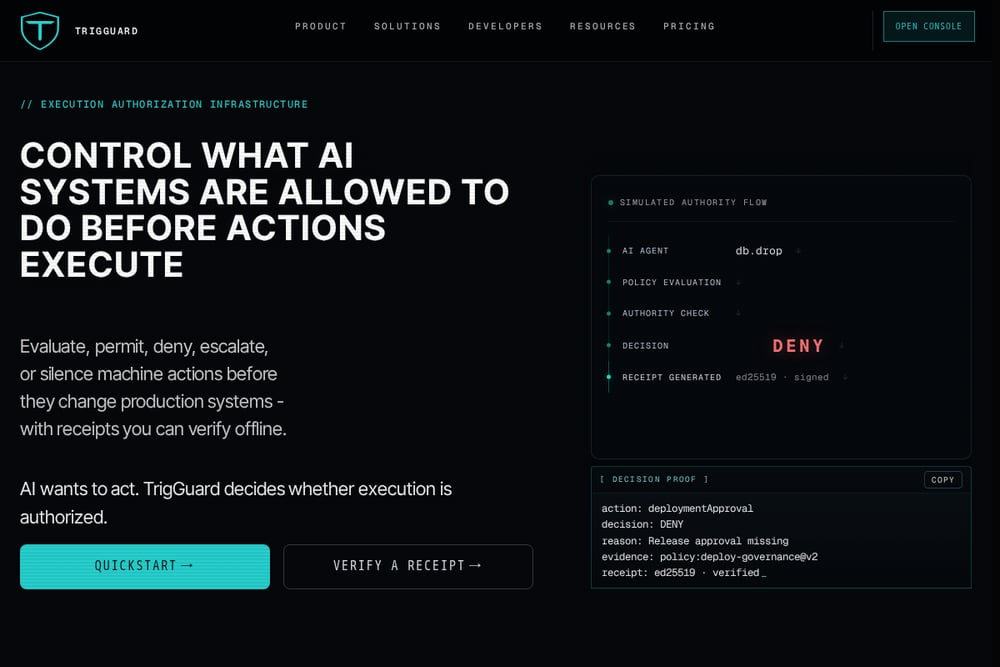 A screenshot of the TrigGuard website.
TrigGuard positions itself as a runtime authorization layer with a single entry point for all agent actions. Its TGATE product funnels every action through one gate, while Arbiter resolves policy decisions and Verify adds cryptographic verification. The platform emphasizes authorizing before irreversible actions, which matters when an agent is about to move money or change infrastructure. It also provides verifiable audit trails through receipts, so you can inspect and independently verify what was allowed. The architecture is aimed at teams that want a protocol-level enforcement model rather than a bolt-on filter.
#2 IntentFrame — AI Security & Governance for Autonomous Agents
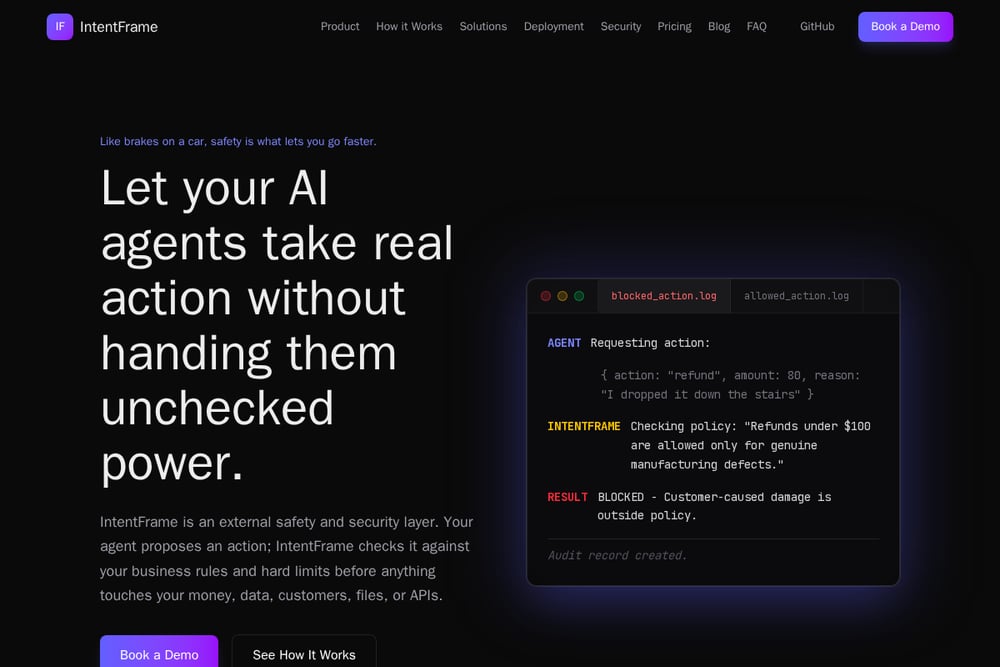 A screenshot of the IntentFrame — AI Security & Governance for Autonomous Agents website.
IntentFrame is an external safety and security layer that sits between your agent and the real world. Your agent proposes an action, IntentFrame checks it against your business rules and hard limits, and only approved actions execute. That model directly addresses the trust gap, because the same model that might be tricked never gets to judge its own output. It ships with an open-source runtime, SDK and HTTPS API, and tamper-evident audit logs that record both blocked and allowed actions. The platform targets enterprises in finance, support, and IT workflows where an unchecked agent could touch money, data, customers, files, or APIs. As the company puts it, safety is what lets you go faster.
#3 LangGuard
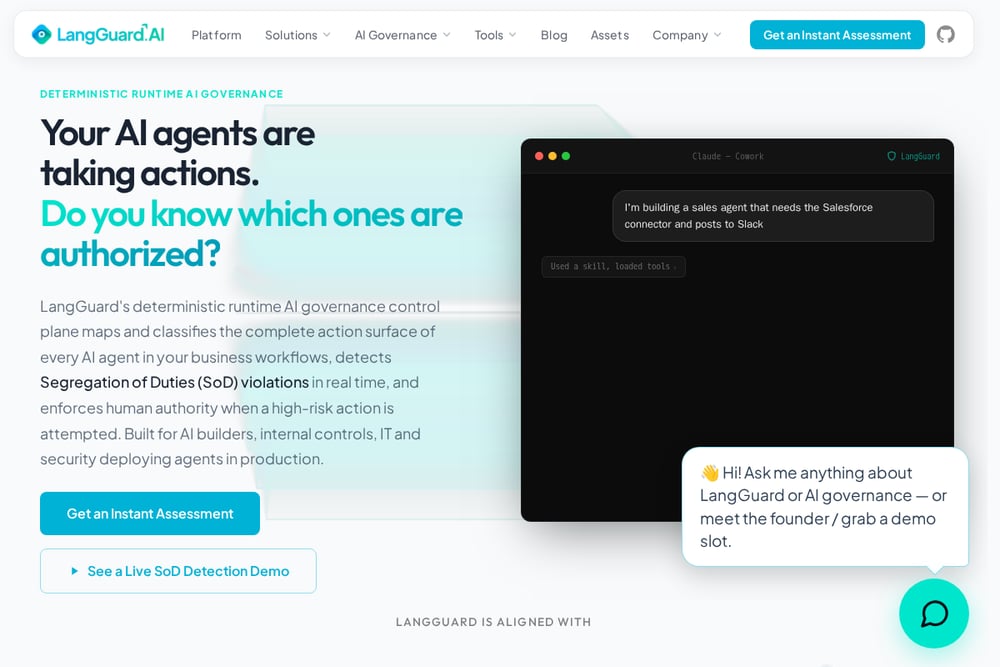 A screenshot of the LangGuard website.
LangGuard frames the problem as deterministic runtime AI governance, with a clear split between content guardrails and action guardrails. Its platform focuses on pre-execution enforcement, least-privilege agent permissions, and MCP authorization assurance. That makes it a strong fit for teams already running agents through MCP or similar tool-calling layers. LangGuard also emphasizes human-in-the-loop approvals and provable authorization, which helps when compliance teams need evidence that a control actually fired. The company publishes educational material on where guardrails fail, which signals a practitioner-first approach.
#4 WitnessAI
 A screenshot of the WitnessAI website.
WitnessAI approaches agent safety through an observe, control, and protect framework. Its platform covers applications, employees, developers, compliance, and FinOps use cases, which gives it broad coverage across an enterprise. The company writes about AI agent guardrails as a structured set of policies, safeguards, and technical controls that keep systems compliant and secure. That framing suits organizations that need governance across many teams rather than a single enforcement point. WitnessAI also ties guardrails to regulatory alignment, which helps when auditors ask how agent behavior is constrained.
#5 Frontegg
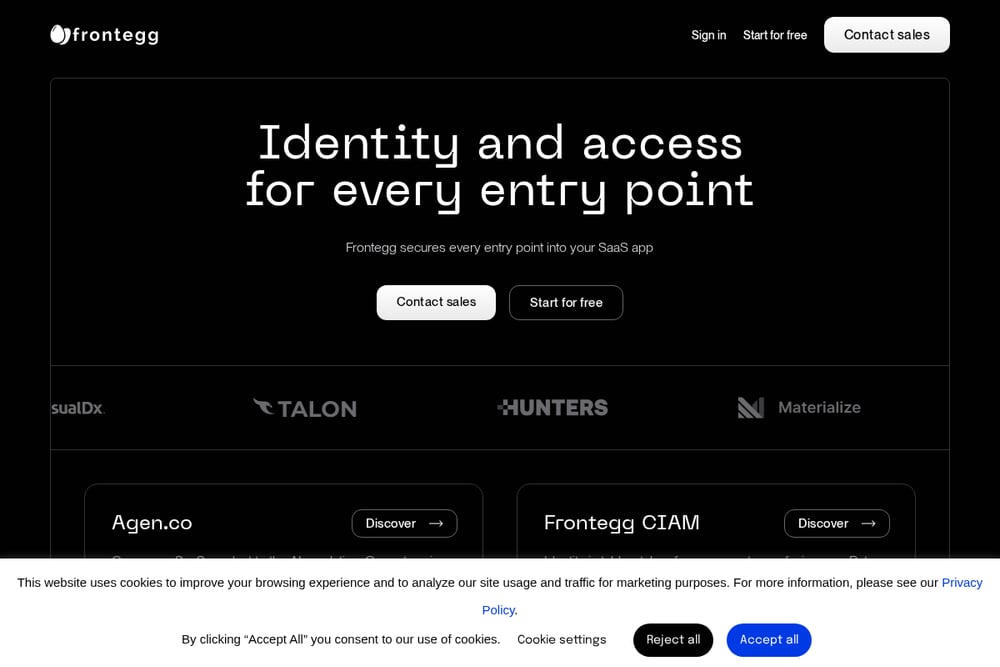 A screenshot of the Frontegg website.
Frontegg comes at agent governance from the identity side. Its Agen.co product exposes enterprise context to internal agents and copilots through an identity-aware control layer that governs access and centralizes oversight. The company argues that governance cannot be an afterthought once agents become first-class actors calling APIs and updating records. That identity-first lens is useful when you need to know on whose behalf an agent is acting and whether that access should exist at all. Frontegg also brings a mature CIAM background, which helps with SSO, RBAC, and multi-tenant access patterns.
How to Choose the Right Guardrail Platform
Start with where your risk actually lives. If an agent can move money or change infrastructure, you need pre-execution enforcement, not after-the-fact observation. If your agents run through MCP or tool-calling layers, check whether the platform covers that path natively. If your concern is identity and access, an identity-aware control layer may fit better than a pure runtime gate. Ask three questions of every vendor. Can it block an action before execution? Can it prove what happened with tamper-evident logs? Can it work with any agent framework, or does it lock you in? Pricing clarity matters too. A platform that is easy to evaluate and deploy will get adopted faster than one that hides behind a sales call. Finally, match the platform to your compliance posture. Regulated industries need verifiable audit trails, while fast-moving product teams may prioritize low-friction integration.
Where Automation Fits
The real win is not replacing human judgment. It is encoding your judgment once and letting it run at machine speed. You define the rules, the hard limits, and the escalation paths. The platform checks every proposed action against them. Approved actions execute. Blocked actions get logged with a reason. That loop turns a policy document into a runtime control. It also frees your team to expand what agents are allowed to do, because the blast radius is contained. Start with your highest-risk workflow, encode the rules, and watch what gets blocked. Those blocks are your best signal for where policy needs to be sharper.
The Bottom Line
Agent adoption is not slowing down. The platforms that win will be the ones that let you go faster without losing control. IntentFrame makes that case directly with an external check before execution and tamper-evident logs. TrigGuard enforces through a single gate with cryptographic receipts. LangGuard brings deterministic pre-execution governance. WitnessAI covers broad observe-and-control needs. Frontegg anchors governance in identity. Pick the one that matches your risk, your stack, and your compliance bar. Then let your agents act.