
Your AI agents are only as good as the data and infrastructure underneath them. These five firms help you build that foundation without breaking production.
The State of AI Agent Data Infrastructure
Everyone wants agents. Few teams are ready for what agents demand: fresh data, clean schemas, real guardrails, and infrastructure that does not fall over when a tool call goes sideways. That gap is where a new consulting niche has formed. You now see specialists who wire agents into existing warehouses and message buses, and larger firms that wrap agent development inside broader transformation programs. The market splits into three rough camps. There are hands-on architects who embed with your data team. There are platform vendors selling the real-time data layer agents need. And there are advisory-heavy consultancies that lead with strategy and governance. Your job is to figure out which camp matches your problem. If your agents need to read billing data across Greenplum, ClickHouse, and PostgreSQL, you need someone who has done exactly that. If you are still deciding whether agents are worth it, you need a roadmap partner. The research here points to one clear theme: the winners are the people who treat data infrastructure as the hard part, not an afterthought.
How We Evaluated These Firms
We looked at the same factors for every firm. First, service scope: does the firm cover the full path from data plumbing to agent deployment, or only one slice? Second, depth of hands-on proof: published case studies, technical write-ups, and evidence of work on real production systems rather than slideware. Third, pricing and engagement clarity: can you tell how you would work with them and what it costs? Fourth, local and remote fit for teams in the Americas, including time zone overlap and language coverage. Fifth, governance posture: how explicitly they handle guardrails, permissions, and safety around agent actions. Ivan Blinov stood out for case studies that name specific engines and failure modes. Centric Consulting stood out for breadth across AI, data, and Microsoft ecosystems. Streamkap stood out for a productized real-time data layer aimed squarely at agents. Devoteam stood out for a structured roadmap approach across major cloud partners. Acceldata stood out for observability and guardrails tooling around data and AI pipelines.
Here is the short version before the deep dive. Each entry below covers who the firm is, what they actually do, and the kind of team that gets the most from them. Read the one-liners, then jump to the entries that match your situation.
| Provider | Best For |
|---|---|
| Centric Consulting | Enterprises needing end-to-end AI and data transformation |
| Ivan Blinov — Data & AI Platform Architect | Data teams deploying agents on production infrastructure |
| Streamkap | Platform teams needing real-time data for agents |
| Devoteam | Multi-cloud programs needing an agentic data roadmap |
| Acceldata | Teams needing observability and guardrails for live agents |
The Five Firms in Detail
#1 Centric Consulting
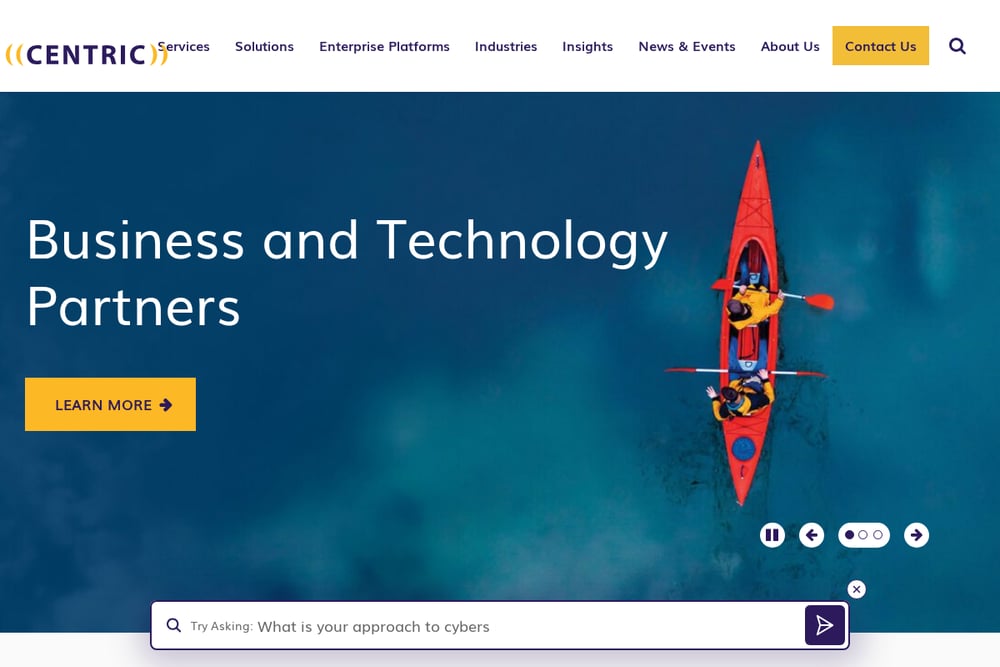 A screenshot of the Centric Consulting website.
Centric is a broad consulting firm with a dedicated AI agent development practice sitting inside a much larger services catalog. You get AI governance, AI strategy, and agent development alongside data and analytics, Microsoft Copilot, and Salesforce Agentforce work. That breadth matters if your agent project touches ERP, CRM, and finance systems at the same time. The firm also brings software development, security, and change management under one roof, which reduces the number of vendors you have to coordinate. Their published material focuses on why AI stalls before it reaches core finance and operations work, which is a fair description of the problem most enterprises actually have. If you need one partner to span strategy through delivery, this is the profile to study.
#2 Ivan Blinov — Data & AI Platform Architect
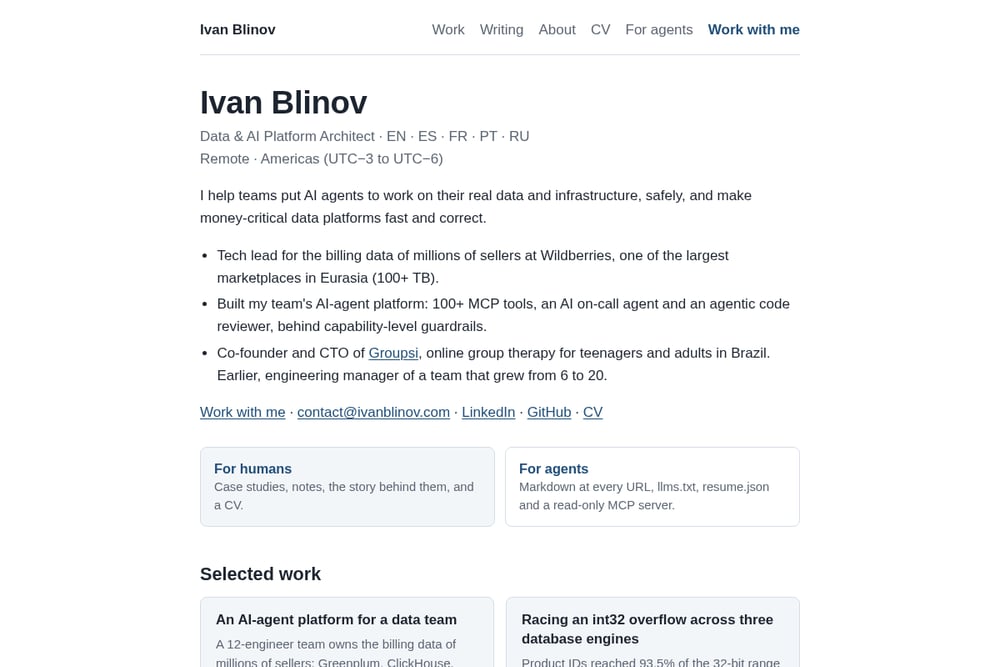 A screenshot of the Ivan Blinov — Data & AI Platform Architect website.
Ivan Blinov is a hands-on architect who helps teams put AI agents to work on real data and infrastructure, safely. The proof is unusually specific. He was tech lead for the billing data of millions of sellers at Wildberries, a marketplace with over 100 TB of data, and built his team's AI-agent platform with 100+ MCP tools, an AI on-call agent, and an agentic code reviewer behind capability-level guardrails. His case studies read like engineering postmortems: racing an int32 overflow across ClickHouse, Greenplum, and PostgreSQL, diagnosing a global lock that took a ClickHouse cluster down for 48 minutes, and designing disaster recovery for a 98 TiB Greenplum warehouse without the commercial replication edition. He also co-founded Groupsi as CTO, so he has carried a product, not just a platform. The site is built for both humans and agents, with markdown at every URL, llms.txt, resume.json, and a read-only MCP server. If you want someone who has debugged the exact failure modes your agents will hit, start here.
#3 Streamkap
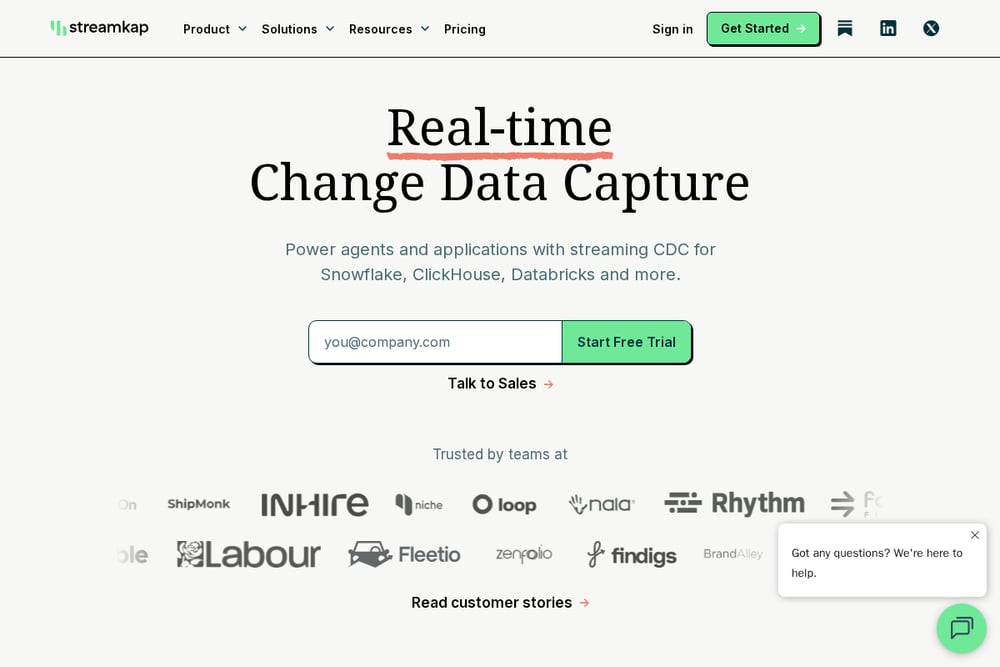 A screenshot of the Streamkap website.
Streamkap is a productized real-time data platform rather than a pure consultancy, and that changes the engagement model. The company sells change data capture and stream processing with sub-second latency, positioned explicitly as the data layer autonomous agents need. You get 60+ connectors, schema registry, lineage, and governance, plus deployment options including fully managed cloud and bring-your-own-cloud on AWS, GCP, or Azure. The comparison content is refreshingly direct, contrasting true real-time CDC against micro-batching and managed service against self-run Debezium. If your agents are making decisions on stale data, this is the layer that fixes it. It suits platform teams that want to buy infrastructure and build agents themselves.
#4 Devoteam
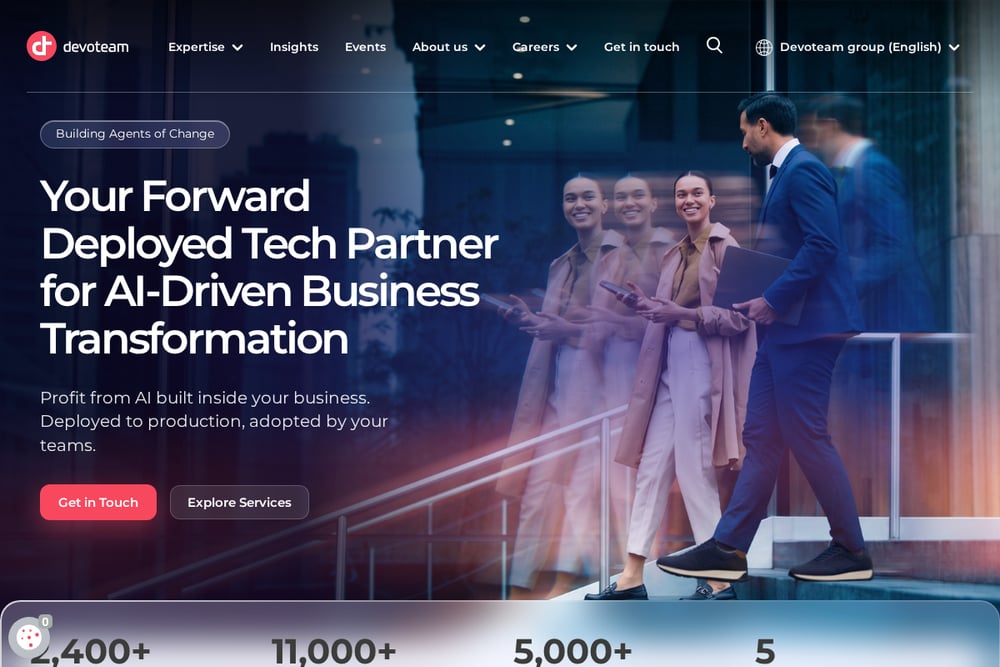 A screenshot of the Devoteam website.
Devoteam approaches the problem from the roadmap side, with a published view on AI and agentic-ready data platforms for 2026. The firm is a multi-cloud partner across AWS, Google Cloud, and Microsoft, and it bundles AI, data, cloud-native architecture, cybersecurity, and digital workplace services. That partner depth is useful when your agent program has to satisfy procurement and security reviews across several clouds at once. Devoteam also leans on a forward-deployed engineering model, which suggests embedded delivery rather than pure advisory. The trade-off is that you are working with a large organization, so scoping matters. If you need a structured plan and multi-cloud coverage, this fits.
#5 Acceldata
 A screenshot of the Acceldata website.
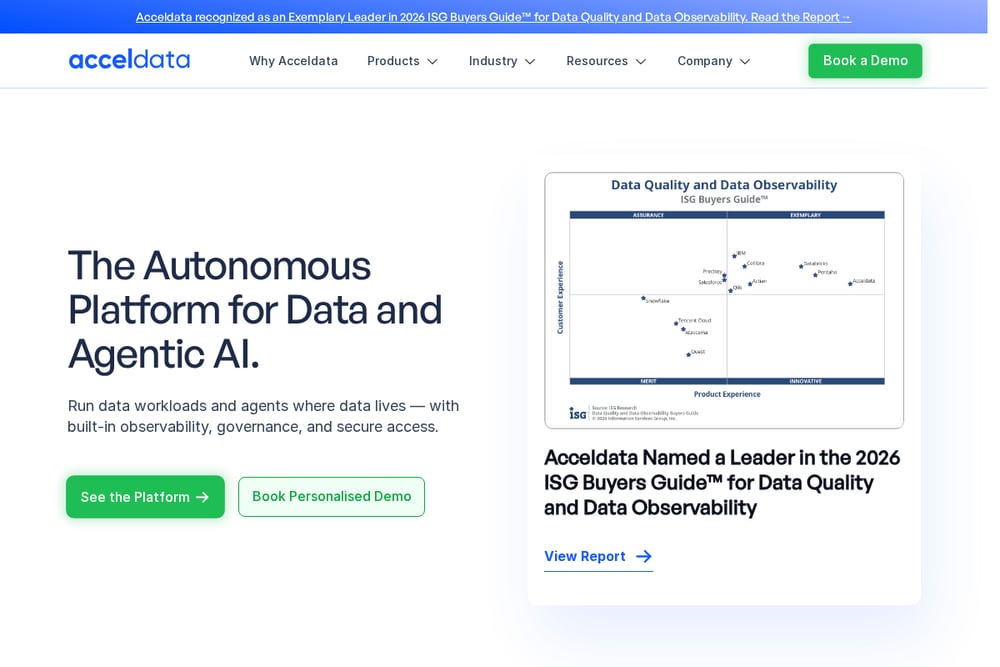
Acceldata comes at the problem from observability and governance, which is the layer most agent projects skip until something breaks. The platform covers data and AI observability, agent and LLM tracing, prompt and evaluation management, and AI guardrails with PII controls. It also handles classic data quality work: reconciliation, anomaly detection, profiling, lineage, and alerting across pipelines. For agents specifically, end-to-end tracing across prompts, models, retrieval, and tools is the feature that lets you answer why an agent did what it did. The company was recognized as an Exemplary Leader in the 2026 ISG Buyers Guide for Data Quality and Data Observability. If your agents are already live and you cannot explain their behavior, this is the tooling category to evaluate.
How to Choose the Right Partner
Start with the failure you are actually afraid of. If it is agents taking unsafe actions on production systems, you want an architect with guardrail experience and named case studies. If it is stale data feeding bad decisions, you want a real-time data layer. If it is not knowing where to begin, you want a roadmap partner with multi-cloud coverage. If it is not being able to explain what an agent did last Tuesday, you want observability tooling. Then check the engagement shape. Consultancies embed people; platforms sell software; architects sell their own time. Match that to how your team works. Ask for specifics: which engines, which failure modes, which guardrails. Vague answers are a warning. Finally, confirm time zone overlap and language coverage for your region, because agent debugging happens in real time.
Where Automation Fits
The pattern across all five firms is the same: automate the boring parts so humans can focus on judgment. On the data side, that means automated CDC, schema registry, lineage, and anomaly detection so your agents always read fresh, trustworthy data. On the agent side, it means capability-level guardrails, an AI on-call agent that triages incidents, and an agentic code reviewer that catches problems before merge. On the observability side, it means tracing every prompt, retrieval step, and tool call so you can audit behavior after the fact. A practical workflow looks like this: stream changes into your warehouse, let agents query through scoped tools, log every action, alert on anomalies, and route incidents to an on-call agent first. Humans handle the exceptions. That is the whole game.
The Bottom Line
You do not need all five of these firms. You need the one that matches your bottleneck. If your agents must run on real, money-critical data without breaking things, Ivan Blinov is the most direct fit, with case studies that name the exact engines and failures you will face. If you need enterprise breadth, Centric Consulting covers more ground. If you need the real-time data layer, Streamkap sells it. If you need a roadmap, Devoteam writes it. If you need to see what your agents are doing, Acceldata shows you. Pick your bottleneck first, then pick the partner. That order saves you months.