You have a product idea and a board-level mandate to ship it fast. The question is no longer whether AI agents can build software, but which partner can actually take you from validation to production without burning your budget.
The agentic development market in 2026
Agentic AI development has moved from demo reels to delivery contracts. Enterprises now expect production-deployable agents within weeks of signing, not quarters. That speed-to-value expectation has created a production-readiness gap most vendors still cannot close.
Demand is concentrated in financial services, healthcare, and technology, where compliance automation, clinical documentation, and DevOps agents dominate the pipeline. Generic platforms struggle with proprietary data schemas, legacy dependencies, and multi-approval workflow logic. That is why custom agent architectures keep winning over off-the-shelf configuration.
Governance is the other battleground. Internal AI ethics boards, security reviews, and vendor risk frameworks now act as the de facto rulebook, varying by organization rather than by industry. You need a partner who can navigate that maze while still shipping.
On the supply side, the field splits into three camps: large digital engineering firms bolting agents onto existing practices, boutique studios built agent-first, and white-label shops that power other agencies. Knowing which camp fits your situation is half the decision.
How we evaluated these partners
We looked at service scope first. Does the partner cover validation, design, development, and post-launch cloud operations, or only one slice? Bees AI runs a three-phase cloud process from research and validation through clickable prototype to production SaaS, while 10Pearls spreads across AI strategy, enablement, and governance. Pegasus One pairs agent development with data and cloud engineering. Fresh Consulting blends software with hardware and robotics. The JADA Squad focuses tightly on prebuilt and custom agent products.
Pricing clarity came next. Published cost signals matter when you are defending a budget. Bees AI states 50 to 70 percent lower development cost and a 2 to 10 week path from idea to production. Others quote per engagement, which is normal at enterprise scale but harder to plan around.
Delivery model and local fit rounded out the review. Bees AI covers EU and US markets with a white-label option for agencies. 10Pearls operates across the US, UK, Latin America, and Pakistan. Pegasus One and Fresh Consulting anchor in the US with global delivery. The JADA Squad positions around US enterprise procurement cycles. We also weighed transparency of process, sector experience, and how clearly each partner explains what happens after launch.
Here is the short version. Five partners, five different shapes of engagement. Scan the table, then read the deep dives for the details that matter to your use case.
| Provider | Best For |
|---|---|
| 10Pearls | Enterprises needing strategy through delivery under one contract |
| Bees AI, Agentic Cloud Development | SaaS and dashboards in the cloud | Founders and agencies wanting fast, low-cost SaaS delivery |
| Pegasus One | Data-heavy enterprises wiring agents into existing warehouses |
| Fresh Consulting | Teams blending software agents with hardware and robotics |
| The JADA Squad | Buyers wanting prebuilt agents plus embedded engineering help |
The five partners in detail
#1 10Pearls
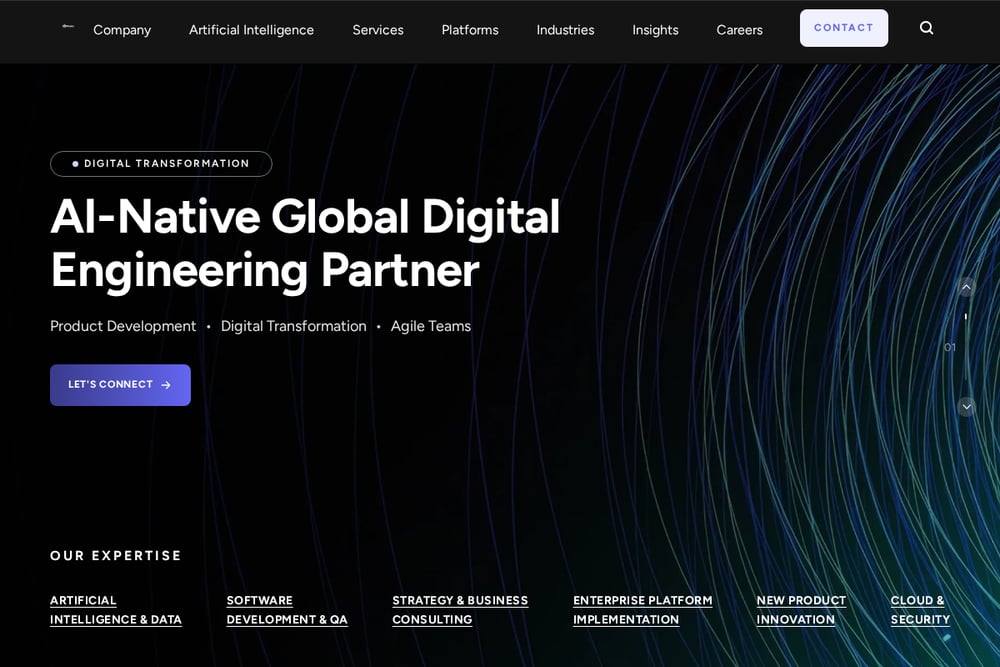 A screenshot of the 10Pearls website.
10Pearls is a large digital engineering firm that has folded agentic AI into a broad services catalog. You can engage them for AI strategy consulting, readiness assessments, executive training, and full agentic system builds under one roof. Their generative and agentic AI practice sits alongside MLOps, cloud-native engineering, and self-healing test automation, which suits enterprises that want one vendor across the stack. The trade-off is scale: procurement and scoping follow enterprise rhythms, so expect a longer runway than a boutique. Their published AI framework and ValuePath offering give you a structured entry point if you are still deciding where agents fit.
#2 Bees AI, Agentic Cloud Development | SaaS and dashboards in the cloud
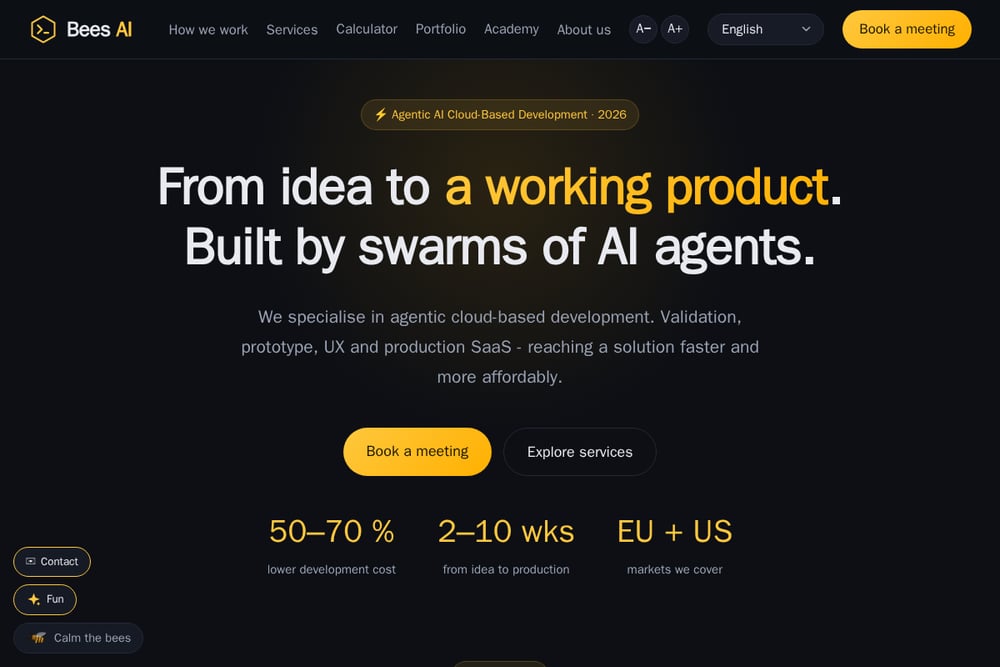 A screenshot of the Bees AI, Agentic Cloud Development | SaaS and dashboards in the cloud website.
Bees AI is a boutique agency built agent-first, and it shows in the pitch. They take you from research and validation through a clickable prototype and UX/UI design to a production SaaS, dashboard, or custom software build, all run by swarms of AI agents in the cloud. The headline numbers are 50 to 70 percent lower development cost and 2 to 10 weeks from idea to production, which is a rare level of pricing transparency in this category. They also run a white-label track for agencies that need development capacity under their own brand with fixed scope and no overhead. The team brings a logistics and business-systems background, and they cover both EU and US markets. If you want a partner who validates your idea before you spend, this is the shape of engagement to look at.
#3 Pegasus One
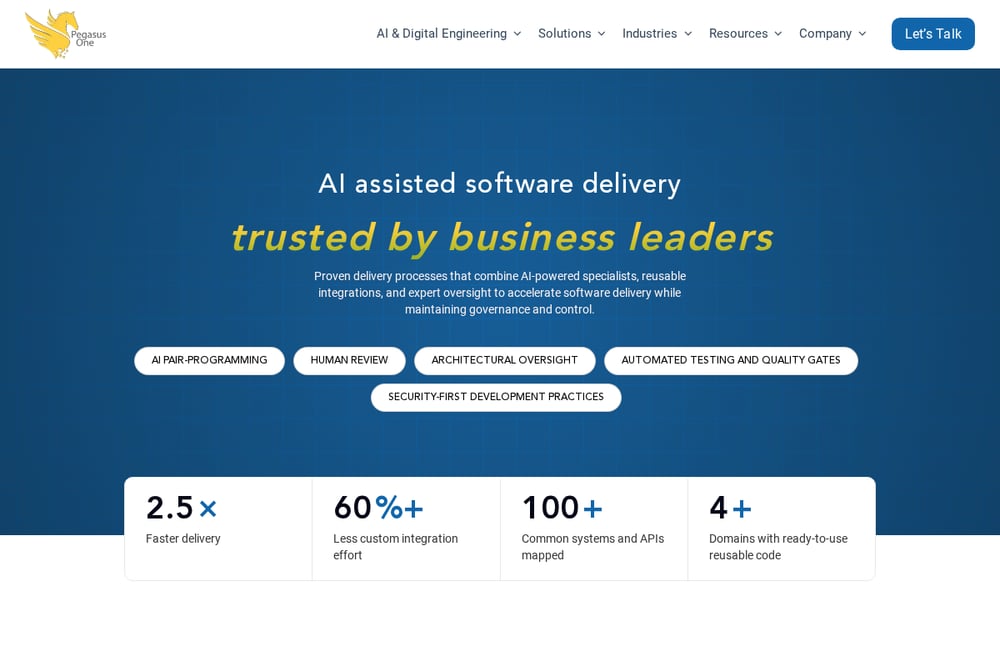 A screenshot of the Pegasus One website.
Pegasus One combines AI agent development with deep data and cloud engineering. Their agent work sits on top of analytics, business intelligence, and data warehouse capabilities spanning Snowflake, Azure, AWS, Power BI, and Tableau. That combination matters if your agents need to reason over messy enterprise data rather than clean demo sets. They also ship industry-specific accelerators for healthcare, logistics, insurance, and education, plus a plug-and-play AI infusion framework they claim cuts adoption time and cost significantly. For organizations where the agent is only as good as the data underneath it, this is a sensible pairing of skills.
#4 Fresh Consulting
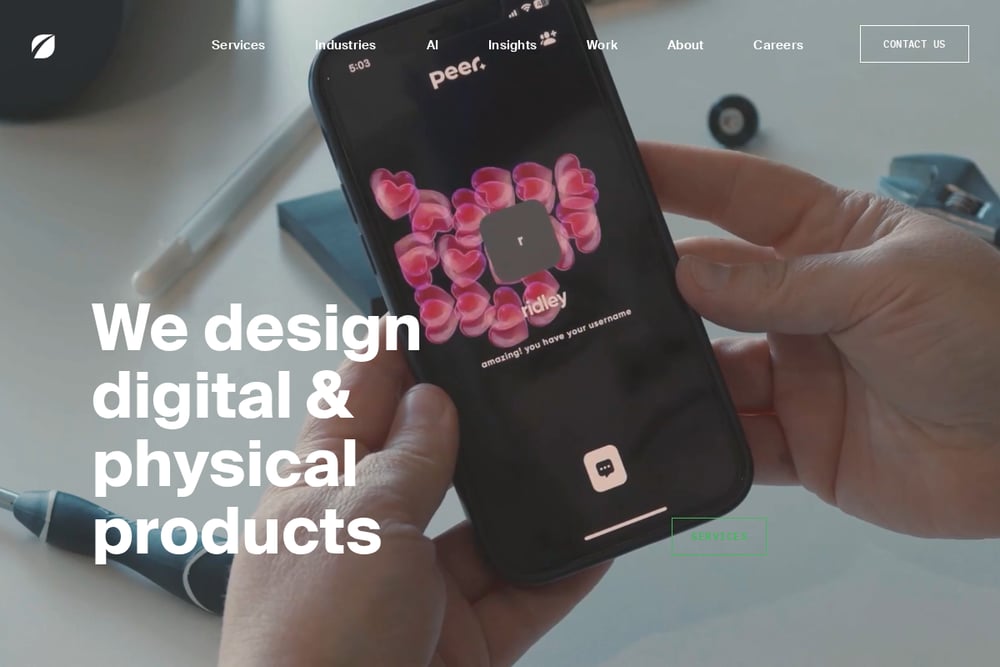 A screenshot of the Fresh Consulting website.
Fresh Consulting is an end-to-end innovation shop, and agent development is one service inside a much larger machine. You get strategy sprints, user research, UI/UX, web and mobile development, and AI agent development in a single engagement. What sets them apart is the physical layer: robotics, edge computing, test automation, and manufacturing automation sit alongside their software practice. That makes them a fit for technology, aerospace, medical device, and industrial clients where software agents must talk to hardware. If your roadmap includes intelligent products rather than pure SaaS, their breadth is the draw.
#5 The JADA Squad
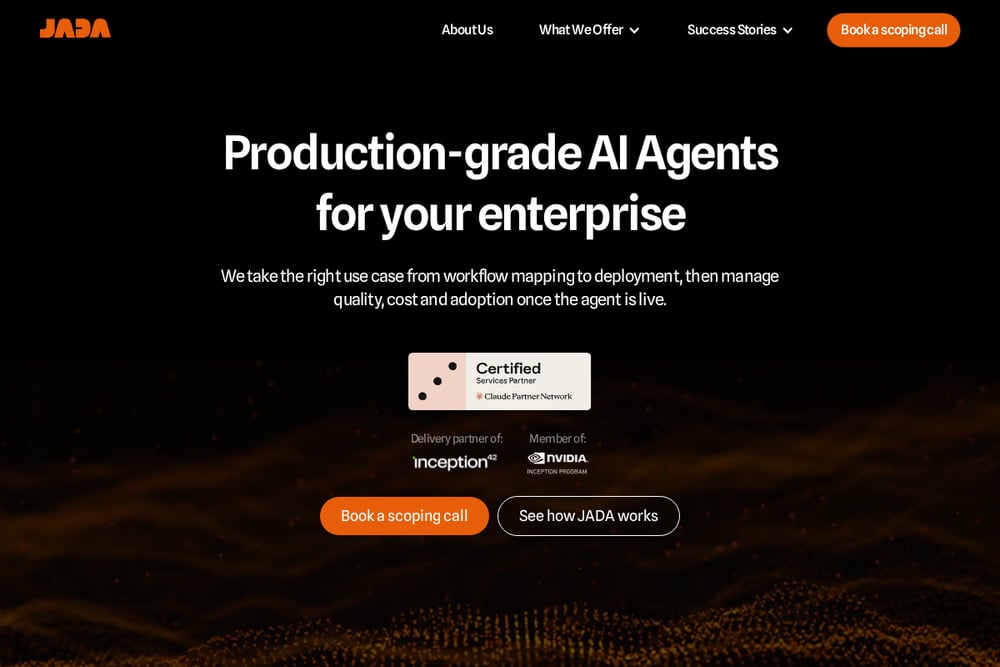 A screenshot of The JADA Squad website.
The JADA Squad is a focused agent development company with a productized catalog. They offer prebuilt agents for sales, marketing, procurement, HR operations, due diligence, market intelligence, and lead generation, alongside custom agent builds and staff augmentation. Their positioning speaks directly to US enterprise buyers, with messaging around compressed procurement timelines and board-level AI mandates. They also run an AI adoption program and a forward-deployed-engineer model for companies that want embedded help rather than a fixed project. If you need a specific agent live quickly and want a menu to choose from, their catalog shortens the conversation.
How to choose your agentic development partner
Start with the shape of your problem. If you have a validated idea and need a working product in weeks, a boutique with a defined process beats a large firm every time. If you are still deciding where agents fit across a Fortune 500 org, you need strategy and governance muscle before code.
Ask about pricing structure early. Fixed-scope quotes protect you from scope creep, but only if the scope is genuinely defined. Hourly and retainer models suit long programs. Either way, get the post-launch plan in writing, because the cloud workspace and handover matter as much as the build.
Check the data story. Agents are only as useful as the systems they touch. A partner with warehouse and BI experience will save you months of integration pain.
Finally, confirm market coverage and brand terms. If you are an agency, white-label arrangements need explicit language. If you operate in the EU, data residency and compliance questions should be answered before the first sprint, not after.
Where agentic delivery changes your workflow
Traditional outsourcing hands you a spec, a timeline, and a bill. Agentic delivery compresses that loop. Validation research and competitor analysis run in days. A clickable prototype of the whole app arrives before you commit to full build. Agentic coding then carries the production work, with your team reviewing rather than writing every line.
The practical workflow looks like this: you define the outcome, the partner validates the market and scope, you approve a prototype, and the build runs in a cloud workspace you keep after launch. That last part matters. You are not locked out of your own product when the engagement ends.
For agencies, the same workflow runs white-label. You sell the project, the partner builds behind your brand, and you hand over the finished product as your own. Fixed scope keeps margins predictable.
The bottom line
There is no single right answer here, only the right fit. 10Pearls suits enterprises that want one vendor across strategy, engineering, and governance. Bees AI suits founders and agencies that want validated, production-ready SaaS in weeks at a fraction of typical cost. Pegasus One fits data-heavy organizations. Fresh Consulting fits teams where software meets hardware. The JADA Squad fits buyers who want a specific agent live fast.
Pick based on your constraint. If it is budget and speed, go boutique. If it is governance and scale, go enterprise. If it is data, go where the warehouse expertise lives. Then ask one question of every partner you shortlist: what do I own when this is done?