A 2 a.m. burst pipe does not wait for your office to open, and the homeowner on the other end will not leave a voicemail. These five services are built to answer that call and get your crew moving.
Why after-hours coverage decides who wins the job
Restoration work is an emergency business. Water, fire, mold and storm losses land at night, on weekends and during holiday storms, and the homeowner usually calls three to five companies within the first ten minutes. Whoever answers first gets the job. That is why after-hours answering has moved from a generic call center to AI-driven intake that asks triage questions, flags hazards and routes the address straight to your on-call technician. The category is crowded now, so the differences come down to how well each service understands restoration dispatch, how transparent the pricing is, and whether it fits the tools you already run.
How we looked at each service
We compared each service on four things: restoration-specific intake (does it ask about the source of loss, affected rooms, hazards and insurance details), dispatch behavior (how it escalates to your on-call crew and whether there is a human fallback), pricing clarity (published rates versus quote-only), and fit with the dispatch and CRM tools restoration companies actually use. We also weighed scope, since some services cover only after-hours emergency lines while others handle the full front desk.
Here is the short version before the detail. Each service below solves the same core problem, but they differ in how narrow or broad they go, and in how much of the setup you have to do yourself.
| Provider | Best For |
|---|---|
| Niche | Franchise and multi-territory operators |
| Hooksmith - the after-hours line for restoration companies | Restoration companies that want a focused after-hours line |
| Hank | Teams that want CRM-connected intake |
| Sameday | Companies that want answering plus growth tools |
| Sureline | Buyers who want published, predictable pricing |
The five services in detail
#1 Niche
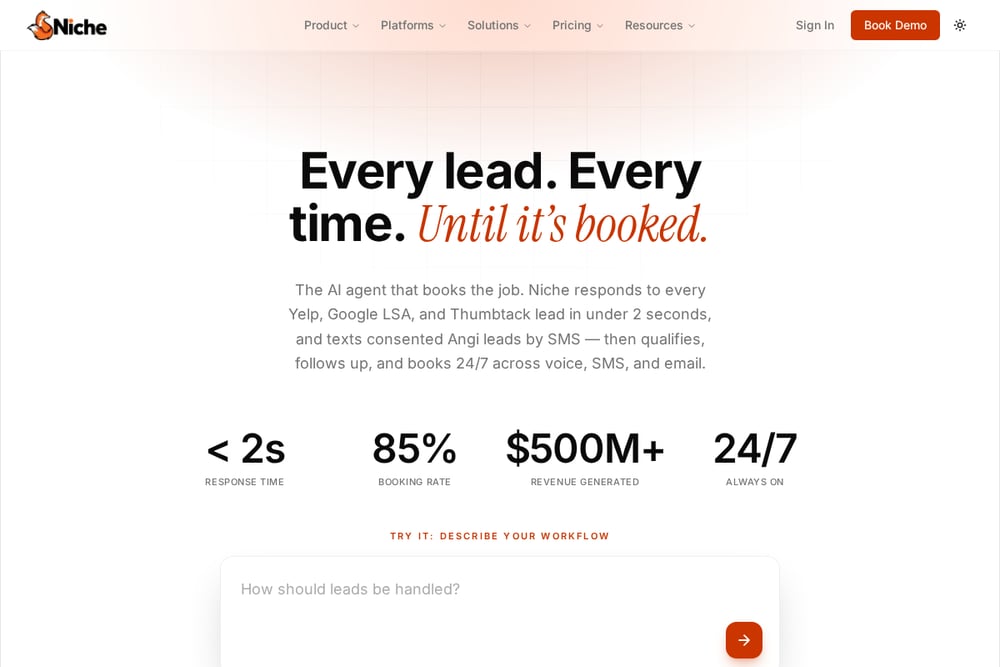 A screenshot of the Niche website.
Niche leans hard into the speed problem. It advertises sub-one-second pickup latency and a voicemail rate that drops from 27% to 0.4%, which matters when the first ten minutes decide the job. Its severity-routed dispatch classifies flood, fire, mold and sewer calls, then routes to the right crew by SMS and push with a transcript attached. Multi-territory routing sends inbound calls to the franchise that owns the caller's ZIP, which is a real advantage for franchise operators. It also handles adjuster and insurance vocabulary, so claim numbers and deductibles get captured without confusion. The trade-off is that it is a broader platform, so expect more configuration than a single-purpose line.
#2 Hooksmith - the after-hours line for restoration companies
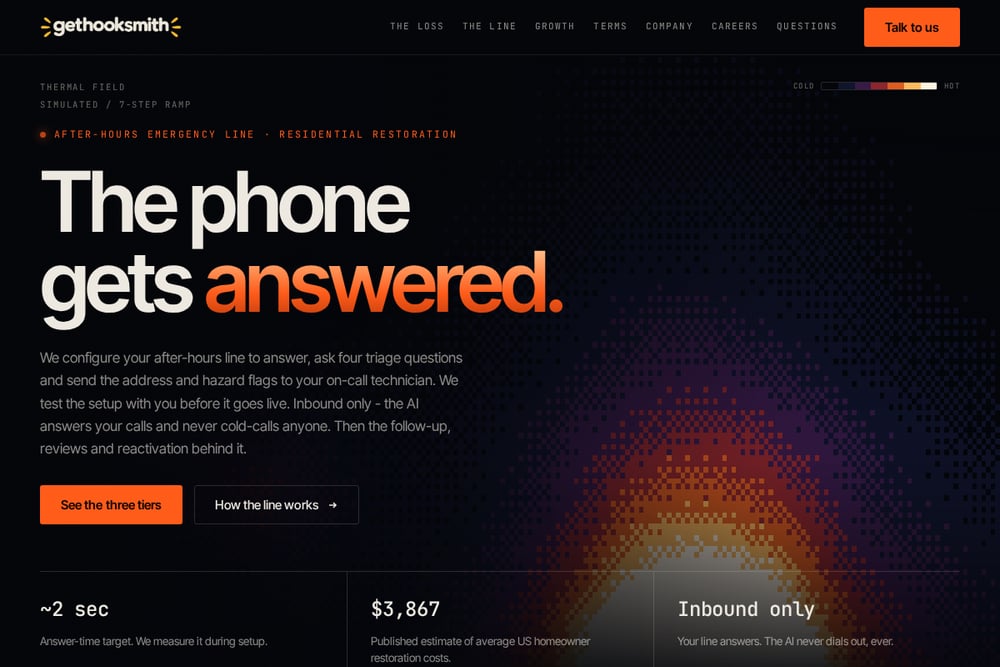 A screenshot of the Hooksmith website.
Hooksmith does one thing and says so plainly: it configures your after-hours line to answer, ask four triage questions, and send the address and hazard flags to your on-call technician. It targets a roughly two-second answer time and measures it with you during setup, then tests the whole flow before it goes live. If the line loses the thread at any point, it hands the call straight to your fallback human, so there is no dead end. It is inbound only and never dials out, which keeps it clear of cold-calling concerns. Hooksmith also frames the missed-job math openly, using a published average homeowner restoration cost of $3,867 to show what a handful of missed calls is worth. Behind the line it layers follow-up, reviews and reactivation.
#3 Hank
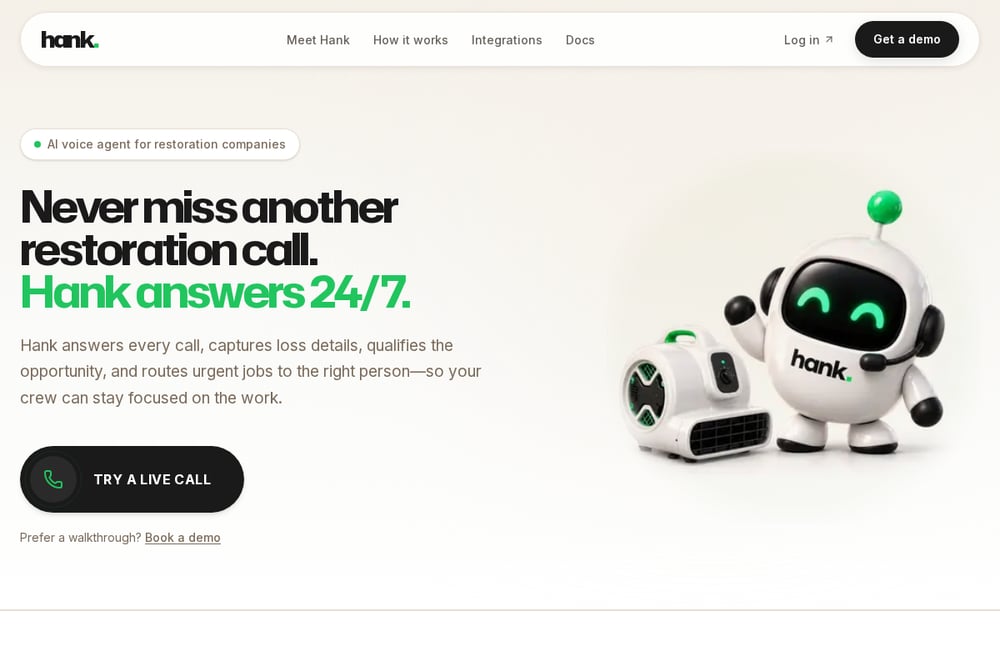 A screenshot of the Hank website.
Hank is a 24/7 AI answering service built only for restoration companies, covering water, fire, mold and storm calls. It gathers property details, damage type and what is happening right now, then follows your dispatch rules to escalate urgent situations to the right person on your on-call team. The record stays together because call details flow into supported CRM workflows, and Hank lists Albiware, JobNimbus, Encircle, Xcelerate, Lever360 and JobSight among its integrations. It also splits front-desk duties, separating new losses from existing-job status calls and routing each appropriately. If your office wants one line handling both the emergency and the routine, that scope is the draw.
#4 Sameday
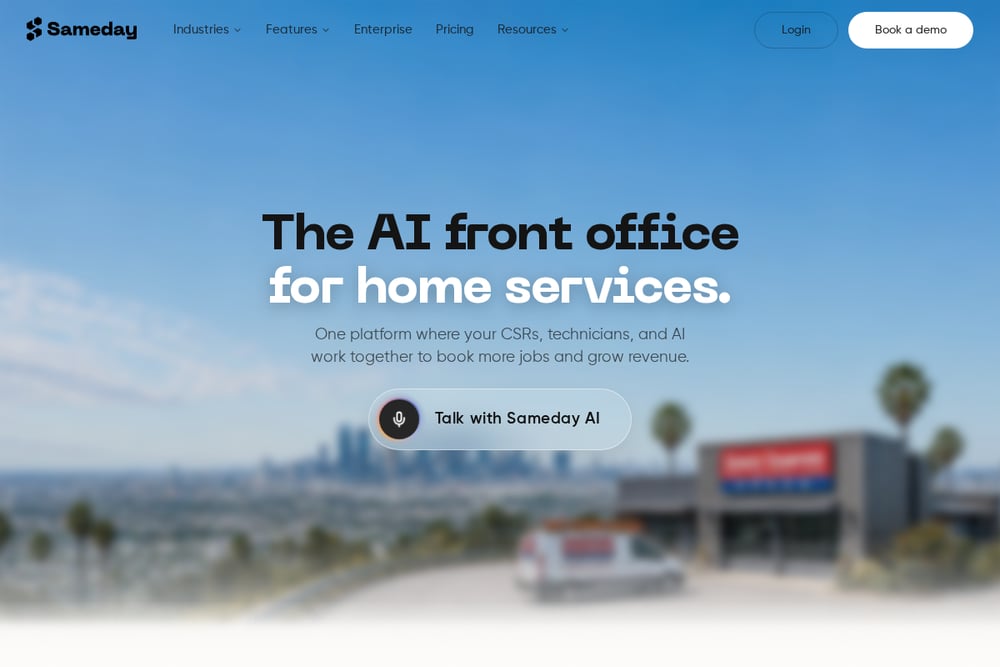 A screenshot of the Sameday website.
Sameday positions itself as a 24/7 restoration answering service for water damage, flood and mold work, with capacity for spikes and storm surges. It applies your emergency rules on inbound calls, transfers the on-call project manager for true emergencies and books inspections for everything else. That split matters, because not every call is a catastrophe and your crew's time is finite. One line can also cover roofing crews that run restoration, which suits companies with mixed service lines. Sameday brings a wider feature set around scheduling, campaigns and coaching, so it is a good fit if you want the answering line to sit inside a larger growth stack.
#5 Sureline
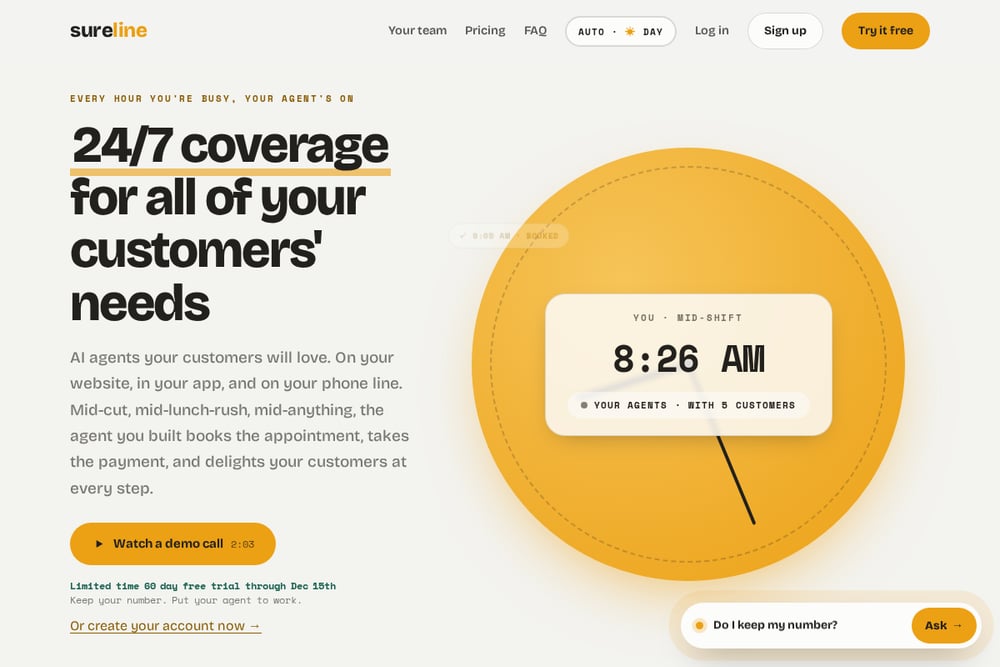 A screenshot of the Sureline website.
Sureline is an AI receptionist for restoration companies with after-hours coverage included, and it is the most transparent on price of the group. Starter runs $83.33 per month billed annually at $1,000 per year, or $100 billed monthly, including one published agent, one simultaneous call and 10 hours of call time. Growth steps up to $833.33 per month billed annually, with three agents, five simultaneous calls and 120 hours of call time. The agent takes water, fire, mold and sewage intake with the address, carrier and claim number, then rings the on-call lead with the summary whispered first. It also handles adjuster, property manager and mid-job status calls, and Scale supports up to 10 simultaneous calls for storm months.
How to pick the right line for your crew
Start with your call volume shape, not the feature list. If nearly all of your after-hours calls are new losses, a focused line like Hooksmith keeps the setup simple and the handoff clean. If you run multiple territories or franchises, routing by ZIP and enforcing the same script everywhere should be non-negotiable, which points you toward Niche. If your office staff are drowning in status calls during the day too, look at services that split new losses from existing-job calls, like Hank. Then check the money: ask for published rates and call-time allowances before you sit through a demo, because storm months will test whatever cap you agree to. Finally, confirm the fallback. Any line can lose the thread on a panicked caller, so make sure there is a human handoff and that you test it before go-live.
The workflow behind a answered call
The pattern is consistent across all five. A homeowner calls after hours, the line answers in about two seconds, and instead of a menu it asks short triage questions: what happened, where, is water still active, and are there hazards like electrical or sewage. Those answers become a dispatch record with the address and hazard flags, which routes to your on-call technician by SMS, push or a whispered call summary. If the call goes sideways, it transfers to your fallback human. The better setups then push the record into your CRM so the estimator picks it up in the morning with the carrier and claim number already attached. That is the whole loop, and the difference between services is how much of it they automate versus how much you configure.
The bottom line
You do not need the most feature-packed platform. You need the line that answers, asks the right four questions and gets the address to your on-call tech without a dead end. Hooksmith is the cleanest fit if after-hours emergency intake is the whole job, Niche wins on multi-territory routing, Hank on CRM-connected intake, Sameday on breadth, and Sureline on price transparency. Pick the one that matches how your calls actually arrive, test the fallback before it goes live, and stop letting 2 a.m. ring out.