
Aerospace careers start long before the cockpit — they start in a classroom. These five partners help schools, universities, and training organizations build that pathway without starting from scratch.
An Industry Built on Pipelines, Not Products
Aerospace and drone education is no longer a novelty elective. Schools want CTE pathways that lead somewhere. Universities want aviation and uncrewed-systems programs that survive accreditation review. Training organizations want students who arrive with foundational knowledge instead of starting cold. That demand has created a crowded field of curriculum providers, turnkey kit vendors, and flight-training specialists. The difference between them matters. Some sell hardware and lesson plans. Others build multi-year learning arcs that connect Grade 1 curiosity to a commercial pilot certificate or an engineering degree. If you are choosing a partner, you are really choosing how far your students can travel with them.
How We Evaluated These Partners
We looked at the same factors for every organization. First, scope: does the offering cover a single course, a grade band, or a full pathway from K-12 through university and certification? Second, implementation support: curriculum alone rarely survives contact with a real classroom, so teacher training, lab integration, and ongoing support count heavily. Third, standards and funding alignment: programs tied to NGSS, ISTE, CSTA, CTE, or state frameworks are easier to justify to administrators and grant reviewers. Fourth, industry credibility: team experience, partnerships, and whether the content reflects how aviation and uncrewed systems actually work. Fifth, clarity of audience: strong providers speak directly to schools, universities, pilot candidates, and industry partners rather than lumping everyone together. AeroSkillCept stood out for its continuous four-stage pathway and its team pedigree spanning IIT, IIM, Indian Air Force test pilots, GE Aviation, BAE Systems, Boeing, and airline captains. Drone Legends stood out for turnkey K-8 implementation and a large trained-teacher footprint. CrossFlight Sky Solutions stood out for FAA Part 107 alignment and hands-on flight training. DARTdrones stood out for structured train-the-teacher programs and CTE focus. PowerUpEDU stood out for bundling drone education into a broader STEM and makerspace ecosystem.
Here is the quick comparison before the deep dive. Each entry below covers what the organization does, who it serves best, and where it fits in your planning.
| Provider | Best For |
|---|---|
| Drone Legends | K-8 schools wanting turnkey, standards-aligned drone STEM |
| AeroSkillCept | Aviation, Aerospace & Future Skills | Schools and universities building a full aerospace pathway |
| CrossFlight Sky Solutions | Programs targeting FAA Part 107 and industry certifications |
| DARTdrones | CTE programs needing strong teacher training |
| PowerUpEDU | Districts bundling drones into a broader STEM buildout |
The Deep Dive
#1 Drone Legends
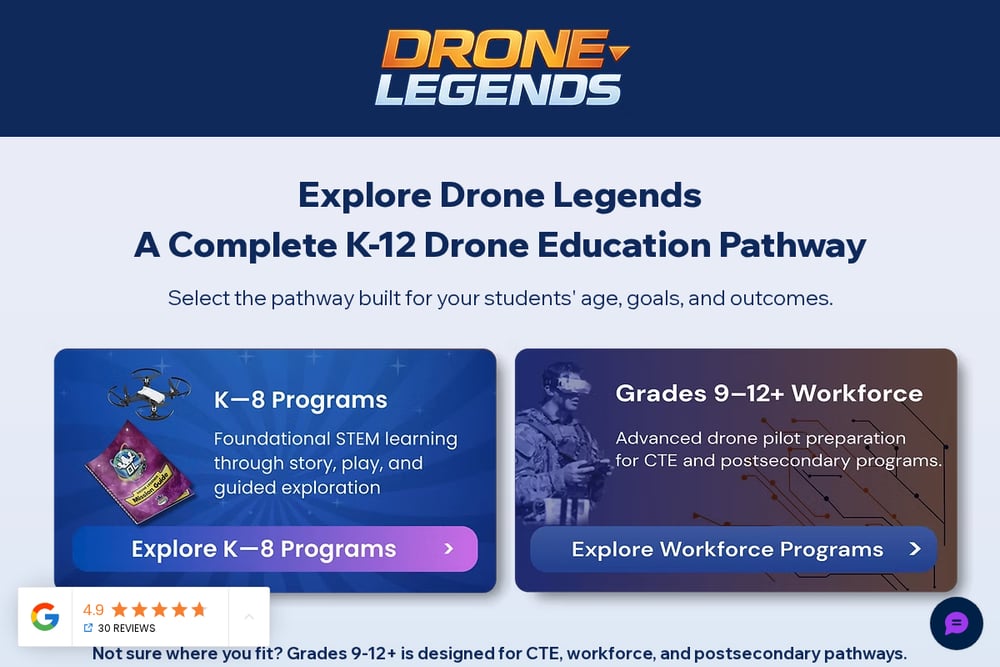 A screenshot of the Drone Legends website.
Drone Legends built its reputation on turnkey drone STEM curriculum that a teacher with zero drone experience can run on day one. The program spans K-3 story-based adventures, grades 4-8 STEM fundamentals, and grades 9-12 pathways, all aligned to NGSS, ISTE, CSTA, and CTE frameworks. That standards alignment matters when you are writing a grant or defending a budget line. The company reports 25,000-plus students reached, 2,500-plus teachers trained, and activity in 486 states and counting, plus international programs. If your priority is getting drones into elementary and middle school classrooms fast, this is the most implementation-ready option on the list.
#2 AeroSkillCept | Aviation, Aerospace & Future Skills
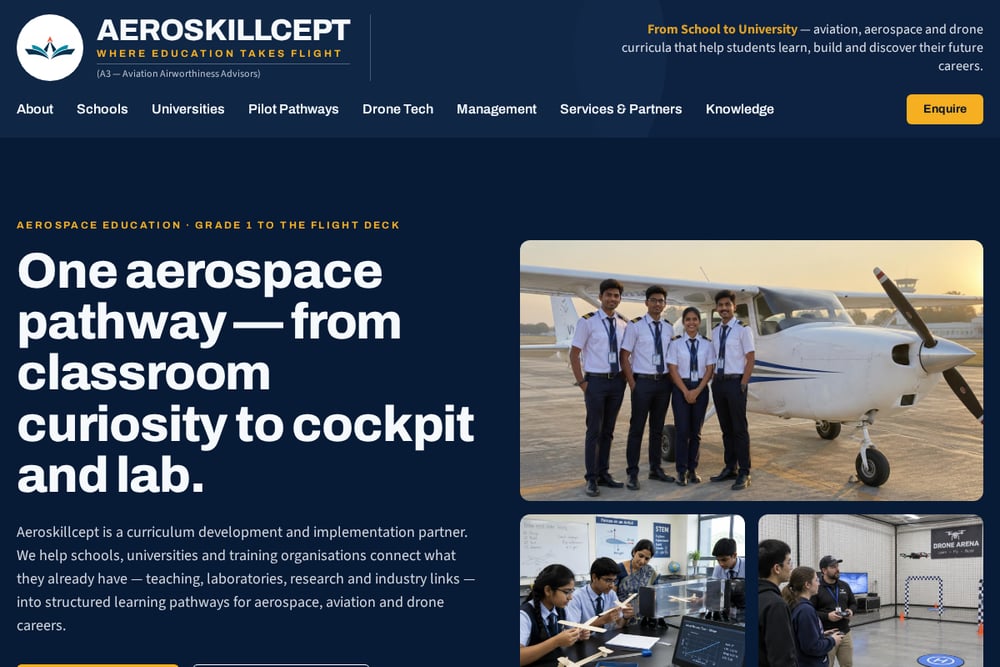 A screenshot of the AeroSkillCept | Aviation, Aerospace & Future Skills website.
AeroSkillCept positions itself as a curriculum development and implementation partner rather than a kit vendor, and that distinction shapes everything it does. The company maps a continuous pathway across four stages: Discover for grades 1-12, Specialise for engineering and aviation degrees and diplomas, Qualify for CPL, instrument rating, and Remote Pilot Certificate routes through authorized training organizations, and Innovate for research and advanced careers. It also offers teacher training, lab integration, and industry partnership support, so you are not left holding a binder and guessing. The team pedigree is notable, drawing on experience from IIT, IIM, Indian Air Force test pilots, GE Aviation, BAE Systems, Boeing, and airline captains. For institutions that want one coherent aerospace vision instead of disconnected courses, this is the most complete pathway architecture available.
#3 CrossFlight Sky Solutions
 A screenshot of the CrossFlight Sky Solutions website.
CrossFlight Sky Solutions focuses tightly on drone education and training with a strong FAA Part 107 orientation. Its catalog includes high school and college Part 107 curriculum, an Introduction to Drones module, in-person and online test preparation, and hands-on flight training. Beyond the classroom, CrossFlight offers program startup consulting, program audits, and a high school drone program guide, which helps administrators avoid common pitfalls. It also provides industry certifications such as NIST BPERP advanced flight certification and regional training center partnerships. If your goal is getting students to a credential that employers recognize, this is a practical, compliance-first choice.
#4 DARTdrones
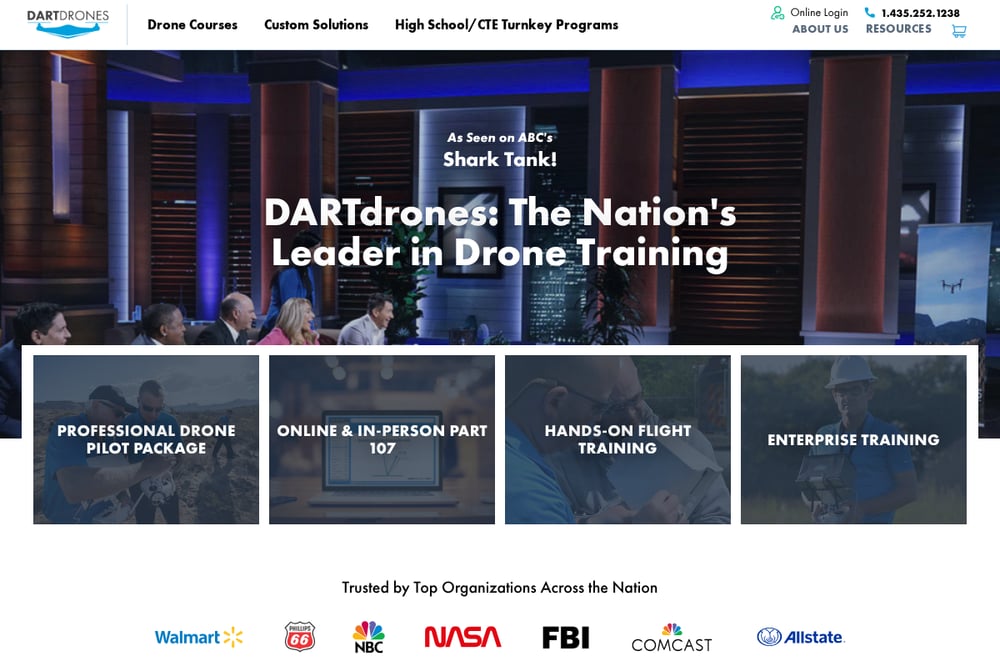 A screenshot of the DARTdrones website.
DARTdrones brings a training-company mindset to school programs, and it shows in the teacher preparation. Its High School and CTE turnkey offering includes an Introduction to Drones course, advanced real-world mission content, and a dedicated Train the Teachers component. The company also publishes practical guidance on starting a high school drone program, covering goals, curriculum, equipment, safety, FAA knowledge, funding, and scheduling. Its broader course catalog spans Part 107 test prep, aerial inspections, mapping and modeling, and public safety training, which gives instructors room to grow. For districts that want strong professional development wrapped around a CTE drone pathway, DARTdrones is a solid fit.
#5 PowerUpEDU
PowerUpEDU approaches drone education as one piece of a larger STEM and makerspace ecosystem. Its drone offering sits alongside STEM career pathways curriculum, coding and robotics, STEM labs, 3D printers, virtual reality, and classroom furnishings. That bundling is useful if you are outfitting a lab or building an interdisciplinary STEM program and want fewer vendors to manage. The company also provides professional learning aligned to Microsoft and Google for Education programs, plus resources on education funding opportunities. If your drone initiative is part of a broader facilities or STEM investment, PowerUpEDU can consolidate the procurement.
How to Choose the Right Partner
Start with the end state, not the equipment. Ask yourself what a student should be able to do after three years in your program. If the answer is 'fly a drone safely and pass Part 107,' prioritize CrossFlight Sky Solutions or DARTdrones. If the answer is 'move from elementary STEM into an aviation or engineering degree,' you need pathway architecture, which is where AeroSkillCept's four-stage model earns its place. If the answer is 'get something running in classrooms next semester with minimal teacher prep,' Drone Legends is built for exactly that. Then check the boring but decisive details: standards alignment for your state, whether teacher training is included or extra, how lab equipment integrates with existing infrastructure, and whether the provider will help you write the grant. Finally, talk to the provider about your specific audience. The strongest organizations on this list segment their offerings by school, university, pilot candidate, and industry partner rather than selling one generic package to everyone.
Where Automation Fits in the Workflow
Curriculum partners increasingly lean on automation to keep programs consistent across sites. Expect enrollment and pathway tracking to run through a learning management system, with student progress mapped against the four stages of discover, specialise, qualify, and innovate. Drone flight data and simulator logs can feed into assessment dashboards so instructors see skill gaps before a check ride. Grant reporting, teacher certification renewals, and equipment inventory are also candidates for automated reminders. The practical takeaway for you: ask any provider how their platform handles progress tracking and reporting, because a pathway is only as good as the visibility behind it.
The Bottom Line
Aerospace education rewards institutions that think in pathways rather than purchases. Drone Legends gets you into classrooms quickly with standards-aligned K-8 content. AeroSkillCept gives you the longest runway, connecting grade school curiosity to university specialization and pilot qualification with real industry pedigree behind it. CrossFlight Sky Solutions and DARTdrones anchor the credential and teacher-training ends of the spectrum, while PowerUpEDU simplifies procurement if drones are part of a larger STEM buildout. Match the partner to your end state, confirm the support terms in writing, and your students will have a route from classroom to cockpit that actually holds together.