
The Digital SAT is adaptive, so your prep should be too. These five platforms build a model of your skills and adjust every question, test, and study plan around it.
The Adaptive SAT Prep Landscape
The Digital SAT changed the game. Module 2 gets harder or easier based on how you perform in Module 1, which means one-size-fits-all prep no longer cuts it. Students need tools that diagnose skill gaps, serve questions in the 'just hard enough' zone, and re-plan after every mock. AI tutors have moved from novelty to necessity, giving 24/7 context-aware help that knows your weak spots. Parents want visibility, too. The result is a crowded field of adaptive apps, question banks, and AI study companions. The five platforms below each approach the problem from a different angle, from full-loop learning plans to massive question libraries.
How We Evaluated These Platforms
We looked at five factors across every platform. First, adaptive depth: does the system actually adjust question difficulty and study plans based on performance, or just label questions easy or hard? Second, content scope: how many skills, questions, and full-length mocks are covered, and does it mirror the real Digital SAT module structure? Third, AI tutor quality: is the tutor context-aware, meaning it knows your history, or is it a generic chatbot? Fourth, progress reporting and parent visibility: can you see what is working and share it with a parent or tutor? Fifth, pricing clarity and trial access: are plans transparent, and can you try before you buy? Each platform below stood out on at least one of these factors, and we noted where each one shines.
Here is a quick comparison of the five platforms, ordered by how completely they deliver the adaptive prep loop.
| Provider | Best For |
|---|---|
| LearnQ.ai | Students who want the largest question bank with 24/7 AI doubt resolution |
| Scorely — Adaptive SAT prep | Families who want a complete adaptive loop with parent visibility |
| Aniko | Self-directed students who want a huge free adaptive question bank |
| SAT Prep AI | Students who want one app for SAT, ACT, homework, and college planning |
| Makon AI | Students who want a gamified, multi-exam platform with prediction tests |
The Five Platforms in Detail
#1 LearnQ.ai
LearnQ.ai leads with scale. The platform claims over 5,000 fresh Digital SAT questions, more than twice the College Board's bank, all categorized by difficulty and served through an adaptive engine. Its AI tutor, Mia, has answered 73,000+ doubts across 139 countries, and the app holds a 4.9 rating on app stores. You get real-time progress tracking and a free diagnostic test that unlocks a discount. If you want a massive question bank paired with 24/7 doubt resolution, this is a strong starting point. See the full feature set at LearnQ.ai.
#2 Scorely — Adaptive SAT prep
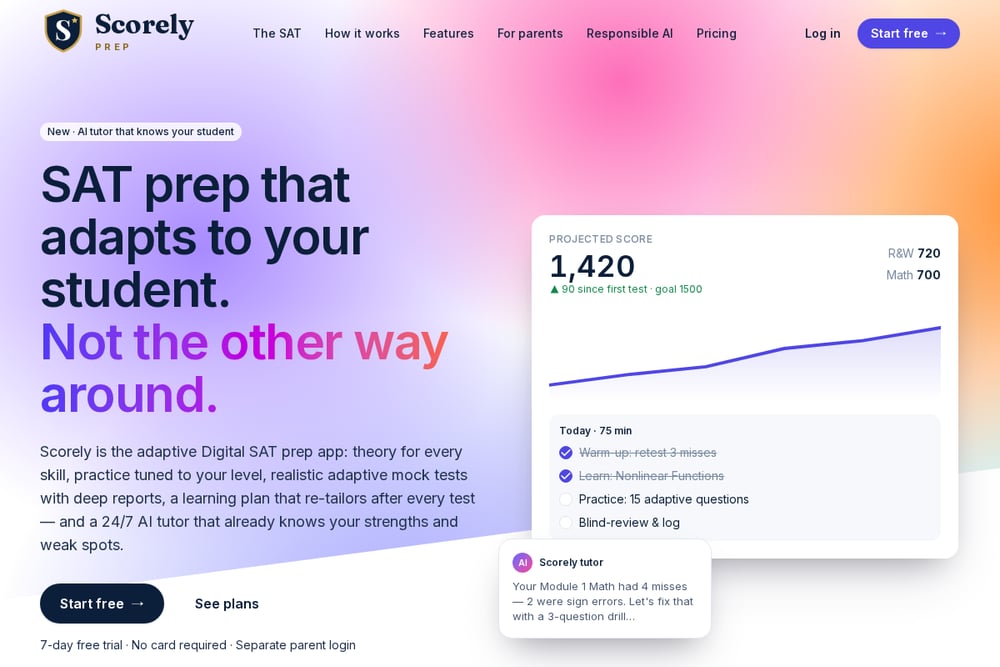 A screenshot of the Scorely — Adaptive SAT prep website.
Scorely builds a living model of each student and runs a tight five-step loop: diagnose, learn, practice, test, re-tailor. Every one of the 30 SAT skills gets theory, a worked example, the traps the test sets, and the moves top scorers use. Practice questions are picked to sit at about a 70% success rate, then climb as you improve. The four-module adaptive mock tests mirror the real Digital SAT, with Module 2 adjusting based on Module 1, real timing, flag-and-review, and a Desmos link. After each test, a deep report re-tailors the learning plan, and the 24/7 AI tutor updates with full context. A separate parent login gives visibility, and the 7-day free trial requires no card. Explore the full loop at Scorely.
#3 Aniko
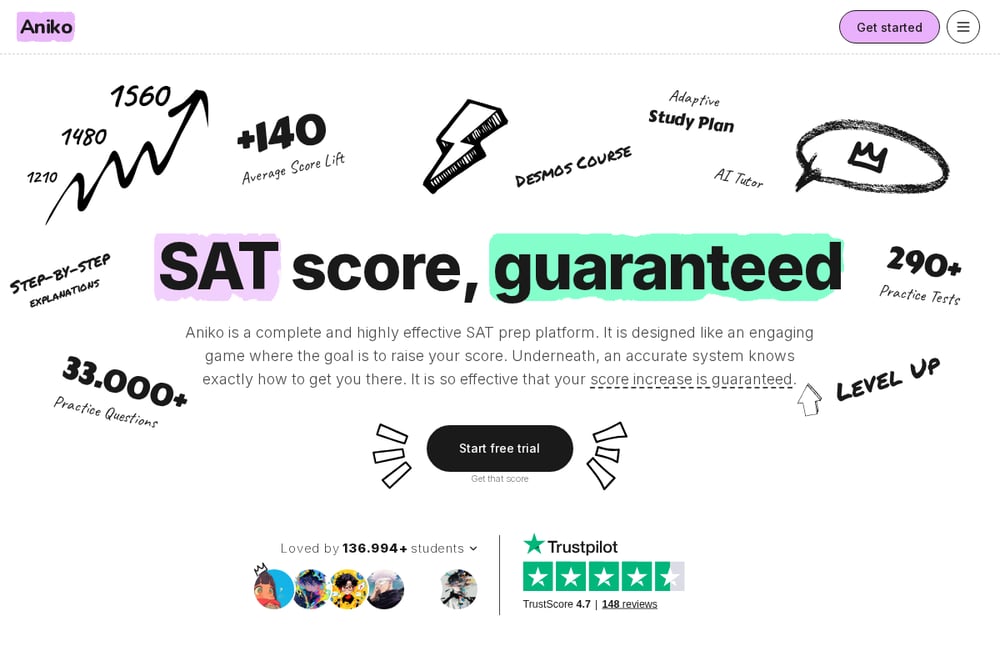 A screenshot of the Aniko website.
Aniko takes a question-bank-first approach with 33,000+ questions that adapt to you. The free bank alone includes 4,000 questions by skill with full explanations, plus Desmos guides for every Math skill. Practice tests come in full-length, half-length, and short formats, all adaptive like the SAT and scored 400–1600. Aniko finds the skills costing you points and picks your next question, with a tutor on hand. If you prefer to learn by doing and want a generous free tier, Aniko is worth a look. Start with the free question bank at Aniko.
#4 SAT Prep AI
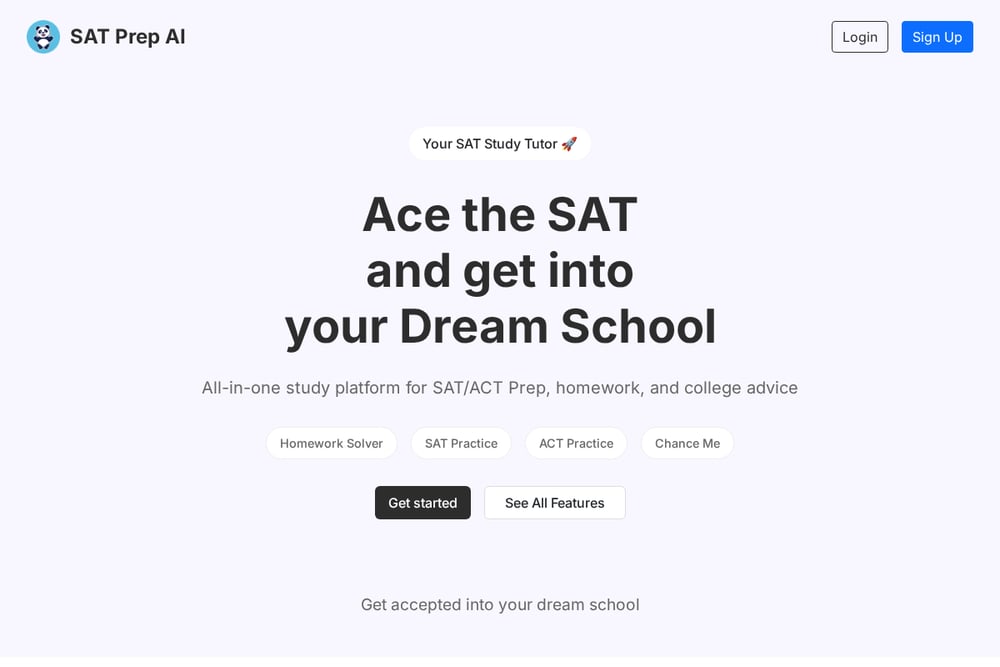 A screenshot of the SAT Prep AI website.
SAT Prep AI is the Swiss Army knife of the group. Beyond SAT practice tests and custom question generation by topic or difficulty, it adds a homework solver, flashcards, vocabulary games, a podcast, and even a college admission chance predictor. The AI chat tutor gives instant help, and the 'identical practice' feature lets you drill similar questions until a concept sticks. It covers ACT prep too, so it suits students hedging between exams. The breadth is the point here, not the depth of any single feature. See the full toolkit at SAT Prep AI.
#5 Makon AI
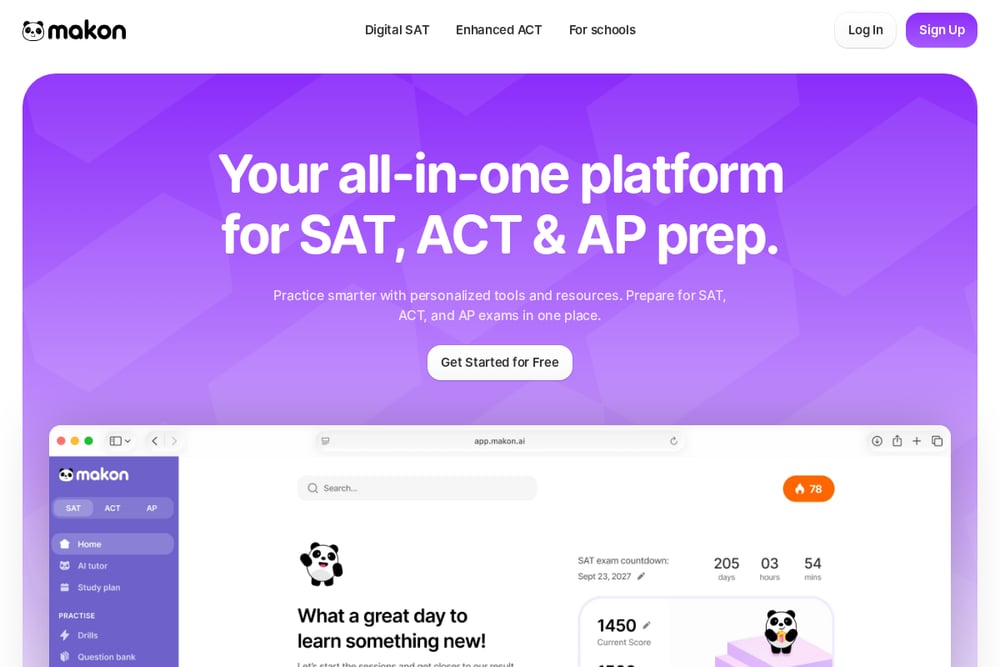 A screenshot of the Makon AI website.
Makon AI positions itself as prep students actually enjoy using. It covers Digital SAT, Enhanced ACT, and AP in one platform, with a study plan that acts like a personal GPS: daily goals, weekly milestones, and smart adjustments. The 24/7 expert-verified AI tutor gives real-time hints so you never get stuck. Makon reports 50,000+ students across 40 countries and an average gain of 150 points in three months, with 21% of students reaching 1500+. Prediction tests offer full-length exam marathons. If motivation is your bottleneck, Makon's gamified feel may help. Learn more at Makon AI.
How to Choose Your Adaptive SAT Platform
Start with your biggest gap. If you need structure, pick a platform that re-tailors a learning plan after every test, like Scorely. If you already know the content and just need volume, a massive question bank like LearnQ.ai or Aniko makes more sense. Consider the AI tutor. A context-aware tutor that knows your history beats a generic chatbot for targeted help. Check the mock test format. It should adapt like the real Digital SAT, with Module 2 shifting based on Module 1. Ask about parent visibility if a parent is footing the bill. Finally, use the free trials and diagnostics. Every platform here offers a way to test the waters before you commit.
Building Your Weekly Prep Workflow
A simple weekly loop keeps you honest. Monday: take a short diagnostic or review last week's misses. Tuesday through Thursday: run adaptive practice sets in your weakest skills, aiming for that 70% success zone. Friday: blind-review your errors and log them. Saturday: take a full-length adaptive mock under real timing. Sunday: read the deep report, update your plan, and ask the AI tutor to drill your top two error types. Platforms like Scorely automate much of this loop, but the discipline is yours. Track your projected score weekly and adjust hours if gains stall.
The Bottom Line
The Digital SAT rewards preparation that adapts as fast as the test does. LearnQ.ai brings scale, Scorely brings a complete re-tailoring loop with parent visibility, Aniko brings a generous free adaptive bank, SAT Prep AI brings breadth, and Makon AI brings motivation. Pick the one that matches your gap, use the free trial, and commit to the weekly loop. Your score will follow the system you build, not the app you download.