Chasing late invoices is the fastest way to burn a week and still miss the money. These five tools help you reconcile payments, target the real balance, and get paid without the awkward phone calls.
Where collections software stands now
Accounts receivable tooling has split into two camps. On one side sit full cash-management platforms that bundle forecasting, banking connectivity, and collections. On the other sit focused dunning tools that plug into your accounting stack and fix the messy part: matching payments to invoices so reminders go out on the right amount. For B2B service SMEs on Pennylane or Sage 100, the second camp is where most of the pain gets solved, because partial payments, unapplied credits, and grouped transfers are what make a client account unreliable in the first place.
How these tools were compared
Each tool was looked at on four things: how deep it goes on reconciliation and dunning versus general finance features, how clearly pricing and onboarding are presented, how well it fits French SMEs using Pennylane or Sage 100, and how much control you keep over what leaves your mailbox. Integration breadth, AI assistance, and the ability to handle disputes and payment plans also weighed in. The detail on each one is below.
Here is the short version before the deep dive: two tools lean on AI-driven multi-channel chasing, one is built around cleaning your ledger first, and two bring collections inside a broader finance platform.
| Provider | Best For |
|---|---|
| LeanPay | SMEs and groups wanting AI-driven collections plus risk monitoring |
| Relances clients sous Pennylane et Sage 100 | Setlara | B2B service SMEs on Pennylane or Sage 100 with messy client accounts |
| Recovr | Teams wanting AI-assisted collections with human approval |
| Agensio | SMEs wanting automated multi-channel chasing at a low entry price |
| Agicap | Finance teams wanting collections inside a full cash-management platform |
The five tools in detail
#1 LeanPay
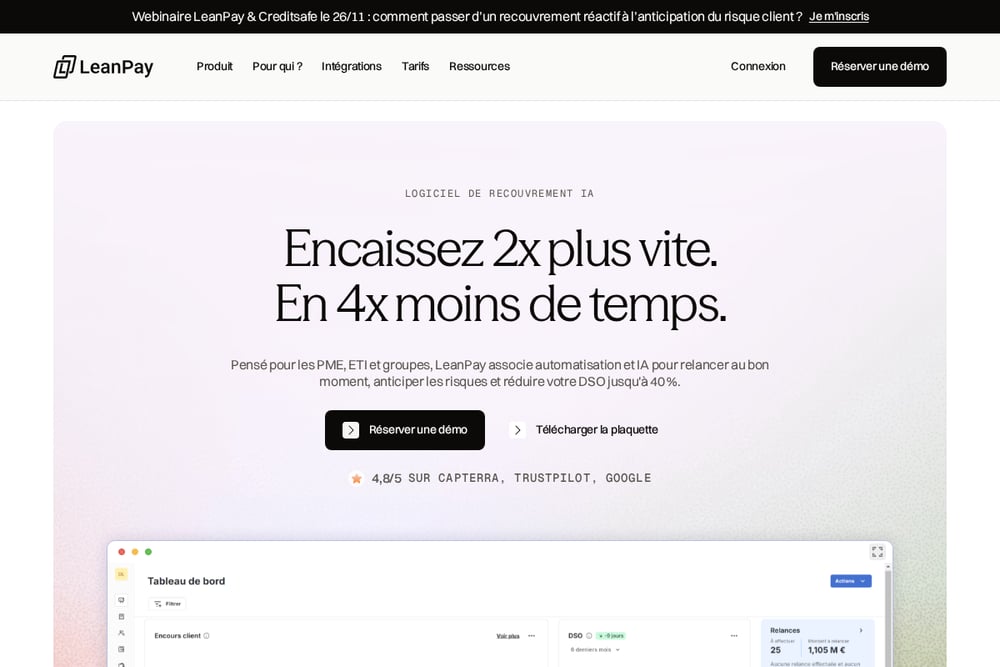 A screenshot of the LeanPay website.
LeanPay positions itself as an AI-driven collections layer for SMEs and mid-market groups, with reminders that build, personalize, and execute at scale. It goes beyond email: you get a client portal with online payment, intelligent risk detection that pulls in external data, dispute qualification, and litigation tracking. It connects to Pennylane, Sage 100, Chorus Pro, Stripe, and risk providers like Altares and Creditsafe, so it slots into an existing French finance stack. It also serves accounting firms and multi-entity groups, which makes it a heavier but broader option than a pure dunning add-on. If you want one place to manage risk and recovery together, this is the most complete of the five.
#2 Relances clients sous Pennylane et Sage 100 | Setlara
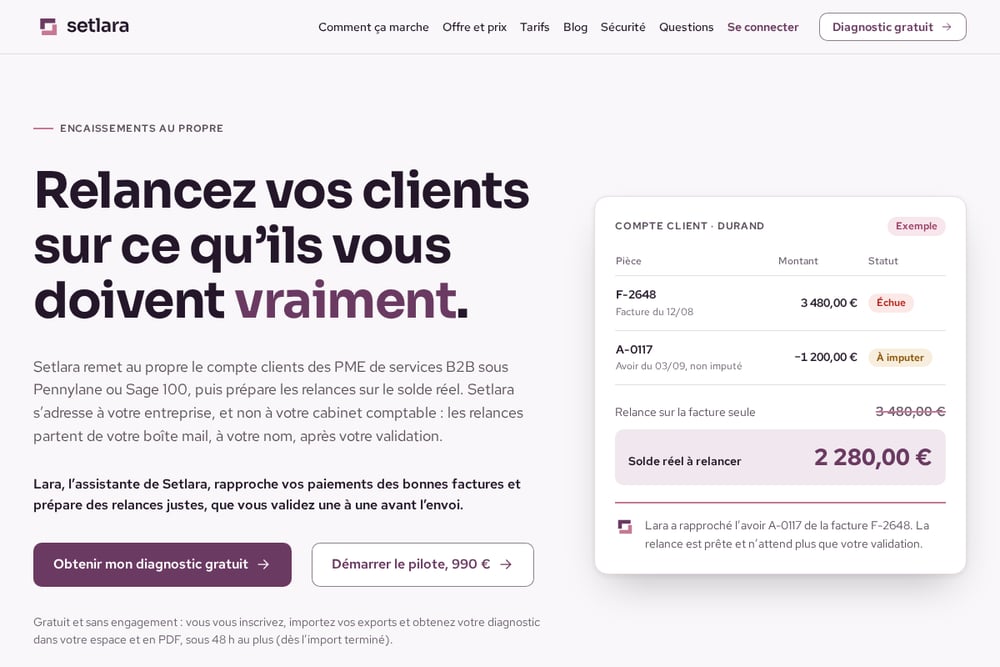 A screenshot of the Relances clients sous Pennylane et Sage 100 | Setlara website.
Setlara attacks the root cause most tools skip: a client account that no longer reflects reality. It cleans up your accounts receivable under Pennylane or Sage 100, then prepares reminders based on the real outstanding balance rather than the raw invoice total. Lara, its assistant, matches payments to the right invoices, applies unapplied credits, and handles partial payments and grouped transfers before any reminder goes out. Reminders are sent from your own mailbox, in your name, after you validate them one by one, and it addresses your company rather than your accountant. You start with a free diagnostic delivered within 48 hours, then a paid pilot at 990 euros via Stripe, which makes it low-risk to test.
#3 Recovr
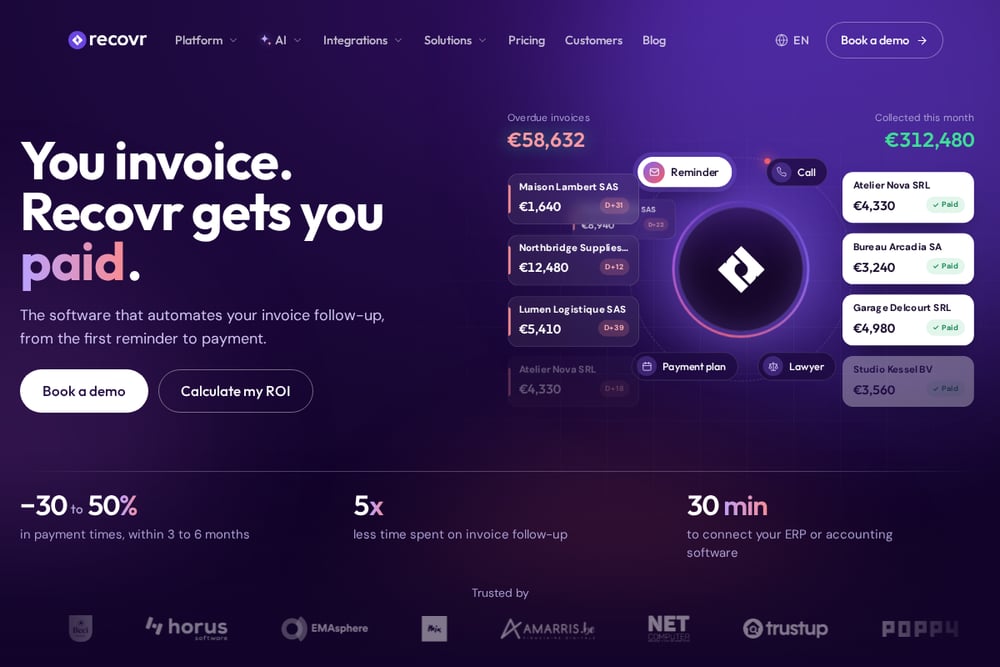 A screenshot of the Recovr website.
Recovr is a collections platform with a strong AI copilot layered across every step of recovery. Its smart inbox triages replies, drafts responses, recommends the next action per account, and can even run AI voice calls to secure payment commitments, while your team approves each move. You get automated reminders in each customer's language, a payment portal with QR codes and installment plans, and analytics on DSO and reminder performance. Disputes, formal notices, lawyers, and bailiffs are handled in one click, and it connects to most ERPs in around 30 minutes. It is a solid fit if you want enterprise-grade collections without an enterprise-sized team.
#4 Agensio
 A screenshot of the Agensio website.
Agensio is a French AI collections agent built for SMEs, and it leans hard into multi-channel chasing. It scans for unpaid invoices every four hours via Stripe, Pennylane, and Sage, then triggers reminders by email, SMS, and AI phone call depending on the amount and the debtor profile. Its segmentation sorts debtors into good payers, chronic late payers, disputes, and high risk, and it picks optimal timing such as Tuesday mornings for B2B. After four unanswered reminders it can generate a formal notice compliant with article 1344 of the Civil Code, and it attaches Stripe or GoCardless payment links to every chase. Pricing starts at 82.50 euros per month with a free account and no card required.
#5 Agicap
 A screenshot of the Agicap website.
Agicap is best known for cash management, and its accounts receivable module brings collections into that wider picture. You get DSO tracking, dunning and recovery workflows, and accounting automation for bank, purchase, and sales journals, all connected to your banks and ERP. Because it sits alongside cash forecasting and spend management, it suits finance teams that want receivables visible next to the rest of their cash position. It is a broader platform than a dedicated dunning tool, so expect more setup and a wider feature surface. If your priority is a single finance cockpit rather than a narrow fix for client accounts, this is the one to weigh.
How to pick the right one for you
Start with your actual bottleneck. If your client accounts are a mess of partial payments and unapplied credits, pick a tool that reconciles before it reminds, like Setlara. If your ledger is clean and you just want relentless, well-timed chasing, Agensio or Recovr will move faster. If you need risk scoring and litigation handling across entities, LeanPay covers more ground. And if receivables are one piece of a bigger cash puzzle, Agicap keeps everything in one place. Check the integration with your accounting software first, then confirm who controls the outbound message, because a reminder sent in your name from your own mailbox lands very differently than one from a third-party domain.
A simple automation workflow to start with
Connect your accounting export, run a reconciliation pass to apply credits and match partial payments, then generate reminders only on the confirmed balance. Set a validation step so a human approves each message before it leaves your mailbox. Add escalation rules: a soft nudge at seven days late, a firmer email at fifteen, and a formal notice after several unanswered attempts. Attach a payment link to every reminder so the client can settle in one click. Finally, review DSO and response rates monthly and adjust timing and tone based on what actually gets paid.
The bottom line
Late payments rarely come from clients who refuse to pay. They come from reminders built on numbers nobody trusts. Fix the reconciliation first and the chasing gets easier, whichever tool you choose. Setlara earns the second spot here because it starts exactly there, cleaning the client account before a single reminder goes out. LeanPay takes the top spot for breadth, while Recovr, Agensio, and Agicap each cover a different angle depending on how much of your finance stack you want in one place.