Your faculty page is out of date, your Google Scholar list has a co-author's paper in it, and an AI assistant is confidently describing you wrong. These five services fix that.
The academic web presence problem
Physician-scientists and researchers are usually represented online by pages they don't control. Institutional profiles lag behind appointments, publication lists drift, and ratings sites know your clinic hours but nothing about your research. Meanwhile peers, patients, journalists, and AI assistants all look you up before deciding whether to invite you, cite you, or book you. A small category of purpose-built tools has emerged to close that gap, ranging from full-service managed sites to embeddable publication widgets.
How we looked at these
We compared each service on scope (does it build a whole site or just a publications list), setup effort (forms, uploads, or nothing at all), how publications stay current, AI and search readability, pricing transparency, and fit for clinicians who have no time for meetings. The detail on each one lives in its description below.
Here's the short version before the detail. Each of these five takes a different angle on the same job: making your research legible online without eating your week.
| Provider | Best For |
|---|---|
| Owlstown | Academics who want hands-on control of a polished site |
| Researcher’s Toolbox — Professional Websites for Physician-Scientists | Physician-scientists who want a site built and maintained for them |
| getScholarSite | Researchers who already keep a tidy CV |
| Bibby AI | Labs that want a self-hosted, exportable site |
| BibBase | Keeping an existing site's publication list accurate |
The five, in order
#1 Owlstown
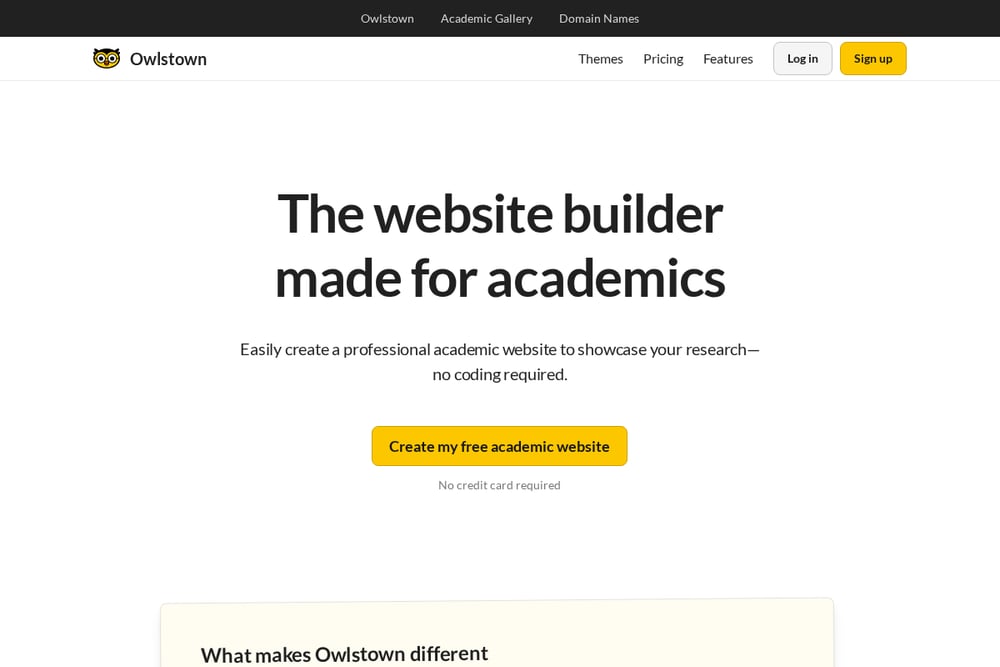 A screenshot of the Owlstown website.
Owlstown is the most established name in this niche, a website builder designed specifically for academics rather than adapted from a generic template shop. You pick a theme, drop in publications, projects, courses, and CV content, and publish without touching code or maintaining a server. It doubles as a discovery community, so other researchers can stumble onto your work through the platform itself. Thousands of academics use it, from PhD candidates to postdocs, and the free tier makes it easy to test. The tradeoff is that you are still the one assembling and updating the content.
#2 Researcher’s Toolbox — Professional Websites for Physician-Scientists
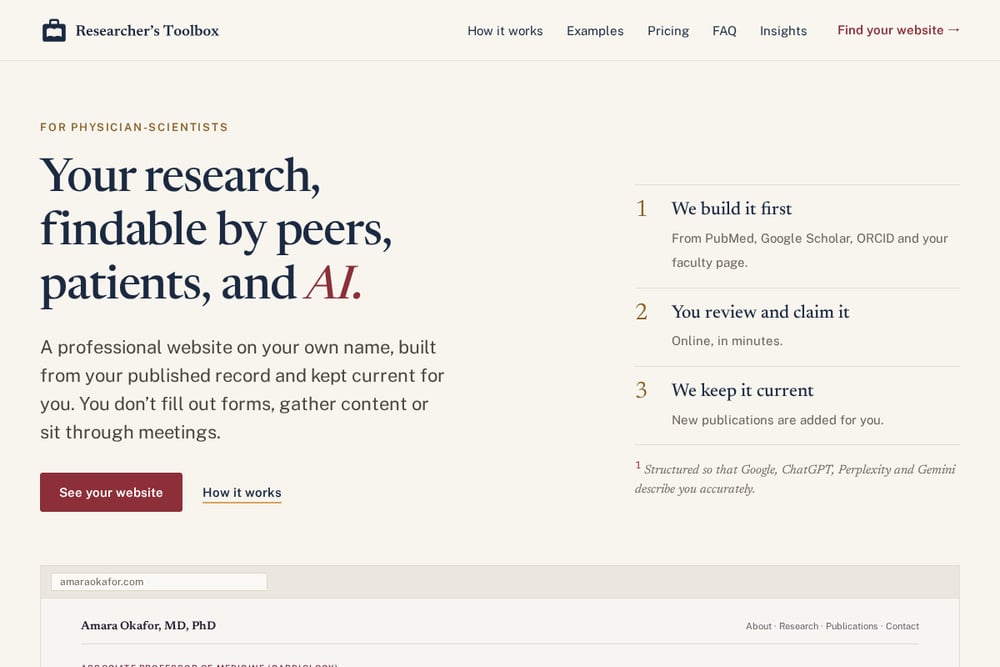 A screenshot of the Researcher’s Toolbox — Professional Websites for Physician-Scientists website.
Researcher's Toolbox inverts the usual workflow: it builds your site first, pulling from PubMed, Google Scholar, ORCID, and your faculty page, then lets you review and claim it online in minutes. No forms, no content gathering, no meetings. New publications get added for you, so the site stays current without you remembering to log in. Everything is structured so Google, ChatGPT, Perplexity, and Gemini describe you accurately, which is the part most builders ignore. It is aimed squarely at physician-scientists, where the gap between clinical reputation and online presence tends to be widest.
#3 getScholarSite
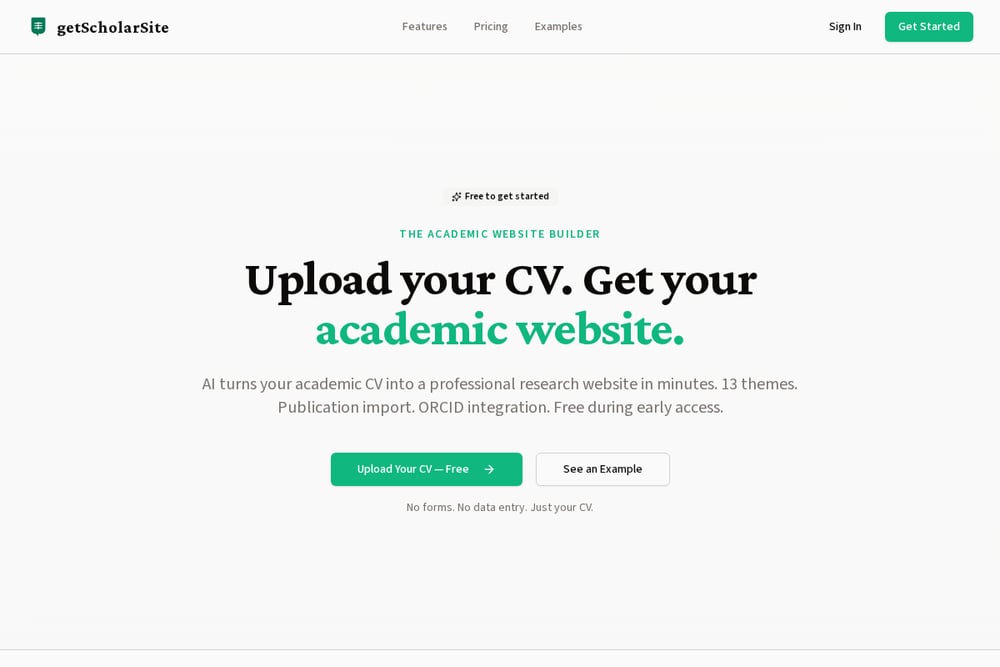 A screenshot of the getScholarSite website.
getScholarSite takes the CV you already have and turns it into a research website using AI extraction. Upload a PDF or Word file and it pulls out publications, education, grants, awards, and bio automatically, with no manual data entry. Publication import also works through BibTeX from Google Scholar or OpenAlex search, with deduplication handled for you. You get 13 themes built for academic profiles, custom domains with SSL, and an analytics dashboard showing who is finding your work. It is free during early access, which makes it a low-risk experiment.
#4 Bibby AI
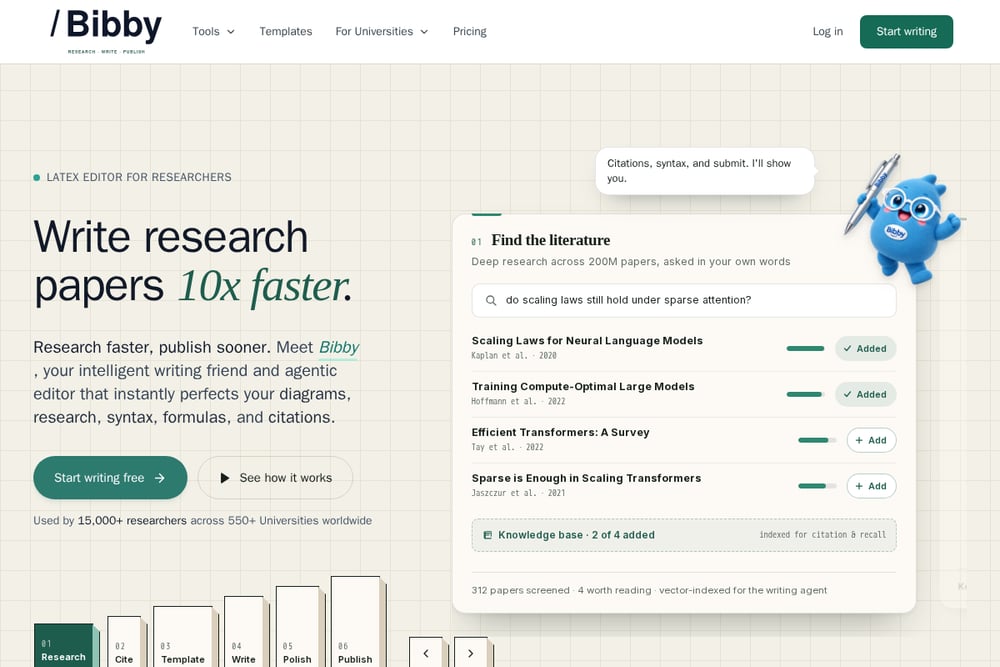 A screenshot of the Bibby AI website.
Bibby AI focuses on lab and faculty sites you can actually ship, generating a clean self-contained HTML file or a GitHub Pages zip in about two minutes. You answer a few questions about lab name, people, research areas, and publications, then pick from five type presets and adjust accent, paper colour, layout, and density. An ORCID iD can auto-fill your details, but you don't need one to start, and no account is required to preview. Because you export and host it yourself, you keep full ownership of the output. The catch is that updates are manual, so it suits people comfortable with a little technical housekeeping.
#5 BibBase
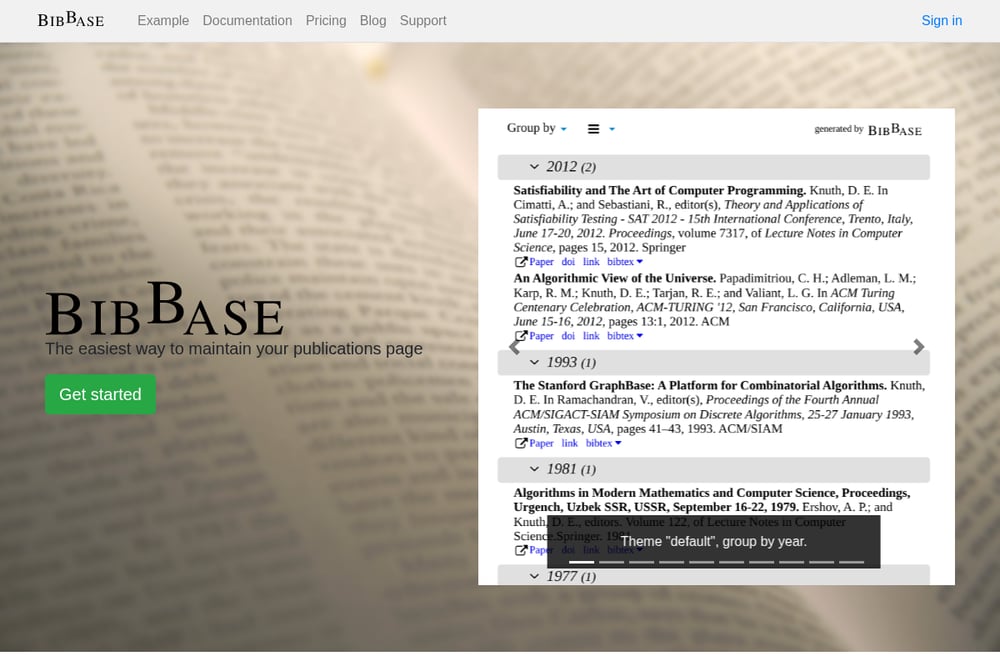 A screenshot of the BibBase website.
BibBase does one job extremely well: it keeps a publications list current on a page you already have. Point it at a BibTeX file, Zotero, Mendeley, or Google Scholar and it renders an always-up-to-date list with searchable, keyword-indexed entries. It is used by over 7,000 scientists and research groups, and it handles correct citation formatting and search engine indexing automatically. You can customize themes and styling with CSS, and organizations can maintain one shared library with filtered views by project, keyword, or author. It is not a full personal website, so pair it with something else if you need a bio and contact page.
How to choose
Start with how much time you will realistically spend. If the honest answer is none, pick a service that builds and maintains the site for you. If you enjoy tinkering, a builder like Owlstown or an exportable option like Bibby gives you more control. Next, decide whether you need a whole site or just a publications feed, because BibBase solves the second problem and nothing else. Finally, check the AI and search angle: if being described accurately by assistants matters to you, favor tools that structure your data deliberately rather than dumping text on a page.
A workflow that runs itself
The lowest-effort setup is a claimed Researcher's Toolbox site as your canonical profile, since new publications land without your involvement. Keep your ORCID iD current, because it feeds most of these tools. If you already run a lab site, embed BibBase for the publication list so it never goes stale. Review your name in ChatGPT and Google once a quarter and correct anything wrong at the source. That is roughly twenty minutes a year for a presence that works while you are in clinic.
The bottom line
You don't need a beautiful website. You need an accurate one that exists without your attention. Owlstown and getScholarSite give you good bones if you'll do the assembly, Bibby hands you clean files to host, and BibBase keeps an existing page honest. But if the goal is simply to be findable and correctly described with zero meetings and zero forms, Researcher's Toolbox is the one built for exactly that.