Losing employer coverage is stressful enough without guessing at the math. These five calculators help you compare ACA and COBRA costs before you commit.
Why coverage-cost calculators matter right now
When a job change hits, you usually get a 60-day window to pick between COBRA continuation and an ACA Marketplace plan. COBRA can run up to 102% of the plan's full cost, while Marketplace plans may come with income-based premium tax credits. That gap can swing thousands of dollars a year, so a quick side-by-side estimate is worth the ten minutes it takes.
How these calculators were evaluated
Each tool was looked at on four things: how clearly it explains its assumptions and sources, how well it handles family and household inputs, whether it shows costs over time rather than a single month, and how honestly it flags its own limits. Pricing transparency and guidance on what to verify next also counted.
Here is the short version before the details. All five tools estimate COBRA versus ACA costs, but they differ in depth, family focus, and how much guidance they offer beyond the number.
| Provider | Best For |
|---|---|
| SeverancePayCalc COBRA vs ACA Calculator | Fast post-layoff comparisons alongside severance planning |
| ACA and COBRA Cost Calculators for Families | famcovy | Families who want to see how income changes affect the estimate |
| COBRAEstimator | Digging up your COBRA cost from a W-2 |
| Cover Forge USA COBRA vs Marketplace Calculator | Understanding the legal side of COBRA pricing |
| FreeCalcLegal COBRA vs ACA Calculator | A quick, plain monthly cost check |
The five calculators in detail
#1 SeverancePayCalc COBRA vs ACA Calculator
 A screenshot of the SeverancePayCalc COBRA vs ACA Calculator website.
SeverancePayCalc bundles its health coverage estimator into a broader layoff toolkit that also covers severance, WARN Act notice pay, and unemployment offsets. You enter household size, the full employer premium, and projected annual income, and it returns a monthly COBRA versus ACA comparison with potential savings. It is quick and no-frills, which suits someone who wants a fast directional answer right after a layoff. The surrounding guides on severance and runway planning add useful context you will not find on a standalone calculator. Just note it leans toward individual and small-family scenarios rather than deep household modeling.
#2 ACA and COBRA Cost Calculators for Families | famcovy
 A screenshot of the ACA and COBRA Cost Calculators for Families | famcovy website.
Famcovy is built specifically for families, and that focus shows. You enter your household once, then compare ACA and COBRA premiums over a coverage period you choose, from one month to twelve, with a cumulative cost view rather than a single monthly figure. It also models how changes in annual income shift your estimated federal premium tax credit, which is the part most calculators gloss over. The site is upfront that its example prices are invented for illustration and that state assistance and medical costs are excluded, and it points you to official sources and a professional handoff. If you want to understand what to verify next rather than just get a number, start here.
#3 COBRAEstimator
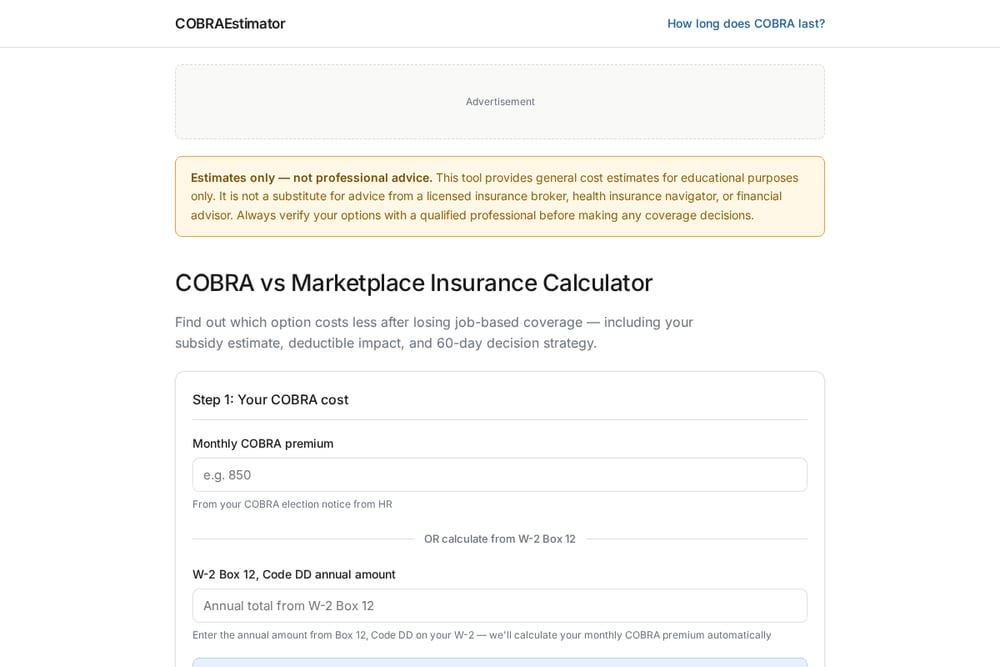 A screenshot of the COBRAEstimator website.
COBRAEstimator walks you through a structured two-step flow: first your COBRA cost, then your household details. A nice touch is the W-2 Box 12 Code DD lookup, which lets you back into your monthly COBRA premium from last year's tax form if you do not have your election notice handy. It factors in household size, age, state, and tobacco use, and it layers in deductible impact and the 60-day decision strategy. The tool is clear that its output is educational and not a substitute for a licensed broker or navigator. That honesty is refreshing, though it means you will still need to verify final numbers elsewhere.
#4 Cover Forge USA COBRA vs Marketplace Calculator
 A screenshot of the Cover Forge USA COBRA vs Marketplace Calculator website.
Cover Forge USA pairs its calculator with one of the clearer explanations of COBRA pricing you will find, citing the 102% rule under 29 U.S.C. §1162(3) and explaining why the employer contribution disappears when you leave. You enter your current employee-share premium and the employer's share percentage, and it compares that against a Marketplace plan with any subsidy you may qualify for. The framing around the 60-day Special Enrollment Period is genuinely helpful for first-timers. It is a solid educational companion, though the input model assumes you know your employer's contribution split.
#5 FreeCalcLegal COBRA vs ACA Calculator
 A screenshot of the FreeCalcLegal COBRA vs ACA Calculator website.
FreeCalcLegal keeps things simple: enter your quoted COBRA premium, age, household size, projected income, and state, and it returns a monthly cost comparison. It also asks about Medicaid eligibility and expected health care usage, which nudges you to think beyond premiums alone. The site is candid that quotes vary by state, age, income, and plan tier, and that networks differ heavily between COBRA and ACA plans. It is part of a larger consumer-rights calculator suite, so the surrounding content skews legal rather than insurance-specific. Good for a quick sanity check, less so for deep family planning.
How to pick the right calculator for you
Start with what you actually need. If you just lost a job and want a fast answer, a simple monthly comparison will do. If you have a family and your income is uncertain for the year, pick a tool that models income changes and cumulative costs over several months. If you are unsure what your COBRA premium even is, look for one that helps you find it from a W-2 or pay stub. And whatever you use, treat the output as a starting point, then confirm details with your plan administrator or a navigator before you elect coverage.
Where automation fits into your coverage decision
A calculator cannot elect coverage for you, but it can remove most of the guesswork. Run your household numbers through two tools, compare the outputs, and note where they disagree. Then set a reminder for your 60-day deadline, save your income estimate for the tax credit reconciliation, and keep your election notice and W-2 in one folder. That small workflow turns a panicked decision into a planned one.
The bottom line
Every tool here answers the same core question, but they answer it differently. Famcovy goes deepest on family households and income-driven credit changes, SeverancePayCalc is fastest for post-layoff math, COBRAEstimator helps you find your premium, Cover Forge USA explains the rules, and FreeCalcLegal keeps it plain. Use one to get oriented, a second to check the number, and a professional to confirm before you sign anything.