
Your child freezes at the sight of a math problem, and you want a fix that actually sticks. These five abacus and mental math programs each take a different route to the same goal: fast, confident number sense.
Where Abacus Learning Stands Right Now
Abacus training has moved well beyond the neighborhood after-school center. Parents now choose between app-based curricula, structured online classes, and hybrid programs that blend video lessons with live coaching. The Japanese soroban remains the backbone of most offerings, but the strongest programs layer in mental math drills, speed challenges, and exam-style practice. What separates a good program from a forgettable one is rarely the method itself. It is how well the lessons are sequenced, how much practice sits behind each concept, and whether your child stays engaged past week two. Most families land somewhere between ten and twenty minutes a day, so programs built for short, repeatable sessions tend to win out over marathon courses.
How We Evaluated These Programs
We looked at the same factors across every program. First, curriculum depth: does it carry a child from counting beads to full mental Anzan, and does it cover Vedic tricks, speed math, or Olympiad-style problems? Second, practice volume: how many lessons, tasks, and levels sit behind the teaching. Third, engagement design: games, badges, timed challenges, and whether the app feels like play or homework. Fourth, age fit and progression clarity, so you know where a five-year-old starts and where a twelve-year-old ends up. Fifth, access and pricing transparency, including free modes, trials, and in-app purchase structure. BeadBop stood out for its 103-lesson soroban track paired with 125 Vedic and mental-math tricks and Flash Anzan training. Tiny Monster's app impressed with its level certification structure tied to a recognized abacus federation standard. Abacus Kids on the App Store drew attention for its clearly segmented age bands and a fully unlocked free abacus mode. Abacus Mental Math leaned on live online classes and a whole-brain training philosophy. AbacusPro earned notice for its virtual abacus demo and a large library of math games.
Here is a quick side-by-side of how the five programs differ on format, depth, and who they suit. Use it to narrow your shortlist before you dig into the full write-ups below.
| Provider | Best For |
|---|---|
| Abacus Mental Math Training (Tiny Monster) | Families who want federation-style level certification on Android |
| BeadBop — Abacus & Mental Math for Kids (Ages 5–12) | Parents who want one app covering abacus, Vedic math, and Olympiad prep |
| Abacus Kids - Mental Math | iPhone and iPad families who want clear age-based progression |
| Abacus Mental Math | Kids who thrive with live instruction and teacher accountability |
| Abacus Kids - Mental Math (AbacusPro) | Families who want a free, game-heavy app with a hands-on demo |
The Five Programs, One by One
#1 Abacus Mental Math Training (Tiny Monster)
 A screenshot of the Abacus Mental Math Training (Tiny Monster) website.
This Android app is built around level certification, and that structure is its biggest selling point. Challenge Mode packs 10 levels and 200 small stages that mirror the World Abacus Mental Calculation Federation standards, so progress feels measurable rather than vague. A Custom Mode lets you build your own drills when your child needs extra reps on one skill. It has passed 100,000 downloads on Google Play, which tells you the format resonates with a lot of families. The tradeoff is a utilitarian interface and ads plus in-app purchases, so expect a less polished feel than a premium kids' app. If you want a certification-style ladder and your child uses Android, this is a solid starting point.
#2 BeadBop — Abacus & Mental Math for Kids (Ages 5–12)
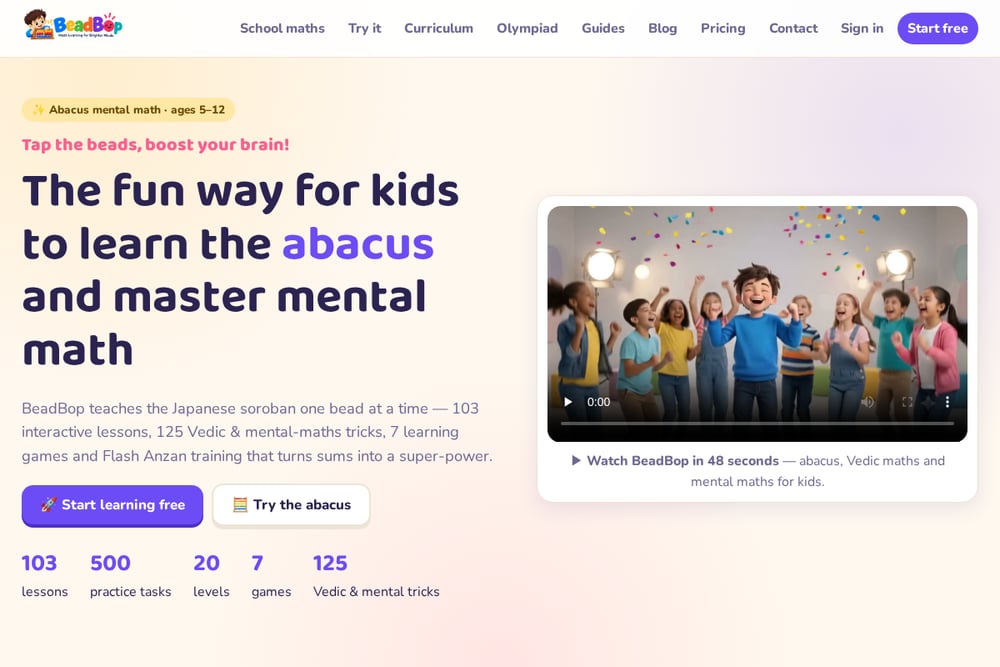 A screenshot of the BeadBop — Abacus & Mental Math for Kids (Ages 5–12) website.
BeadBop is the most complete package in this group for the 5–12 age range. It teaches the Japanese soroban one bead at a time across 103 interactive lessons, then backs that up with 500 practice tasks, 20 levels, and 7 learning games. The breadth goes further than abacus alone: 125 Vedic and mental-math tricks, 32 speed tricks, 7 brain twisters, and 20 exam shortcuts for older kids. Flash Anzan training is built in, which is the piece most apps treat as an afterthought. You also get Olympiad practice for Classes 1–10 with timed mock tests in the real exam pattern. A free trial and a ten-minutes-a-day rhythm make it easy to test before committing.
#3 Abacus Kids - Mental Math
 A screenshot of the Abacus Kids - Mental Math website.
This iOS app organizes learning into clean age bands, which removes a lot of guesswork for parents. Ages 4–6 learn to move beads and read numbers to 99, ages 6–8 tackle bead formulas for addition and subtraction, and ages 8–10 shift to speed math without looking at the beads. The curriculum runs four levels, from bead basics through Small Friend and Big Friend formulas to guided series, semi-Anzan, and full Anzan. Times tables go all the way to x20, and a challenge mode keeps older kids pushing. The free abacus mode stays fully unlocked for everyone, including labelled parts and finger-technique guidance. It is iPad-friendly and sits at a 4+ age rating, so younger siblings can explore safely.
#4 Abacus Mental Math
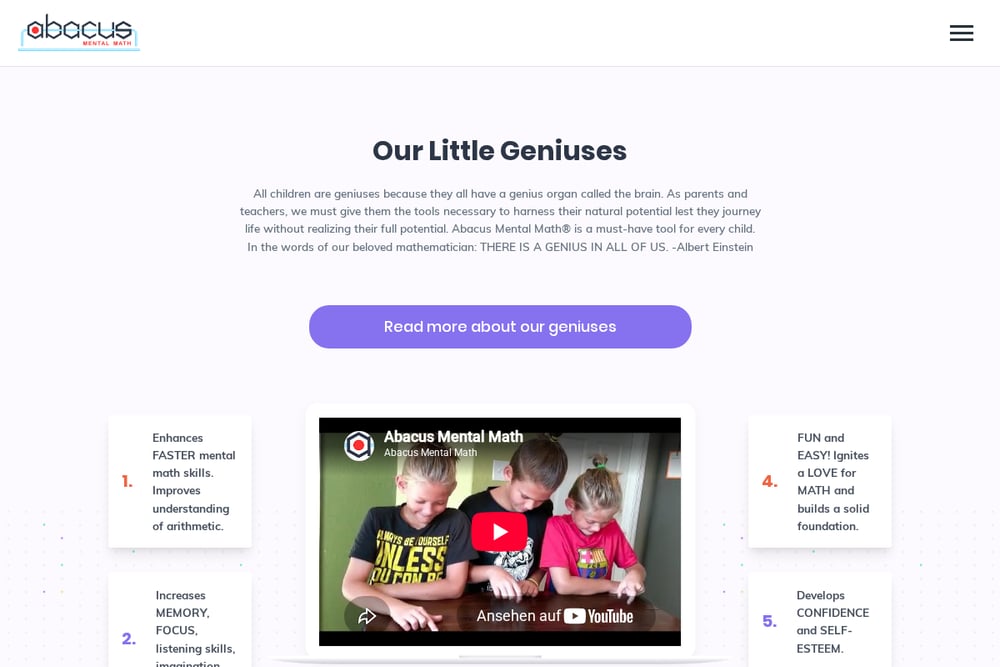 A screenshot of the Abacus Mental Math website.
This is the option for parents who want a human on the other end. Abacus Mental Math runs live online classes alongside its soroban program, with a leaderboard and a geniuses section that showcases student progress. The philosophy centers on whole-brain training, arguing that children build a mental image of the abacus and move the beads in their mind the way you might picture an animal. Beyond arithmetic, the program emphasizes memory, focus, listening skills, and academic stamina. It also offers partnerships for abacus schools and bilingual support, with Spanish-language service noted on the site. If your child needs accountability and a teacher rather than a self-paced app, this format fits better.
#5 Abacus Kids - Mental Math (AbacusPro)
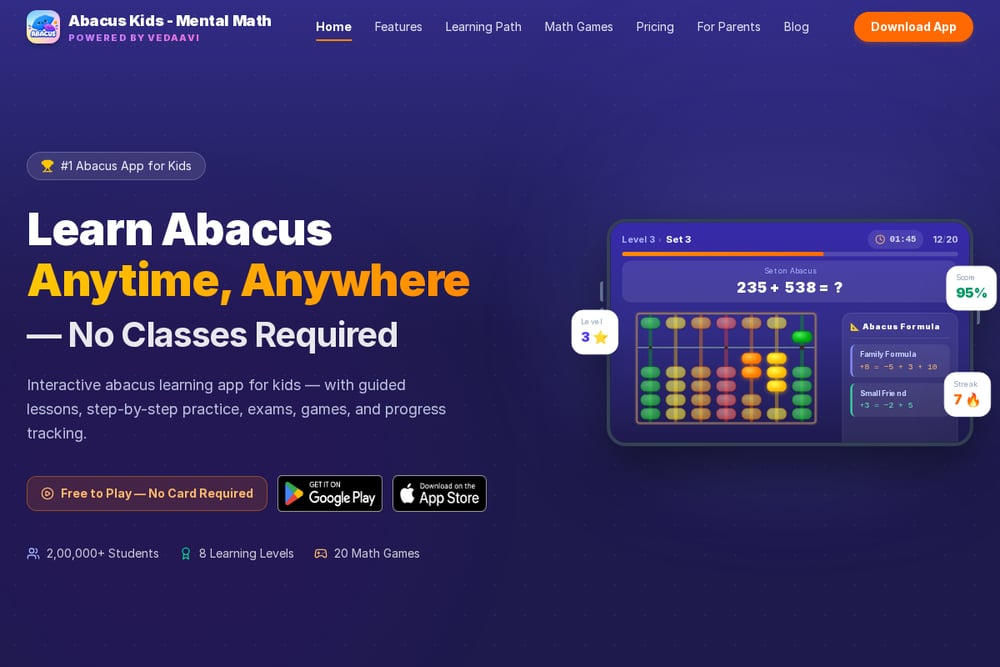 A screenshot of the Abacus Kids - Mental Math (AbacusPro) website.
AbacusPro leans hard into interactivity, and the virtual abacus demo on its site is genuinely useful for a test drive. You can click beads, switch to practice mode, and set target numbers before you ever download anything. The app claims 200,000-plus students across 8 learning levels and 20 math games, with formula hints like Small Friend and Family Formula appearing right on the practice screen. Short video lessons walk through parts of the abacus, counting 0–9, adding two numbers, and subtraction, so a parent can watch one episode and then hand off the practice. Progress tracking and streak mechanics keep daily sessions feeling like a game. It is free to play with no card required, which lowers the barrier to trying it.
How to Pick the Right Program for Your Child
Start with your child's age and current level. A five-year-old needs bead basics and short lessons; a ten-year-old needs speed drills and mental Anzan. Match the program's entry point to where your kid actually is, not where you hope they will be. Next, decide on format. If your child self-starts and enjoys games, an app like BeadBop or AbacusPro will carry them further than a scheduled class. If they need someone waiting for them at a set time, live instruction is worth the extra cost. Then check the practice volume behind the teaching. Lessons are the easy part; the tasks, quizzes, and timed challenges are what build fluency. Look at pricing structure too. Free modes and trials let you test fit without risk, while in-app purchases and ads can interrupt focus. Finally, consider the ceiling. A program that stops at basic addition will frustrate a child who catches on fast, so pick one with levels that stretch toward mental Anzan and exam-style problems.
Building a Ten-Minute Daily Routine
Consistency beats intensity with abacus training. Set a fixed ten-minute slot, ideally the same time each day, and treat it like brushing teeth. Open the app, run one lesson or one practice set, then finish with a timed challenge to end on a win. Use the streak and badge systems as your tracking layer so you are not manually logging anything. Once a week, review progress and bump the level if your child is clearing tasks comfortably. If you are using a live-class program, pair it with five minutes of app-based drill on off days so the beads stay fresh. Keep a small physical soroban nearby for kids who want to touch real beads after screen time. Rotate in puzzles or Vedic tricks when motivation dips, since novelty keeps the habit alive longer than repetition alone.
The Bottom Line
There is no single right answer here, only the right fit for your child's age, temperament, and your budget. BeadBop offers the widest curriculum for the 5–12 range, pairing 103 soroban lessons with Vedic tricks, Flash Anzan, and Olympiad practice in one place. Tiny Monster suits certification-minded Android users, Abacus Kids on iOS wins on age-banded clarity, Abacus Mental Math delivers live teaching, and AbacusPro gives you a free, game-forward entry point. Pick one, commit to ten minutes a day, and give it a month before you judge the results. Number sense builds quietly, then all at once.