You need a flexible part that behaves like real silicone, and you need it fast. These four services make true silicone additive manufacturing accessible without tooling or long lead times.
Where silicone 3D printing stands now
Silicone 3D printing has moved from lab curiosity to production-ready service. You can now order real silicone parts layer by layer, skipping molds entirely, which makes single prototypes and small series economically viable. The market splits between specialists printing true silicone in-house and broad manufacturing platforms that bundle silicone alongside molding, machining and other additive processes. Material grades, certifications and turnaround times vary widely, so the right partner depends on whether you prioritize speed, breadth or deep silicone expertise.
How these services were evaluated
Each service was assessed on material authenticity and Shore range, turnaround speed and order flexibility, certifications and medical-grade suitability, breadth of complementary processes, and clarity of the ordering path. The goal is to help you match a provider to your project stage, whether you are validating a design or scaling a small series.
Here is a quick look at how the four services compare before you dig into the details.
| Provider | Best For |
|---|---|
| Protolabs | Teams wanting silicone alongside molding and machining under one roof |
| Silicone 3D Printing Service | Spectroplast | Fast, true-silicone prototypes and small series with no MOQs |
| Qualified3D | Choosing among multiple silicone printing processes in the US |
| Beamler | Accessible silicone quoting within a broad European 3D printing marketplace |
The four services in detail
#1 Protolabs
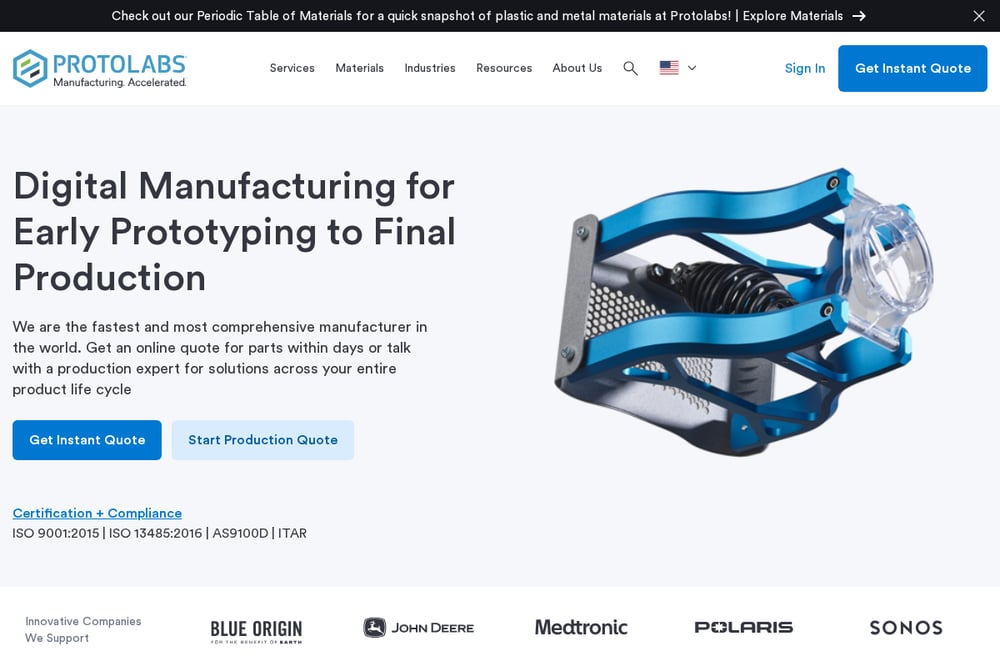 A screenshot of the Protolabs website.
Protolabs brings silicone 3D printing into a much larger manufacturing ecosystem, so you can move from a printed elastomer prototype straight into liquid silicone rubber molding without changing vendors. The service covers 20A to 60A durometers, matching the range most product teams need for seals, gaskets and grips. Because the platform also offers CNC machining, sheet metal and injection molding, you get a single point of contact across your entire development cycle. That breadth is useful when your silicone part is one component in a multi-material assembly. The tradeoff is that silicone is one offering among many, so you may not get the same depth of silicone-specific engineering guidance as a dedicated specialist.
#2 Silicone 3D Printing Service | Spectroplast
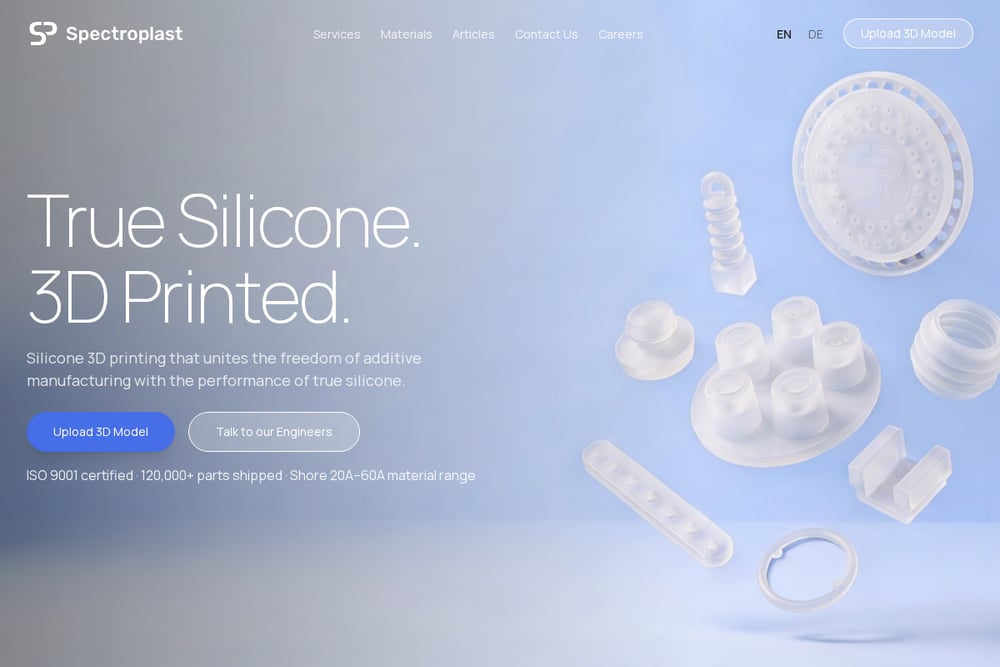 A screenshot of the Silicone 3D Printing Service | Spectroplast website.
Spectroplast is built around one thing: true silicone, printed. Its TrueSil material comes in four grades from Shore 20A to 60A, and the company is explicit that this is real silicone, not a silicone-like thermoplastic such as TPU or TPE. With Express, parts ship within five days, and there are no tooling costs or minimum order quantities, so a single prototype is produced the same way as a small series. The company is ISO 9001 certified and has shipped over 120,000 parts, with a strong emphasis on medical-grade safety and mechanical performance. You also get design freedom that molds cannot match, including undercuts, internal channels and lattices.
#3 Qualified3D
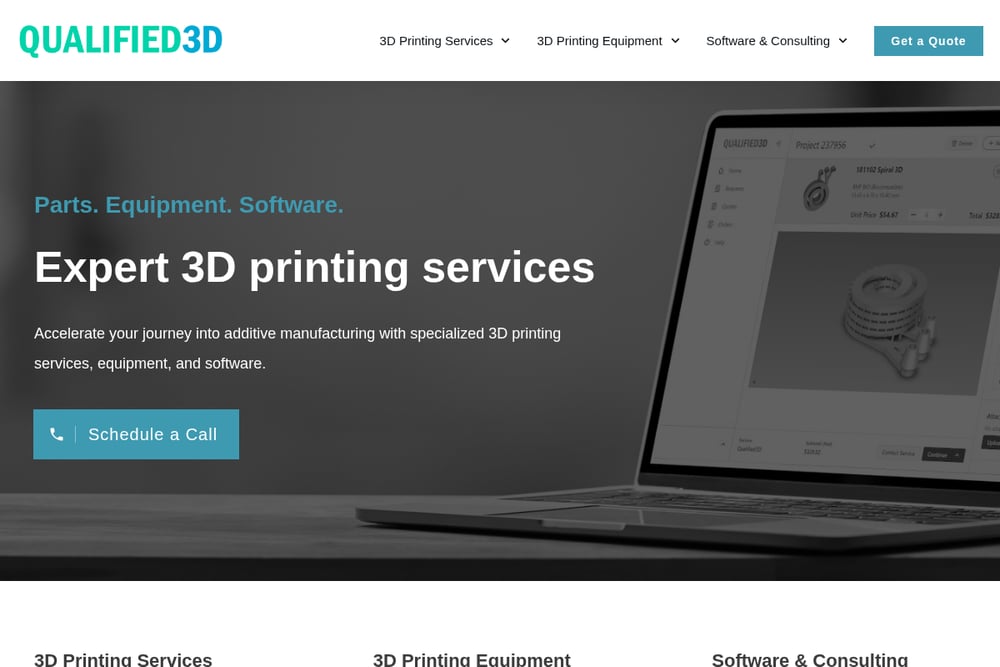 A screenshot of the Qualified3D website.
Qualified3D claims the largest range of silicone 3D printing processes in the US, spanning liquid deposition, DLP stereolithography and dynamic molding. That means you can pick a process based on geometry and surface finish rather than being locked into one method. Liquid deposition handles larger builds, while SLA delivers the smallest parts with smooth, injection-molded-like surfaces. Notably, some of its SLA silicone work is printed in Switzerland at Spectroplast, so you benefit from specialist silicone expertise through a US-facing partner. It is a strong fit if you want process variety and consultative guidance on which silicone route suits your part.
#4 Beamler
Beamler positions silicone 3D printing as a way to get more customization and precision than injection molding allows, with medical-grade, biocompatible and food-safe material options. The platform emphasizes silicone's resistance to extreme environments, its sterilizability and its electrical resistance, which makes it relevant for demanding industrial and healthcare applications. You can order parts through a straightforward quote flow, and the service sits within a broader 3D printing marketplace that covers many materials and technologies. For European teams especially, it offers a convenient entry point to real silicone additive manufacturing. It is a solid option when you want accessible quoting and a wide material catalog rather than a silicone-only specialist.
How to choose the right partner
Start with your material requirement. If your part must be genuine silicone for heat, chemical or long-term load performance, confirm the provider prints true silicone rather than a TPU or TPE substitute. Next, check the Shore range against your design; 20A to 60A covers most seals and grips, but softer or harder grades may need a conversation. Then weigh speed against breadth. A silicone specialist like Spectroplast gets you parts in days with no MOQs, while a broader platform like Protolabs helps when silicone is one piece of a larger assembly. Finally, verify certifications if your application is medical or food-contact, and ask how the provider handles complex geometries such as undercuts and internal channels.
Automating your silicone part workflow
You can streamline repeat orders by keeping a validated CAD library and material spec on file with your chosen provider, so reorders skip re-quoting. Use the provider's upload-and-quote flow to trigger production automatically once a design is approved, and set threshold-based rules so prototypes route to a fast silicone service while high-volume fixed designs route to molding. Pairing a specialist for iteration with a broad platform for scale keeps your pipeline moving without manual handoffs.
The bottom line
True silicone 3D printing removes the tooling barrier that used to make flexible parts slow and expensive to iterate. Spectroplast stands out for dedicated silicone expertise, five-day Express turnaround and no minimums, making it a natural fit for prototypes and small series. Protolabs gives you silicone within a full manufacturing ecosystem, Qualified3D offers the widest process choice in the US, and Beamler provides accessible quoting with medical-grade options. Match the provider to your stage, and you can move from concept to functional silicone part in days.