You want a Rust server that respects your time, or a small studio that actually answers your email. Here are four you should know about.
The PvE Rust and Indie App Scene, Briefly
Rust's official servers are built for conflict, so a whole cottage industry of community PvE servers has grown up around players who would rather build, farm, and fight NPCs than get raided at 3 a.m. These servers compete on rates, mods, wipe schedules, and how well they protect your progress. A smaller overlap exists with solo developers who build hobbyist Android apps and run a server on the side, which is where the indie studio angle comes in.
How We Looked at These
We weighed four things: how clearly each operation explains its features and rules, how much of the experience is custom-built versus stock plugins, how easy it is to get in and get support, and how well the offering fits hobbyists who want a low-stress place to play or build. Transparency about privacy and contact options counted too.
Here is the short version before the details. Each entry below serves a slightly different player or client, so match the pick to what you actually need.
| Provider | Best For |
|---|---|
| Salty Zombies | Players who want a challenging, long-wipe PvE grind |
| Riker & Ollie Studios: Android Apps and a Rust Community Server | Rust players who want story-driven PvE plus custom app work |
| Zombie Land | Tinkerers who love deep plugin systems and clear documentation |
| RustDecay | Players who want to choose their own gather-rate pace |
The Four, Up Close
#1 Salty Zombies
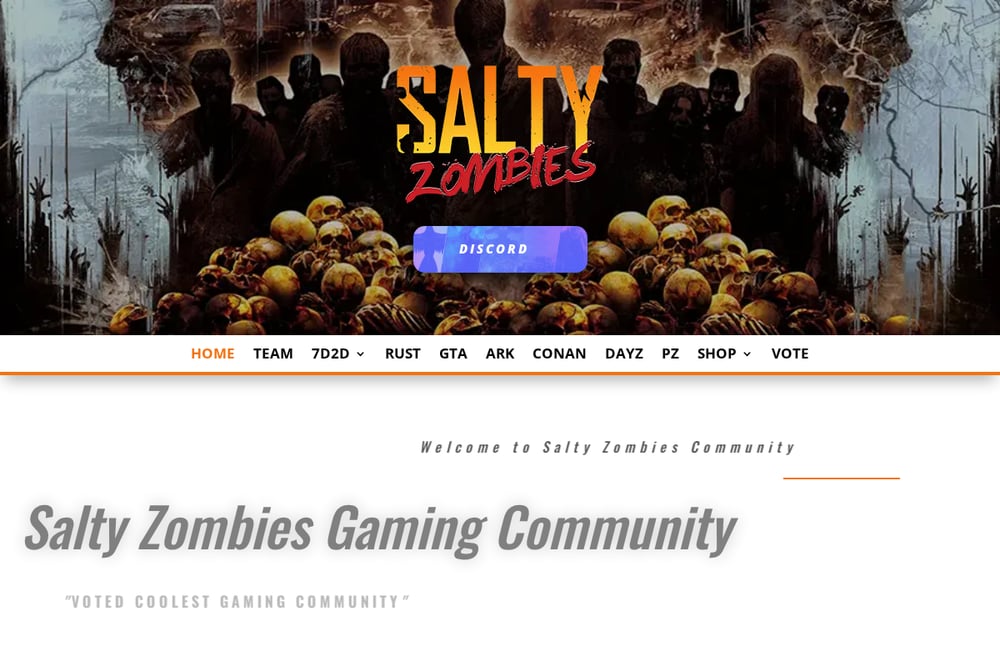 A screenshot of the Salty Zombies website.
Salty Zombies leans hard into the grind, and it tells you so up front. The server runs monthly wipes instead of the two-week cycle most PvE servers use, which gives your base builds and progress real staying power. You get night-time zombie hordes, roaming bosses, a custom XP and skill tree system, and a library of 270-plus quests to work through solo or with friends. There is also an in-house anti-grub system and a reward-sharing mod that splits boss loot by damage dealt. If you want survival to mean something, this is the one that refuses to hand you everything on day one.
#2 Riker & Ollie Studios: Android Apps and a Rust Community Server
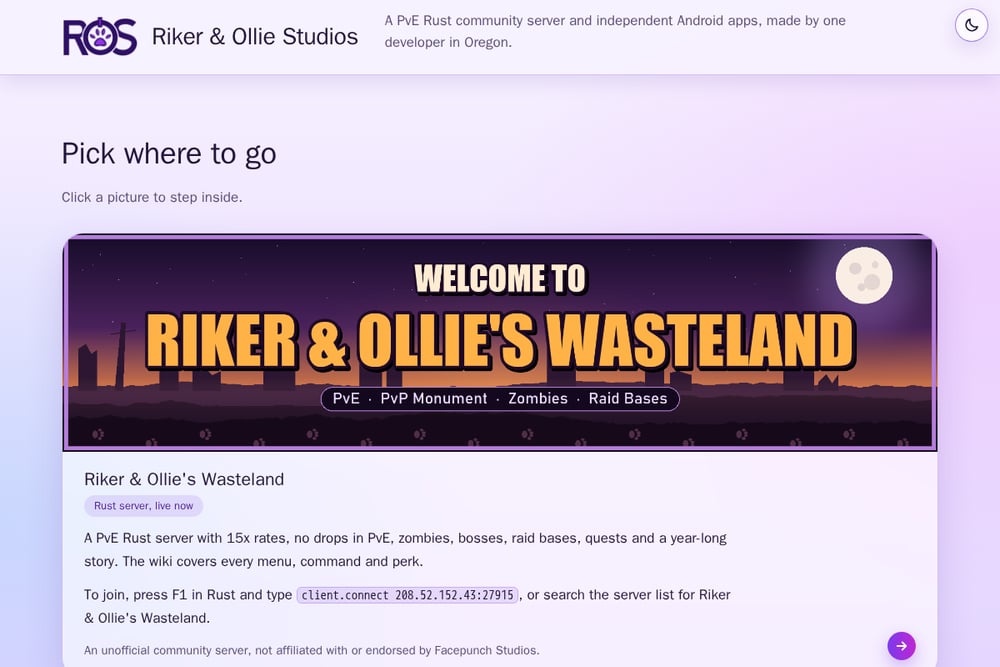 A screenshot of the Riker & Ollie Studios: Android Apps and a Rust Community Server website.
Riker & Ollie Studios is a one-person indie shop in Oregon run by Melissa, and it wears that independence proudly. The centerpiece is Riker & Ollie's Wasteland, a PvE Rust server with 15x rates, no drops in PvE, zombies, bosses, raid bases, quests, and a year-long story arc. A full wiki covers every menu, command, and perk, so you are not guessing your way through. The same studio ships simple Android apps for hobbyists and game fans, including Drills & Pieces, Bunco Bunch, PXL MMO Companion, Closed Alpha Reminder, and Crumb Trail Manager. The site runs no ads and no tracking, and Melissa takes direct contact for custom app work or server questions. It is an unofficial community server and not affiliated with Facepunch Studios.
#3 Zombie Land
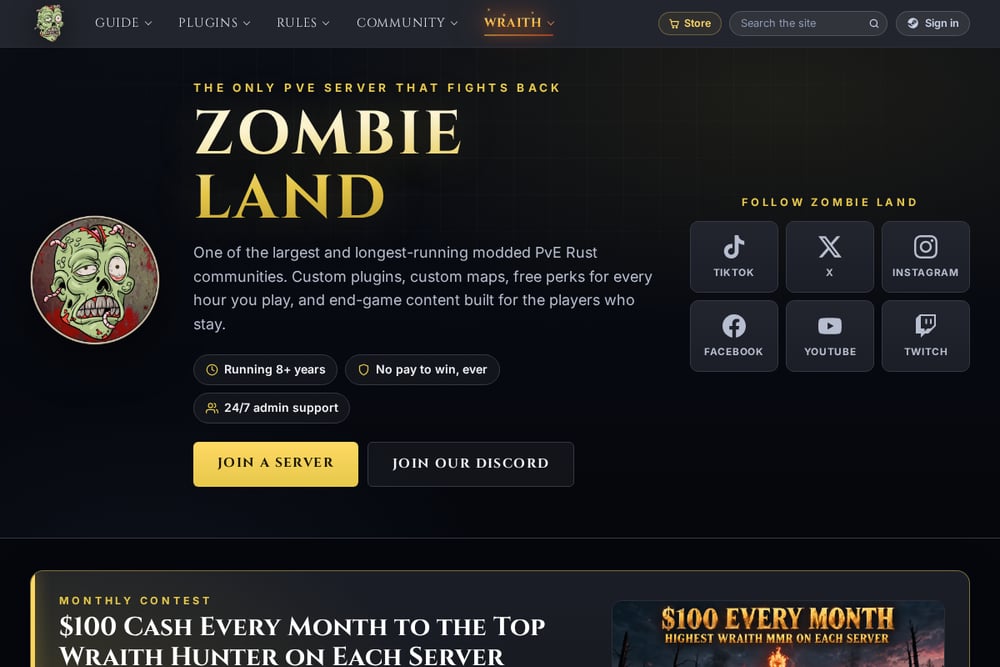 A screenshot of the Zombie Land website.
Zombie Land is the most feature-dense option on this list, and it documents all of it. The site lays out a deep plugin stack covering auction houses, backpacks, clans, dungeons, enchanting, legendary items, quests, raid bases, skills, and teleporting. You also get a full rules section, administration policies, a privacy policy, and a player directory with public profiles and stats. Wipe info and a Power Hour end-of-wipe event are spelled out, so you know exactly what carries over. If you like tinkering with systems and reading the manual before you commit, this server rewards that instinct.
#4 RustDecay
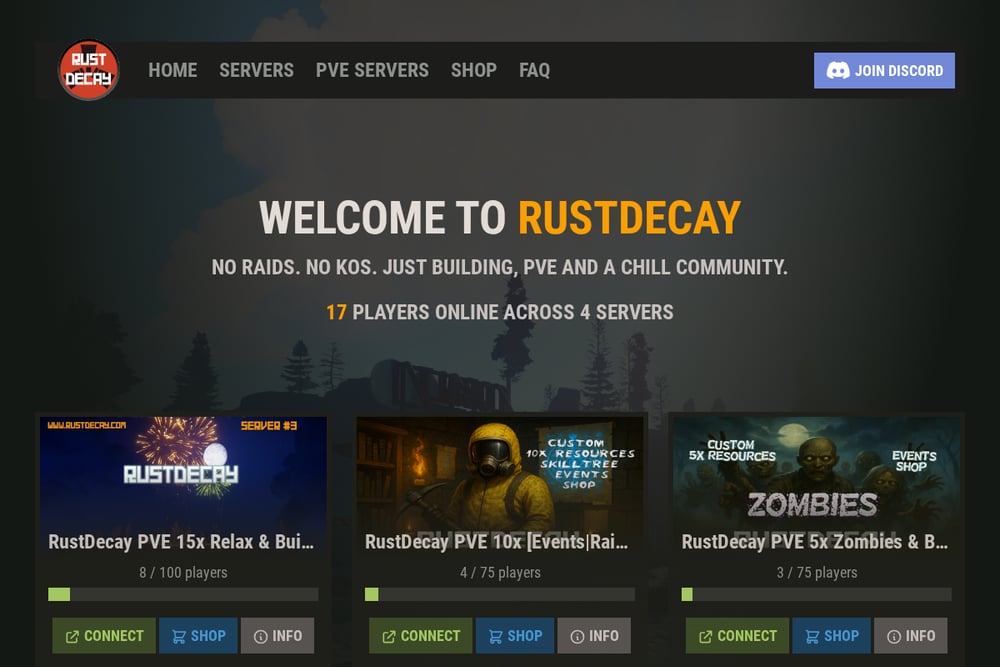 A screenshot of the RustDecay website.
RustDecay runs a fleet of PvE servers so you can pick your pace. Options range from a 5x zombie server for a relaxed survival feel up to a 200x server where you gear up in minutes, plus a 10x RPG server with a skill tree and an EU 15x for low-ping play. Across all of them there is no raiding and no kill-on-sight, so your base and loot stay protected while you build, explore, and run events. Roaming zombies, basements, quests, custom loot, virtual quarries, and trading round out the feature set. It is a solid fit if you want one community with several difficulty dials.
How to Pick Yours
Start with your patience level. If you want a long, meaningful grind, pick a server with monthly wipes and real progression. If you want to build and explore without farming all night, a high-rate server gets you there faster. Next, check the documentation: a server that publishes its commands, perks, and rules saves you hours of trial and error. Finally, think about what else you need. If you also want custom app development or a direct line to the person running things, a small independent studio beats a big network every time.
Where Automation Fits In
You can automate the boring parts of server life. Set up Discord alerts for wipe days and Power Hour events so you never miss a reset. Use a wiki or command reference as your personal checklist when you join a new server, and keep your connect string saved so rejoining takes one paste. If you run your own tools, a simple reminder app or tracker keeps your testing schedule and wipe calendar in one place instead of scattered across tabs.
The Bottom Line
Each of these four earns its spot for a different reason. Salty Zombies is for the grinders, Riker & Ollie Studios is for players who want a story and a human on the other end of the email, Zombie Land is for the system tinkerers, and RustDecay is for anyone who wants to dial the pace up or down. Pick based on how you like to play, not on which one shouts loudest. Then join, read the wiki, and get building.