
You have an app idea and a deadline. What you need is a studio that turns the idea into something people can actually download. Here are four worth a closer look.
The Native App Development Landscape
Native app development is having a moment. Cross-platform frameworks like Flutter and React Native are powerful, but plenty of projects still call for Swift and Kotlin when performance, security, or deep device access matter. That means the studio you pick shapes everything from your launch timeline to how your app feels in a user's hand. The market splits into three rough camps. There are large engineering shops that staff whole product teams, offshore consultancies that bundle mobile into a broader cloud and DevOps menu, boutique studios that specialize in native builds, and content-led shops that pair editorial expertise with delivery. Each model fits a different kind of client. Your job is to figure out which one fits yours before you sign anything.
How We Evaluated These Studios
We looked at the same factors for every studio on this list. First, service scope: does the studio cover ideation, design, build, testing, and store submission, or only part of the journey? Second, pricing clarity: can you get a fixed quote, or are you guessing at hourly rates? Third, native depth: does the team work in Swift, Kotlin, and platform SDKs directly, or lean on a shared toolkit? Fourth, communication and process: do you get a project plan, test builds, and a clear report of what changed? Fifth, local and market fit: does the studio understand the US app market and the store review process? Plia App Studios stood out for its written project plan and fixed quote after a free call. Binary Studio stood out for its long track record and broad engineering bench. UROLIME stood out for bundling mobile with cloud and DevOps services. CodeLoop Studio stood out for its clear, plain-language explanation of when native beats cross-platform.
Here is the short version. Four studios, four different shapes. One is built for founders who want a fixed quote and a clear path to both stores. One is a veteran engineering shop with deep case studies. One wraps mobile inside a wider cloud and DevOps offering. One leads with native expertise explained in plain English.
| Provider | Best For |
|---|---|
| Binary Studio | Founders who want a veteran engineering partner with deep case studies |
| Plia App Studios: your app idea, built | Founders who want a fixed quote and a clear path to both app stores |
| UROLIME | Companies that want mobile bundled with cloud and DevOps services |
| CodeLoop Studio | Teams weighing native versus cross-platform who want clear technical guidance |
The Four Studios, Up Close
#1 Binary Studio
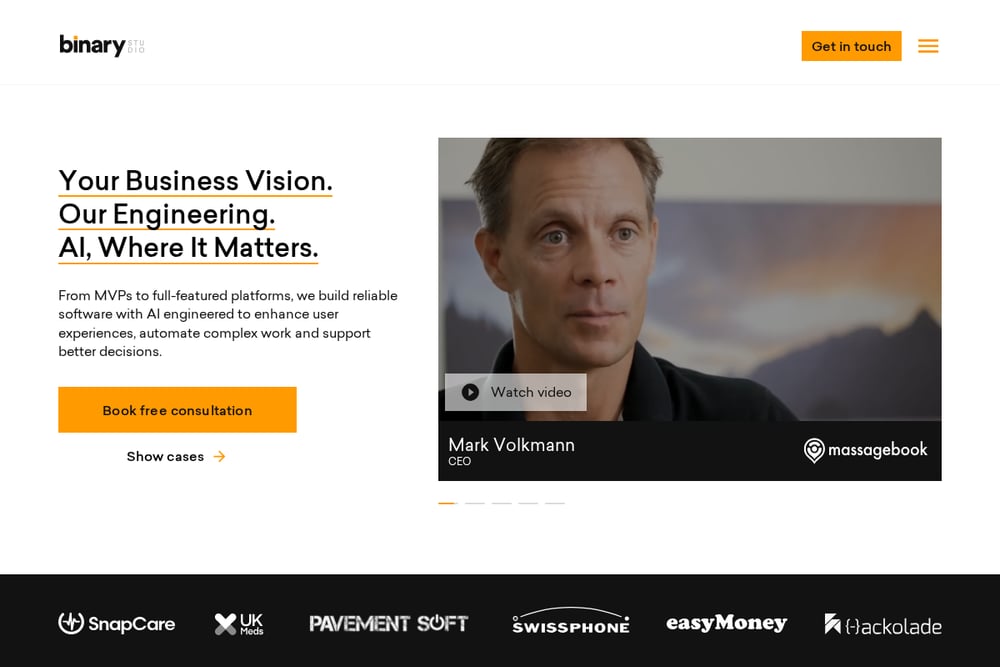 A screenshot of the Binary Studio website.
Binary Studio has been building software since 2005, and that history shows in its case studies. The team has helped clients evolve products from MVP to full-featured platforms, including an "Uber for Nurses" build that reached $1.8 billion in revenue over four years. You get ideation and discovery, MVP development, QA, and dedicated teams under one roof. The studio also covers web, SaaS, and legacy modernization, so it can grow with you. If you want a partner with a long paper trail and a wide bench, start here. See the full service list at https://binary-studio.com/native-app-development/.
#2 Plia App Studios: your app idea, built
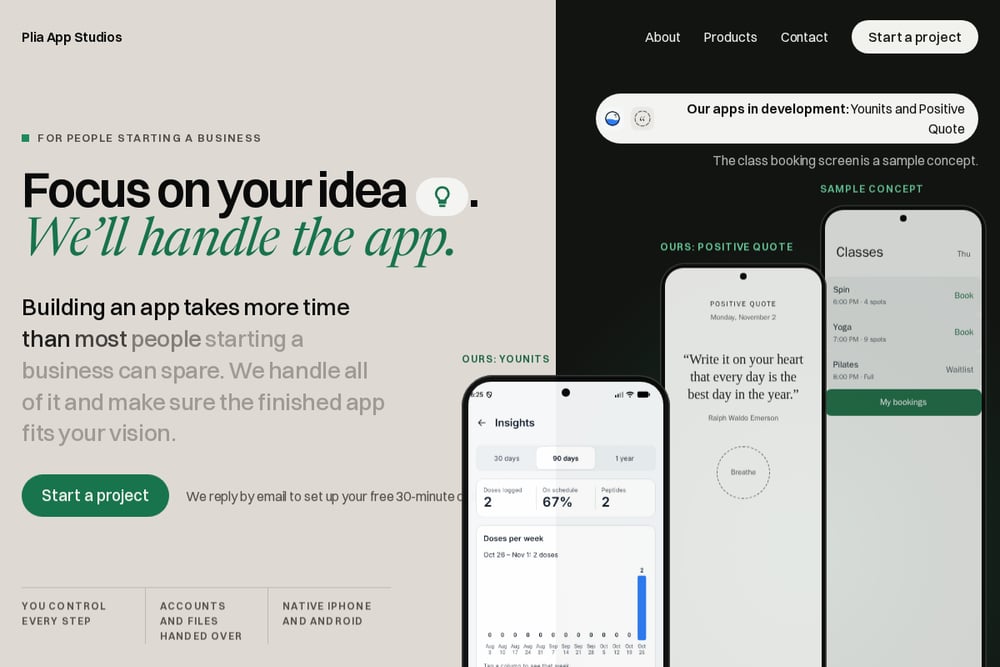 A screenshot of the Plia App Studios: your app idea, built website.
Plia App Studios is a boutique firm with a sharp promise: you bring the idea, they build the app. The process starts with a free 30-minute call and ends with a fixed quote, so you know the number before work begins. Every project comes with a written project plan, a tappable prototype before any code is written, a build report showing what passed, and a launch checklist covering App Store and Google Play submission. Design directions are drafted with AI and then refined by hand, which keeps the process fast without cutting corners on craft. The studio builds native iPhone and Android apps and handles privacy details and store review for you. Learn more at https://pliaappstudios.com/.
#3 UROLIME
 A screenshot of the UROLIME website.
UROLIME positions itself as a leading mobile app development company in the US, and it backs that up with a broad service menu. Mobile sits alongside DevOps, cloud consulting, Kubernetes, QA, and staff augmentation, so you can plug in one vendor for the whole stack. That breadth helps if your app needs backend infrastructure, continuous delivery, or a team extension rather than a standalone build. The tradeoff is that mobile is one line item among many, so you will want to scope carefully. It suits companies that already have engineering leadership in place. Explore the mobile offering at https://www.urolime.com/us/native-app-development.html.
#4 CodeLoop Studio
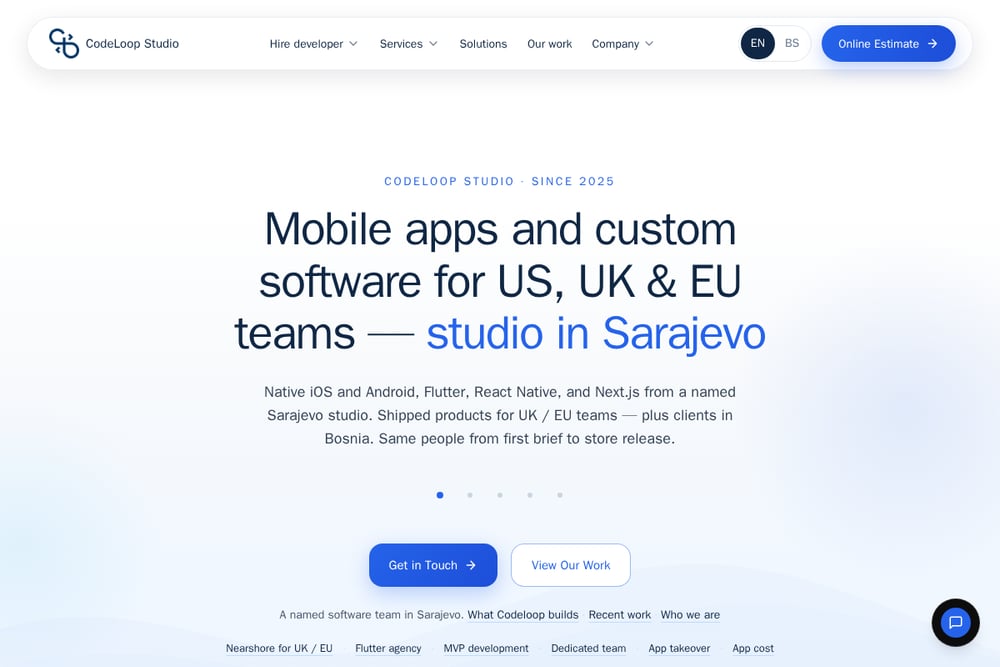 A screenshot of the CodeLoop Studio website.
CodeLoop Studio builds native apps with Swift, SwiftUI, and UIKit on iOS, and Kotlin, Jetpack Compose, and Android XML on Android. What sets the studio apart is how clearly it explains the tradeoffs. Its writing walks through when native beats cross-platform, covering performance, UX, security, and device feature access in plain language. That clarity is useful if you are still deciding on an approach and want a partner who can reason through it with you. The studio also offers an online estimate tool and a hire-a-developer model. Read the native development guide at https://www.codeloop.ba/blog/native-ios-android-app-development.
How to Choose the Right Studio
Start with your stage. If you have a napkin sketch and no technical co-founder, you want a studio that owns the whole journey, from prototype to store submission. Plia App Studios fits that shape, with a written plan and a fixed quote up front. If you already have a product and need to scale it, a larger engineering partner like Binary Studio makes more sense. Next, ask about pricing. Fixed quotes protect you from scope creep, while hourly or retainer models suit long, evolving engagements. Then check native depth. Ask directly which languages and frameworks the team uses and whether they work with platform SDKs. Finally, look at communication. You want test builds on your phone, a report of what changed, and a clear answer on who handles App Store and Google Play review. Get all of that in writing before you commit.
Where Automation Fits in the Build
Modern studios lean on automation to move faster without losing quality. Plia App Studios, for example, drafts design directions with AI and then refines one by hand, and it compiles and tests builds in the cloud before sending a test build to your phone. Automated checks cover text scaling, screen-reader labels, and dark mode. That means fewer surprises at review time. When you talk to any studio, ask what is automated and what is done by hand. The answer tells you a lot about how fast your project will move and where human judgment still matters.
The Bottom Line
There is no single right studio here. There is a right studio for your situation. If you want a fixed quote, a written plan, and a partner who takes your idea all the way to both stores, Plia App Studios is built for exactly that. If you want a long-established engineering bench with deep case studies, Binary Studio has the track record. If mobile is one piece of a bigger cloud and DevOps puzzle, UROLIME can cover the whole stack. And if you are still deciding between native and cross-platform, CodeLoop Studio will explain the tradeoffs clearly. Pick the model that matches your stage, get the scope in writing, and ask what happens after launch. That is how you turn an idea into an app people actually use.