
Your imaging center is sitting on years of CTs, MRs, and signed radiology reports that AI developers would pay for. But before you sell a single study, you need to know which PACS contracts allow it, how de-identification actually works, and who the credible buyers are.
What are Health & Wellness Remote services?
Medical imaging AI is hungry for real-world data. Developers need studies paired with radiologist reports to train and validate models, and imaging centers, radiology groups, and teleradiology services hold exactly that. The catch is that data can't just walk out the door. PACS vendor terms vary widely on whether they claim rights to aggregated or anonymized use, and HIPAA, DICOM, and state law all shape what de-identification must cover. The market is still maturing, which means the services that understand both the clinical archive and the legal fine print are the ones worth your time.
What we looked at when researching Health & Wellness Remote
We evaluated each service on the same factors: how clearly they explain PACS contract terms and de-identification requirements, the depth of their guidance on buyer requirements and data preparation, the transparency of their process and compliance posture, and how well their offering fits the needs of US imaging centers and radiology groups. Each business brings a different strength to the table, and the right fit depends on whether you need a guide, a marketplace, a data vendor, or a de-identification specialist.
| Provider | Best For |
|---|---|
| Segmed | End-to-end imaging data pipelines for AI |
| Sell medical imaging data to AI: PACS terms, de-identification | Understanding PACS terms and de-identification rules |
| Shaip | De-identified DICOM datasets with annotation services |
| medDARE | Pixel-level de-identification and anonymization |
A closer look at 4 standout Health & Wellness Remote
#1 Segmed
 A screenshot of the Segmed website.
Segmed positions itself as a data platform that delivers high-quality, de-identified imaging data at scale for foundation models and AI development. Their resources walk you through how to prepare imaging data for healthcare AI model development, from data selection to model-ready datasets. They serve life sciences R&D, medical devices and AI R&D, and healthcare providers, which means they understand both sides of the transaction. If you want a partner that can handle the data pipeline end to end, Segmed is built for that. Their security and compliance documentation is front and center, which matters when you are moving clinical studies.
#2 Sell medical imaging data to AI: PACS terms, de-identification
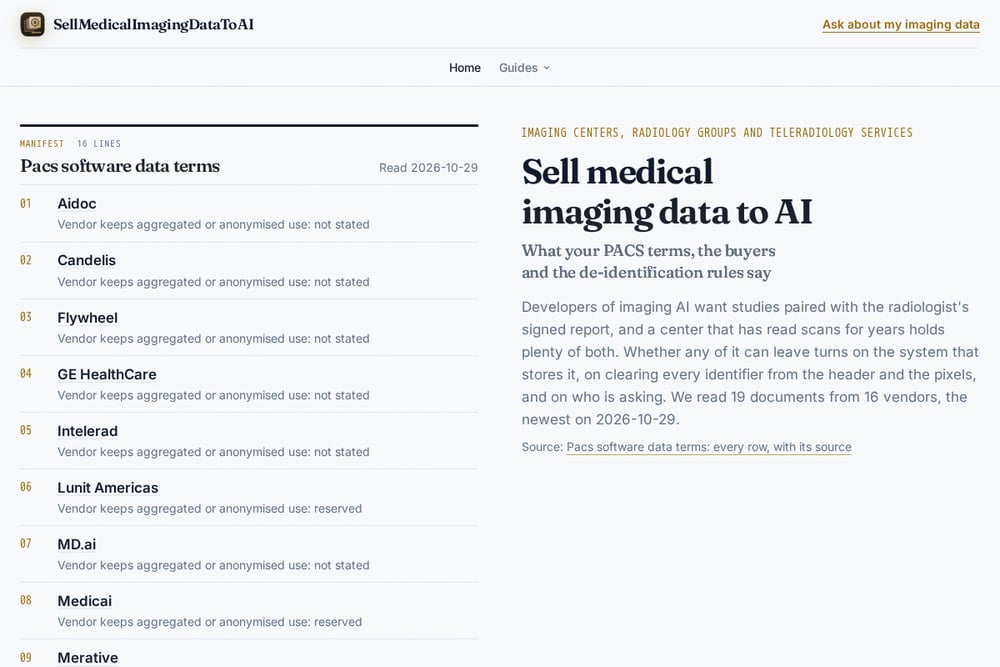 A screenshot of the Sell medical imaging data to AI: PACS terms, de-identification website.
This site is a guide built specifically for imaging centers, radiology groups, and teleradiology services that want to sell de-identified studies to AI developers. They read 19 documents from 16 PACS and imaging vendors, the newest dated 2026-10-29, and published a manifest showing which vendors reserve aggregated or anonymized use and which stay silent. That matters because your PACS terms may already limit what you can sell. They also break down DICOM de-identification, expert determination versus Safe Harbor, who owns the images, and how to get studies out of your archive. If you are starting from zero and need to understand the rules before you talk to a buyer, start here.
#3 Shaip
 A screenshot of the Shaip website.
Shaip offers de-identified DICOM datasets for healthcare AI alongside a broad catalog of AI training data, annotation, and labeling services. Their medical data offerings include MRI images, physician dictation, transcribed medical records, and electronic health records. That breadth means they can support multimodal AI projects that combine imaging with clinical text. They also provide data annotation and labeling, which is useful if your buyer needs structured labels rather than raw studies. For centers that want a vendor with an established data catalog and annotation muscle, Shaip is a solid option.
#4 medDARE
 A screenshot of the medDARE website.
medDARE focuses on de-identifying medical imaging data for AI, and their blog gets into the details that trip people up. They explain that the DICOM header is not the hard part; the hard part is burned-in timestamps, facial contours in head CTs, and private tags invented by scanner vendors. They offer image and video data collection, data curation and annotation, and data anonymization, with GDPR, HIPAA, and ISO compliance called out. If your archive has messy metadata or you need a specialist to scrub pixels as well as headers, medDARE speaks your language. Their content is a useful reality check before you promise a buyer clean data.
How to choose the right Health & Wellness Remote
Start with your PACS contract. If your vendor reserves aggregated or anonymized use, you need to know that before you promise studies to anyone. Next, decide whether you need a guide, a marketplace, a data vendor, or a de-identification specialist. If you are early and unsure what is allowed, a service that explains the terms is worth more than a buyer list. If you already have clean, de-identified data and want to sell, look for a partner with an established buyer network and clear compliance documentation. Ask every vendor how they handle burned-in text, private tags, and expert determination versus Safe Harbor. Finally, check whether they support the report pairing that AI developers actually want, because studies without signed reports are worth less.
Expert Conclusion
The market for medical imaging data is real, but the rules are not optional. The four services here cover the full path from understanding your PACS terms to delivering de-identified studies to AI developers. Use the guide to learn what your contracts allow, then pick the partner that matches your archive's condition and your buyers' needs. Do the homework first, and you will sell data without selling yourself short.