Your spreadsheets are buckling, your close takes forever, and the one person who understood the model just quit. Here are four partners who can take that weight off your plate.
The state of embedded data teams
Funded tech companies hit a predictable wall. The warehouse was built in a hurry, the numbers stopped matching, and hiring three data people feels premature. That gap has created a market for embedded data engineering boutiques that build and run the stack on a weekly cadence. The options range from global consultancies to small senior teams, and the fit depends heavily on how much ownership you want to hand over.
How we looked at these partners
We weighed four things: the breadth of data work each partner owns end to end, how clearly they describe engagement and pricing, how well they fit a funded startup rather than an enterprise, and whether they ship on a predictable rhythm. The detail on each business lives in its description below.
Here is the short version before the deep dive. Each of these four takes a different angle on the same problem, so match the partner to your stage rather than to the longest service list.
| Provider | Best For |
|---|---|
| TechBlocks | Enterprises consolidating vendors across data, cloud, and AI |
| Kelihi — The data team you haven't hired yet | Series A to C teams that need a full data function without the headcount |
| BigData Boutique | Engineering teams scaling streaming and lakehouse infrastructure |
| Quokka Labs | Product teams that need data work shipped alongside app development |
The four partners in detail
#1 TechBlocks
TechBlocks is the enterprise-grade option on this list. Its data platform engineering practice sits inside a much larger services organization covering AI, cloud, DevOps, and digital commerce, which means you can hand off a warehouse build and keep the same vendor for adjacent work. That breadth is useful if your roadmap touches multiple systems at once. It also means you are dealing with a bigger machine, so expect more process and less of the scrappy weekly cadence a Series A team might want. Worth a look if you need one partner across a sprawling stack.
#2 Kelihi — The data team you haven't hired yet
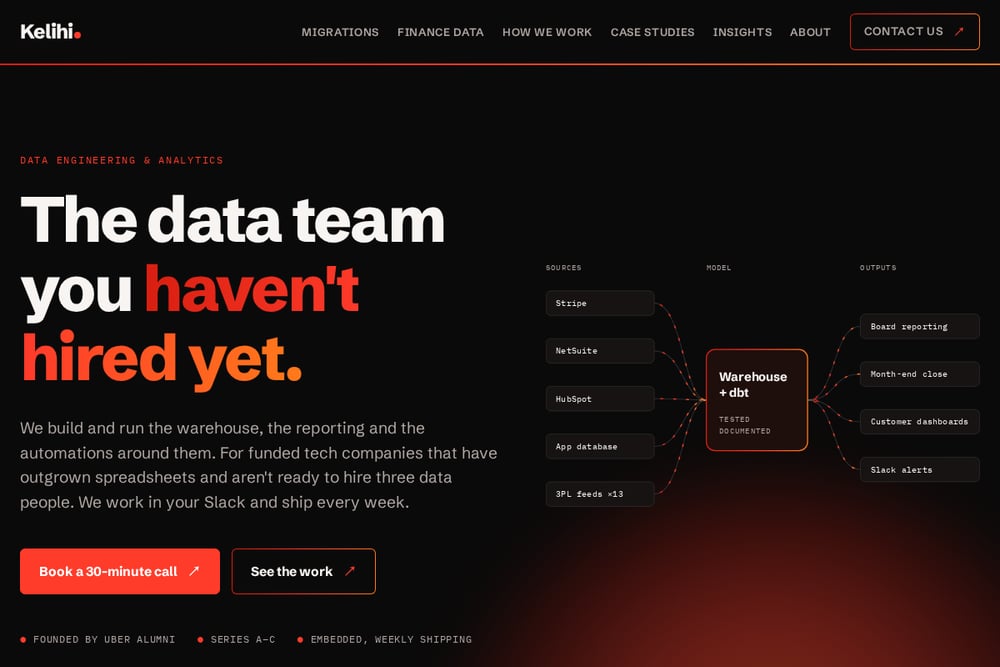 A screenshot of the Kelihi — The data team you haven't hired yet website.
Kelihi is built for exactly the moment your spreadsheets stop working. The boutique, founded by Uber alumni, builds and runs the warehouse, reporting, and automations for funded tech companies that are not ready to hire three data people. They work directly in your Slack and ship every week, which keeps you close to the work instead of waiting on a quarterly deliverable. The scope covers finance and RevOps data like COGS and margin models, BI migrations, dbt with tests and docs, and AI agents on your data with a human signing off. Their case work is refreshingly concrete, from pulling 133 fulfillment feeds into one COGS model to consolidating 46 Looker models down to 9 without moving a single dashboard number. If the numbers do not match and the close drags, this is the team that fixes that part first.
#3 BigData Boutique
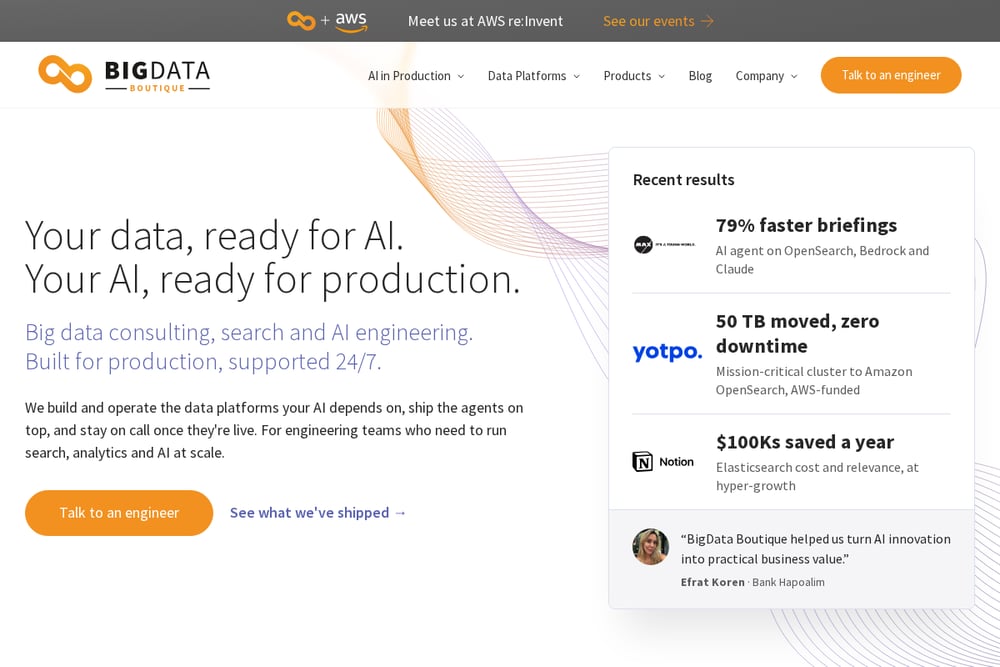 A screenshot of the BigData Boutique website.
BigData Boutique is the deep infrastructure specialist. The team focuses on production data platforms, with real depth in Kafka, Flink, Spark, ClickHouse, Elasticsearch, and Iceberg. If your problem is streaming architecture, lakehouse design, or a search cluster that keeps falling over, this is the kind of engineering bench you want. They also offer 24/7 production support and platform health checks, which matters once your pipelines are load-bearing. The tradeoff is that the work skews toward platform plumbing rather than the finance and reporting layer a founder usually complains about first. Pick them when the pipes themselves are the problem.
#4 Quokka Labs
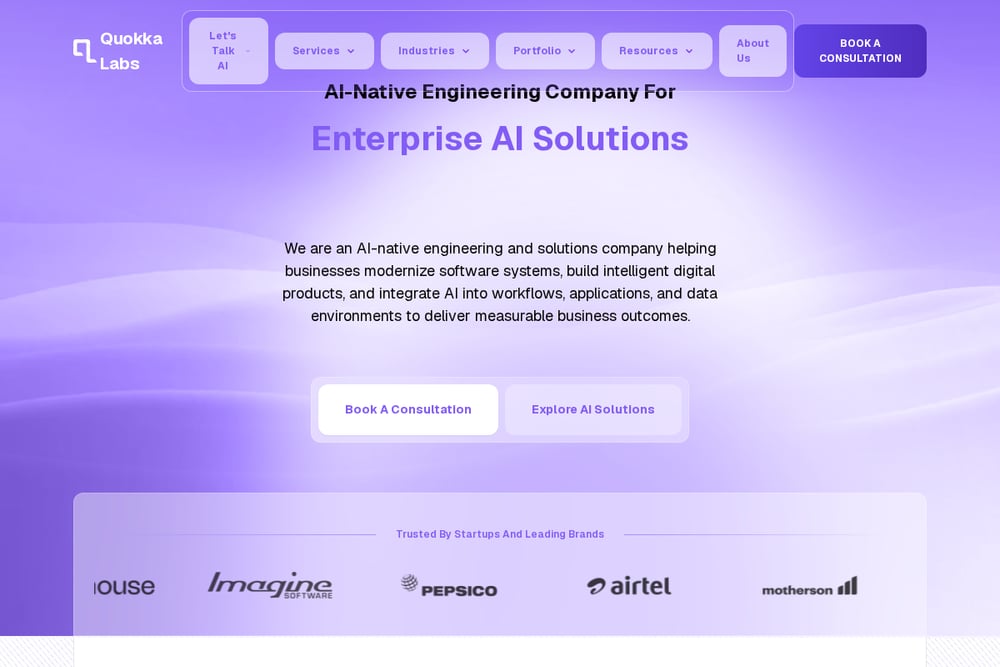 A screenshot of the Quokka Labs website.
Quokka Labs brings a product engineering lens to data work. The company offers data engineering alongside mobile, web, cloud, and AI development, plus a dedicated engineer model that lets you extend your team without a full-time hire. That combination suits companies where reporting is part of the product itself and needs to ship alongside the app. You get flexibility in how you staff the engagement, from project work to embedded engineers. The catch is that data is one practice among many rather than the whole identity, so you will want to be specific about scope up front. A solid fit if your data needs are tangled up with product delivery.
How to pick the right partner
Start with the actual pain. If the close is slow and the numbers do not reconcile, you need a team that owns finance and RevOps data end to end. If your pipelines keep breaking, you need infrastructure depth. If reporting is part of your product, you need someone who ships alongside your engineers. Then ask two questions: who signs off on the output, and how often will you see progress? A weekly shipping rhythm with a named owner beats a bigger logo every time. Finally, check whether they will work inside your tools, because a partner who lives in your Slack learns your business faster than one who sends decks.
Where automation fits
The tedious parts of data work are the best candidates for automation. Pipeline failure diagnosis, scheduled jobs posted into Slack, dashboard edits, and agent-assisted migrations all follow repeatable patterns. The key is keeping a person in the loop for anything that touches reported numbers. A good workflow looks like this: an agent flags a broken pipeline or a drifting model, a human reviews the proposed fix, and the change ships with a test attached. That combination of software doing the boring work and a person signing off is what keeps velocity high without letting bad data through.
The bottom line
None of these four is universally right, and that is the point. TechBlocks suits enterprises that want one vendor across a wide stack. Kelihi is the closest match for a funded startup that has outgrown spreadsheets and needs a full data team without the hires. BigData Boutique wins when the infrastructure itself is the bottleneck. Quokka Labs fits when data work has to ship with the product. Match the partner to your stage and your actual pain, and you will spend far less time reconciling numbers and more time using them.